

Botox and Filler Cost in the Bay Area: What You Pay
Botox is priced by the unit, and fillers by the syringe, so your total depends on how many units or syringes your face actually needs, not on a single menu price. The most useful number to bring to a consultation is not a quote per unit. It is a written treatment plan from a physician-supervised practice that says which areas, how many units or syringes, and why. That is how we build plans at LA ViE MD, under the supervision of Dr. Neetu Nebhwani, a board-certified Internal Medicine physician, for clients in Danville, Livermore, Dublin and Los Gatos.
Below is how the pricing works, what drives it up or down, two worked examples you can adapt, and how to compare quotes fairly.
TL;DR
- Botox is billed per unit or per area, and fillers per syringe. The total is the number of units or syringes your plan needs multiplied by the clinic’s rate.
- Nationally, the American Society of Plastic Surgeons (ASPS) puts Botox at about $400 per treatment and fillers at $500 to $900 per syringe. Bay Area rates are set by each practice, so expect them to sit in that neighborhood or above.
- Botox typically lasts three to four months, so budget for about three to four visits a year to keep results steady.
- Compare quotes by unit count, product and who injects, not by the headline rate alone.
- A consultation with a physician-supervised team gives you a plan and a total before you commit.
Table of Contents
- How Botox pricing works
- How dermal filler pricing works
- Botox or filler: which one are you actually pricing?
- Why two quotes for “Botox” are rarely the same
- Two worked examples
- What the quote should include
- Why physician supervision is part of the value
- Aftercare: the four-hour rule
- Start with a plan, not a price list
- FAQ
- Sources
How Botox pricing works
Botox Cosmetic is a purified neurotoxin injected into facial muscle to relax it. It smooths dynamic wrinkles, the lines that appear when you frown, squint or raise your brows. According to Cleveland Clinic, the three most common areas are around the eyes, between the brows and the forehead.
Practices charge in one of two ways:
- Per unit. A unit is a measured dose of the product. You pay the clinic’s rate times the units used.
- Per area. The practice sets a flat fee for, say, the frown lines, based on a typical number of units.
Neither is better by default. What matters is that you know the unit count behind the number. A low per-unit rate with a high unit count can cost the same as a higher rate with a precise dose.
How many units each area typically takes
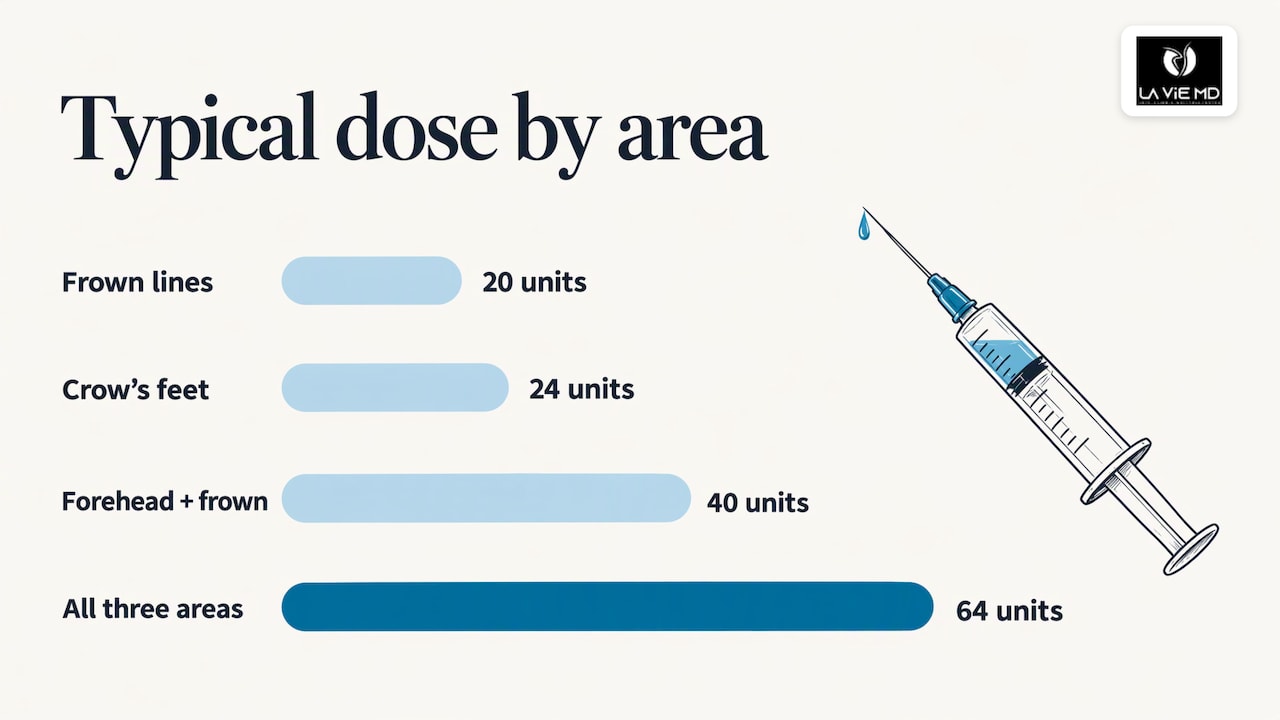
The FDA-approved labeling gives a reference point. According to the Botox Cosmetic dosing information on Drugs.com, the approved doses are 20 units for frown lines, 24 units for crow’s feet, and 40 units for forehead lines treated together with frown lines. All three areas in one session add up to 64 units.
Those are label doses, not a prescription for your face. A physician adjusts for muscle strength, brow position, the look you want and how natural you want it to appear. Some people need less in one area and more in another, which is why a personalized plan beats a standard package.
What the national average tells you
The ASPS says in a consumer article by Eric Chang, MD that Botox averages about $400 per treatment across the country. That is a national figure published in 2018, and it is a starting point rather than a Bay Area quote. Practices in the Bay Area operate with high rents, specialized staff and premium products, and most set their own rates. We do not publish a price list, so the honest way to get your number is a consultation where the plan and the total are laid out together.
How dermal filler pricing works
Fillers do something different. Per Cleveland Clinic, dermal fillers are injected into the skin rather than the muscle to plump and smooth static wrinkles, the lines you see at rest, and to restore lost volume. Cheeks, lips, the lines around the mouth and the under-eye hollows are common areas.
Fillers are priced per syringe. The ASPS reports that fillers usually range from $500 to $900 per syringe nationally, with hyaluronic acid products such as JUVÉDERM and Restylane averaging close to $700, and that more than one syringe may be needed to reach the desired look (ASPS).
So the question to ask is not what one syringe costs. It is how many syringes your goals will take, and whether the plan is built in stages. A subtle cheek refresh might use one syringe. A full midface restoration can use several.
What changes the filler total
- The product. Different fillers are designed for different depths and jobs: soft ones for lips and fine lines, firmer ones for structure.
- The area. Under-eye work and lip work call for fine technique and small volumes. Cheek volume calls for more product.
- The number of syringes. The single biggest lever on your total.
- The goal. Restoring volume and refining a feature are different plans.
- Longevity. A product that lasts longer costs more per session but is repeated less often.
If you are weighing a collagen-stimulating option against a traditional filler, our guide to Sculptra and fillers lays out what each is designed to do. For a broader look at what fillers can do for the skin, see the benefits of dermal fillers.
Botox or filler: which one are you actually pricing?
Many people searching for a cost are really deciding between the two. The short rule from Cleveland Clinic’s Dr. Khetarpal is that dynamic wrinkles respond best to a neuromodulator such as Botox, while fillers address volume loss in the lower face. Static wrinkles are often treated with both, because the neurotoxin relaxes the muscle underneath and the filler softens the line at rest (Cleveland Clinic).
| Botox | Dermal filler | |
|---|---|---|
| What it does | Relaxes muscle to soften movement lines | Adds volume and smooths lines at rest |
| Typical areas | Forehead, between the brows, crow’s feet | Cheeks, lips, nasolabial folds, under eyes |
| Billed by | Unit or area | Syringe |
| National average (ASPS, 2018) | About $400 per treatment | $500 to $900 per syringe |
| How long it lasts | Typically three to four months | Varies by product and area |
The Botox duration comes from the ASPS position statement on botulinum toxin, which also notes that full effects typically take 7 to 10 days to appear. Our own side-by-side is in Botox vs. fillers.
Why two quotes for “Botox” are rarely the same
A neuromodulator is a family of products, not one. Botox, Dysport, Xeomin and Daxxify all relax muscle, but their units are not interchangeable. The ASPS notes that 10 units of Botox Cosmetic or Xeomin may require 20 to 30 units of Dysport for a similar clinical effect (ASPS position statement).
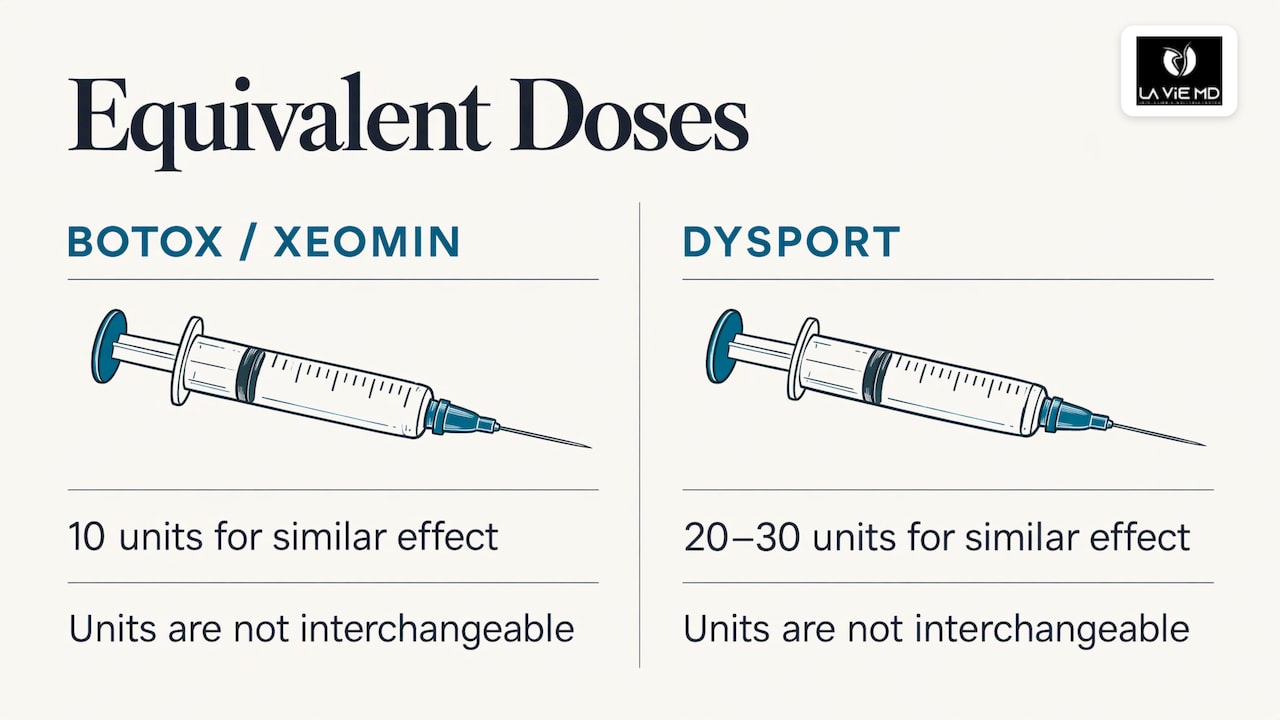
That is why comparing per-unit rates across products can mislead. A Dysport unit costing less than a Botox unit does not mean a cheaper treatment if you need more of them. Compare the total for the same result.
We offer Botox, Dysport and Daxxify among our injectables, and our guide to Botox, Dysport, Xeomin and Daxxify explains how they differ so you can choose with your injector rather than by price tag.
Two worked examples
These use the label doses and the ASPS national ranges to show the arithmetic. They are illustrations, not LA ViE MD prices.
Example 1: first-time Botox, frown lines only.
Label dose is 20 units. Your cost is 20 units times the clinic’s per-unit rate. With a three- to four-month duration, that is about three to four sessions a year. Multiply your session total by that number to see the annual cost.
Example 2: Botox for forehead and frown lines, plus one syringe of filler.
The forehead and frown combination is 40 label units. Add the cost of one syringe, which nationally ranges from $500 to $900 per the ASPS. Because filler is not repeated on the same schedule as Botox, the filler is not a quarterly cost for most plans. The annual picture is four Botox sessions plus the filler visits your plan calls for.
In both examples the variable you control is the plan. A physician who explains why a lower dose will look natural on you is saving you money and protecting the result.
What the quote should include
When you collect any estimate, ask for the same set of facts so the numbers compare:
- The product (Botox, Dysport, Xeomin or Daxxify) and the filler brand.
- The unit count or syringe count for each area.
- Who is injecting and who is supervising.
- Whether a follow-up visit is included. The ASPS describes reevaluation about two weeks after injection, once the full effect has set in (ASPS).
- Whether the plan is staged, particularly for fillers.
A flat promotional price that does not state the units is not a price you can compare.
Why physician supervision is part of the value
Injectables are medical procedures. The value of a Bay Area practice is not the rate on a menu, it is the judgment behind the dose: where to place it, how much, and when to stop. At LA ViE MD, treatments are medically supervised by Dr. Nebhwani, and each client gets a custom plan built around their specific skin concerns and aesthetic goals. That planning is what keeps a result natural and keeps you from paying for units your face does not need.
Aftercare: the four-hour rule
The “four-hour rule” refers to staying upright after Botox. Cleveland Clinic’s aftercare guidance says to stay upright for three to four hours, avoid rubbing or pressing on the treated area for 12 hours, and avoid physical exertion for 24 hours (Cleveland Clinic). Follow the specific instructions your injector gives you, and call the practice if anything seems off.
Our perspective
Most people who ask us about cost are really asking whether they will look like themselves afterward. We start there. A good plan is built from your anatomy, how your face moves and what you want to change, and the price follows from that plan, not the other way around.
That is why we do not sell Botox as a flat package. Under Dr. Nebhwani’s supervision, we map the areas, choose the product, set the dose and explain the reasoning, so you know what you are paying for and what to expect at the two-week mark. The same approach applies to fillers, where we think in stages and syringes rather than one big session.
If you are in Danville, Livermore, Dublin or Los Gatos, the most useful thing you can do is book a consultation and leave with a written plan.
Dr N
Start with a plan, not a price list
Our injectables team treats wrinkles, volume loss and facial contours with Botox, Dysport, Daxxify, dermal fillers, Sculptra, Kybella and non-surgical rhinoplasty, always under physician supervision. You can browse the injectables we offer, or see our Bay Area Botox and fillers page to find the location closest to you. Book a consultation and you will leave with the areas, the product, the number of units or syringes and the total in one place.

FAQ
How often will I need Botox, and what does that do to the yearly cost?
Botox effects typically last three to four months, according to the ASPS. That means roughly three to four treatments a year if you want continuous results. Multiply your per-session total by that number for your annual budget.
Is Botox cheaper per unit than filler is per syringe?
They are not measured the same way, so a direct comparison does not work. Botox is billed by the unit or area and filler by the syringe. Nationally, the ASPS gives about $400 per Botox treatment and $500 to $900 per filler syringe, but the right comparison is the total for the result you want.
Why do some clinics charge more per unit than others?
Rates reflect the product, who injects and supervises, the location and what is included in the visit. Because units differ between products, a lower rate on a different product can still add up to the same or a higher total. Ask for the unit count and the product with every quote.
Is 40 too late to start Botox?
No. Botox treats movement lines that are present at any age, and many adults start in their 30s, 40s or later. A consultation will show which areas respond best and whether Botox alone or combined with filler suits your face.
What can I do right after Botox?
Most people return to normal activities right away. Cleveland Clinic advises staying upright for three to four hours, not rubbing the area for 12 hours, and avoiding exertion for 24 hours. Your injector may add instructions specific to you.
Sources
- Botox vs. Fillers: Differences and Uses, Cleveland Clinic
- Taking the mystery out of Botox and dermal fillers, ASPS
- ASPS Position Statement on Administration of Botulinum Toxin Neuromodulators
- Botox (Botulinum Toxin): What It Is, Results and Side Effects, Cleveland Clinic
- Botox Cosmetic dosage information, Drugs.com


