Med Spa in San Francisco: How to Choose One You Can Trust
The best medical spa for you is one where a licensed physician is truly involved in your care, where the treatment plan is built around your skin and not a menu, and where every question about risks and results gets a straight answer. In California a med spa is a medical practice, so the choice is a medical choice. At LA ViE MD, Dr. Neetu Nebhwani, a board-certified Internal Medicine physician with over ten years of experience, leads care for clients across the Bay Area, including the Tri-Valley and Los Gatos. This guide explains what to look for, whichever side of the Bay you start from.
TL;DR
- A medical spa offers non-invasive cosmetic treatments such as injectables, lasers and medical-grade facials under physician oversight. A day spa works on the surface of the skin only.
- California treats med spa services as the practice of medicine: injections, lasers and medical-level peels must be done by a physician, or by a nurse or physician assistant under physician supervision.
- Before booking, verify licenses and board certification, and ask who is reachable if something goes wrong.
- A good consultation covers your medical history, realistic results, risks, recovery, number of sessions and cost.
- LA ViE MD builds custom treatment plans under the supervision of a board-certified physician, serving Danville, Livermore, Dublin and Los Gatos.
Table of Contents
- What a medical spa is, and how it differs from a day spa
- What San Francisco-area med spas typically treat
- What California law requires of a medical spa
- How to verify who is treating you
- What a good consultation covers
- How to think about price
- Safety and realistic expectations
- Do you need a med spa in San Francisco itself?
- Our perspective
- Start with a consultation at LA ViE MD
- FAQ
- Sources
What a medical spa is, and how it differs from a day spa
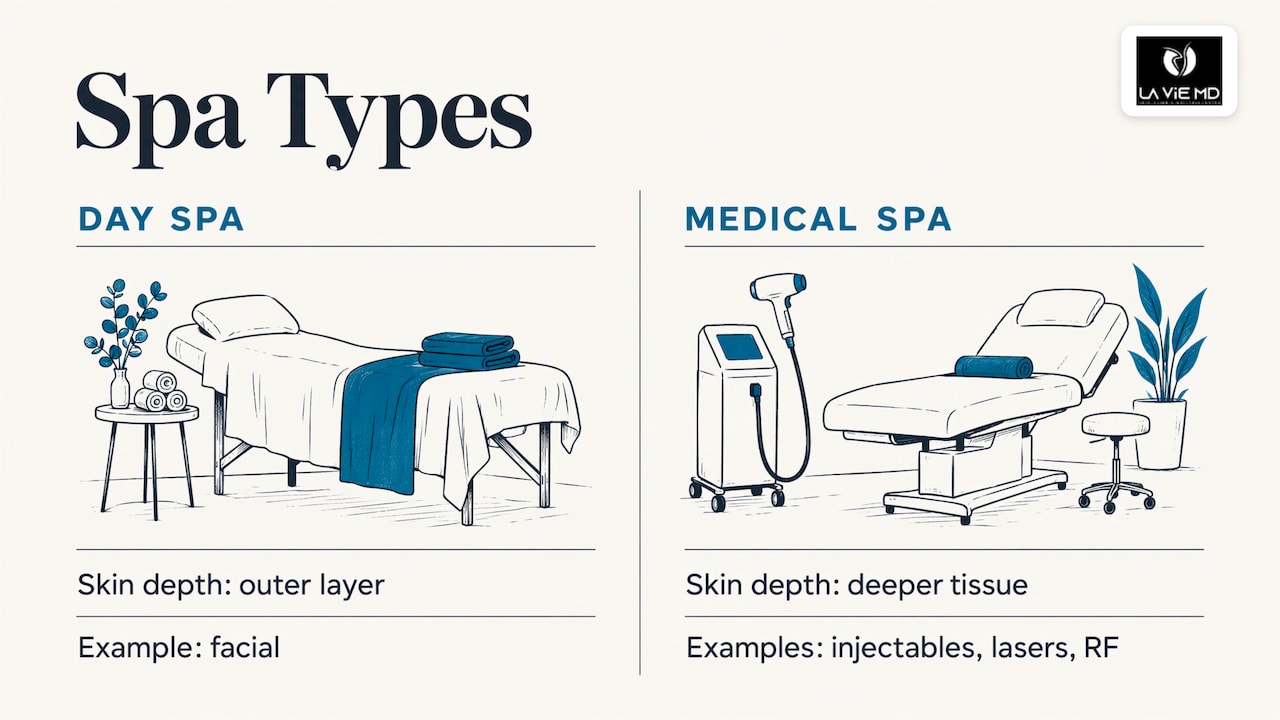
The American Med Spa Association describes a medical spa as a blend of an aesthetic medical center and a day spa. It has four parts: non-surgical aesthetic medical treatments, oversight by a licensed physician or independent practitioner, skilled health care professionals, and a spa-like atmosphere held to medical-grade standards.
The practical difference is depth. A day spa works on the outer layer of the skin. A medical spa performs non-invasive or minimally invasive procedures that reach deeper tissue, such as injectables, lasers and radiofrequency. That is why a facial at a day spa and a laser session at a med spa are regulated so differently.
The Medical Board of California puts it bluntly: “med spa” is a marketing term for medical procedures, and what happens inside is the practice of medicine. The Board’s point for you is that being injected, lasered or resurfaced deserves more thought than a haircut or a pedicure. Treat the decision accordingly, and you will choose better.
What San Francisco-area med spas typically treat
Menus vary, but most Bay Area medical spas cover the same core concerns. Here is how they map to treatments, using what we offer as the example.
| Your concern | Treatment category | What we offer |
|---|---|---|
| Expression lines, volume loss, jawline and chin contour | Injectables | Botox, dermal fillers, Sculptra, Kybella and non-surgical rhinoplasty |
| Dull texture, uneven tone, early laxity | Skin rejuvenation | HydraFacial, microneedling, Morpheus8, Forma and more |
| Unwanted hair, old tattoos, melasma and pigmentation | Laser procedures | Laser hair removal, tattoo removal, Tetra coolpeel CO2 laser and PicoWay |
| Thinning hair | Hair restoration | PRP hair restoration |
| Weight, energy and hormone balance | Wellness medicine | GLP-1 therapy, IV therapy, hormone replacement and B12 shots |
A few notes on reading this list.
Injectables relax or replace what time has changed. Neuromodulators such as Botox soften the lines caused by repeated expression. Fillers and Sculptra restore volume. Because they go beneath the skin, the injector’s training and anatomy knowledge matter more than anything else on the page.
Energy-based treatments such as Morpheus8 (microneedling combined with radiofrequency) and Forma (radiofrequency) are aimed at tightening and texture. Lasers split into two jobs: removal (hair, tattoo ink) and correction (pigment, scarring, resurfacing). If you are weighing a peel against a laser for resurfacing, our guide to chemical peel or laser walks through how to decide.
Hair is its own category. If thinning is your main concern, a hair loss analysis and clinic directory such as this hair loss analysis and clinic directory can help you track changes over time, and PRP is one of the treatments we offer for it.
What California law requires of a medical spa
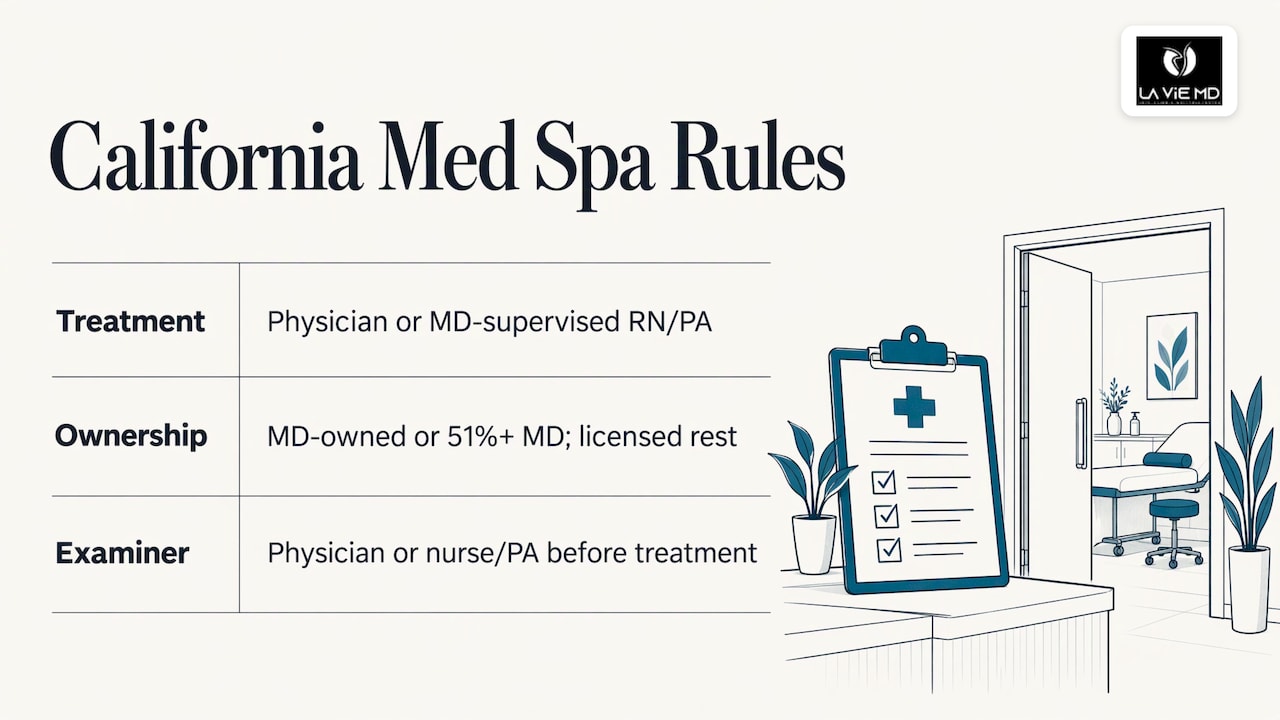
You do not need to read statutes to choose well, but three rules explain most of what you should ask.
Who can treat you. According to the Medical Board of California, injections, lasers and medical-level peels must be performed by a physician, or by a registered nurse or physician assistant under physician supervision. Supervision does not mean the physician stands in the room for every treatment, but the Board advises confirming the supervising physician is immediately reachable, even if offsite.
Who can own it. The California Board of Registered Nursing summarizes AB 1548, signed in 2012, this way: medical businesses must be owned by a physician, or at least 51 percent by a physician with the remainder held by a licensed practitioner such as a nurse. Non-physician investors cannot simply open a med spa. A law firm’s 2025 compliance review describes the same corporate practice rule, which is rooted in the Business and Professions Code.
Who examines you first. The same Board of Registered Nursing summary states that patients must be examined by a physician or an advanced practitioner (a nurse or physician assistant) before treatments are administered. A real consultation is not an upsell. It is part of how the law expects care to begin.
How to verify who is treating you
This is the part most readers skip and the part that matters most. Use this short checklist before any first appointment:
- Look up the physician. The Medical Board of California advises verifying the physician’s license and board certification, and checking the credentials of any RN or PA who will treat you.
- Ask who does what. The American Society of Plastic Surgeons advises reviewing the qualifications of everyone involved: doctors, nurses, physician assistants, estheticians and technicians, each holding a valid license for their specific role.
- Ask about experience with your exact treatment. For less invasive procedures, ASPS suggests looking for proper certifications and hands-on experience with the specific procedure.
- Ask who handles a complication. The Medical Board suggests asking who is available if something goes wrong, including which hospital the physician has privileges at.
At a physician-led practice these questions are easy to answer, because the person who oversees your plan is the person you meet. At LA ViE MD, care is individualized and supervised directly by a board-certified physician, so you know who is responsible for your treatment.
What a good consultation covers
A consultation is where a med spa shows how it works. The American Academy of Dermatology publishes a checklist of questions to ask before a cosmetic treatment. Bring it with you. In short, you should leave knowing:
- Which procedures fit your concern, and whether they suit your medical history.
- What results are realistic. The AAD suggests asking for before-and-after photos of patients with a similar skin tone to yours.
- The risks, how long the procedure takes and how many sessions you will need.
- Typical recovery time, and how to prepare and care for your skin afterward.
- What it will cost. The AAD notes cosmetic procedures are typically not covered by insurance, so confirm this up front.
Tell the provider about everything relevant: medications, supplements, prior reactions, skin conditions, pregnancy or breastfeeding plans. Medical history decides whether a treatment is safe for you, and it is the reason a physician-led consultation comes before any needle or laser.
A worked example
Say you are 38, you have fine lines around your eyes, uneven tone on your cheeks, and you want to look rested without looking “done.” A custom plan might start with a neuromodulator for the lines, a medical-grade facial for tone, and a conversation about whether a skin-tightening treatment makes sense later. The sequence, spacing and products depend on your skin and goals, which is why a one-size package should make you cautious and a plan written for you should not.
How to think about price
Med spa pricing varies by product, amount, provider and treatment area, and we do not publish a price list, because a plan is built after we see you. What matters is the logic behind a quote.
The Medical Board of California cautions against being swayed by low-price advertising: genuine injectables are expensive, and an injection offered at a fraction of the usual physician-office rate is a warning sign. The Board also warns about high-pressure sales techniques and promises of unrealistic results.
So ask for a plan in writing: which product, how much, how many sessions, what follow-up, and the total. Compare plans, not per-unit teasers.
Safety and realistic expectations
Non-invasive does not mean risk-free. Tufts Medicine notes that risks in cosmetic procedures include suboptimal care, scarring and infection, and that supervision arrangements differ from one practice to the next. That is exactly why the checks above are worth ten minutes. The Medical Board’s view is that any procedure, however minor, carries risk that a conscientious practitioner will fully disclose.
Practical safe-use habits:
- Follow pre- and post-care instructions exactly, including sun protection after lasers, peels and microneedling.
- Report unusual swelling, pain, fever, vision changes or spreading redness to your provider promptly. For anything severe, call 911 or go to the nearest emergency room.
- Space treatments as your provider recommends instead of stacking several in one week.
Do you need a med spa in San Francisco itself?
San Francisco has many options, and neighborhood convenience counts. But for treatments you repeat a few times a year, the provider matters more than the zip code. If you live or work in the East Bay or Silicon Valley, or you are happy to make the trip for a physician-led plan, our locations in Danville, Livermore, Dublin and Los Gatos are worth considering. You can see our Danville medical spa page, and if hair removal is your goal, our laser hair removal page for San Francisco clients explains how to book.
Our perspective
We built LA ViE MD on a simple idea: aesthetic treatment is medicine first, and a good result starts with a physician who understands your skin and your health.
Most people who walk in do not want to look different. They want to look like themselves on a good day. That is why we write a custom plan for each person, around specific skin concerns and goals, and why we use advanced technology across our procedures instead of one device for everyone.
Our advice is to choose the provider you can ask anything. Ask who supervises. Ask what is realistic. Ask what happens if you are unhappy or something goes wrong. Care that is built on good answers tends to earn trust, and trust is what keeps people coming back.
Dr N
Start with a consultation at LA ViE MD
If you want a plan built around your skin by a physician-supervised team, we offer injectables, skin rejuvenation, laser procedures, PRP hair restoration and medical weight-loss programs, along with medical-grade skincare. Start with the Botox and injectables page if you are curious about expression lines or volume, or visit LA ViE MD to book a consultation.
FAQ
Is a med spa the same as a day spa?
No. A day spa focuses on the outer layer of the skin. A medical spa performs non-invasive or minimally invasive procedures that reach deeper tissue, and in California those services are the practice of medicine, with physician oversight. See the American Med Spa Association’s patient guide for the distinction.
Who is allowed to give Botox or fillers in California?
A physician, or a registered nurse or physician assistant working under physician supervision. The Medical Board of California lists injections, lasers and medical-level peels in this group. Always ask who will be holding the syringe and confirm their license.
Will insurance cover med spa treatments?
Cosmetic procedures are typically not covered by insurance, according to the American Academy of Dermatology, which recommends confirming this and asking about the full cost before you begin. Ask for a written plan that lists every session and product.
How many sessions will I need?
It depends on the treatment and your goals. Some, like Botox, are repeated on a schedule, while others, like skin tightening or laser hair removal, are done as a series. Your consultation should give you a number, a spacing and a realistic expectation of results.
Sources
- Patient Guide, American Med Spa Association
- Medical Spas, Medical Board of California
- Elective Cosmetic Medical Procedures or Treatments: Med Spa, California Board of Registered Nursing
- Beyond the Glow: Key Medical Spa Compliance Challenges, Hinshaw & Culbertson LLP
- How to Choose the Right Medical Spa for You, ASPS
- Best questions to ask when considering a cosmetic treatment, American Academy of Dermatology
- Are Medical Spas a Safe Choice for Cosmetic Procedures?, Tufts Medicine
- Hair loss analysis and clinic directory