Skin Tightening Buyer’s Guide: XERF vs Morpheus8 vs Thread Lift vs Ultherapy
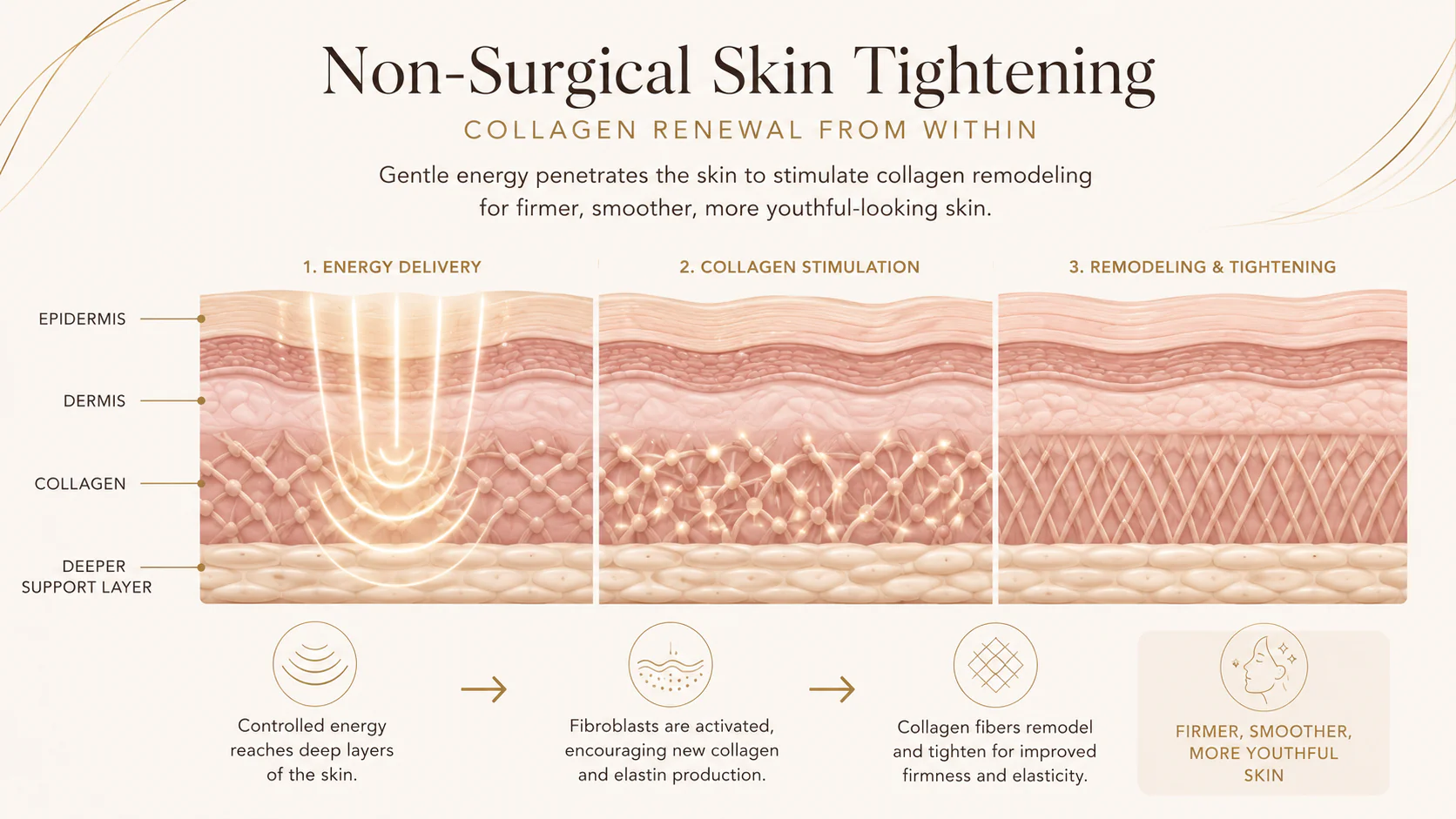
Skin tightening treatments use energy-based devices or absorbable sutures to stimulate collagen remodeling and reduce facial or body laxity without surgery. Four of the most sought-after options at LA ViE MD are XERF, Morpheus8, thread lifts, and Ultherapy. Each uses a distinct mechanism—broadband radiofrequency, fractional RF microneedling, absorbable PDO threads, or microfocused ultrasound—to address mild to moderate skin sagging with varying session requirements, recovery timelines, and cost profiles.
Choosing between these non-surgical skin tightening options depends on your degree of laxity, tolerance for downtime, budget, and whether you want immediate mechanical lift or gradual collagen-building results. Some patients near our Dublin clinic prefer zero-downtime radiofrequency approaches, while others consulting in Livermore lean toward microneedling to address both texture and firmness. Understanding how each technology works, what it costs, and who benefits most will help you make an informed decision.
This buyer’s guide compares XERF, Morpheus8, thread lifts, and Ultherapy across mechanism, session count, cost per treatment, downtime, longevity, and candidate profile. All four are FDA-cleared, non-surgical, and available at our Bay Area locations. By the end of this article, you will know which approach aligns with your aesthetic goals, schedule, and skin quality.
How Each Skin Tightening Technology Works
XERF delivers broadband radiofrequency energy combined with vacuum suction. The vacuum lifts skin into direct contact with the RF applicator, ensuring uniform energy distribution to the dermal layers. This controlled heat triggers collagen remodeling in the weeks following treatment. XERF is FDA-cleared for non-invasive skin tightening and uses surface applicators rather than needles or cannulas, making it the gentlest option among these skin tightening treatments.
Morpheus8 uses fractional radiofrequency microneedling: 24 ultra-fine needles penetrate skin at controlled depths up to 4mm, delivering RF energy to the deep dermis. This dual mechanism stimulates collagen through both thermal coagulation and the micro-injury response from the needles themselves. Because Morpheus8 targets the deeper dermis, it addresses moderate skin laxity paired with texture concerns including acne scarring, enlarged pores, and fine lines.
Thread lifts insert absorbable PDO (polydioxanone) threads under the skin via fine cannulas. These threads physically lift sagging tissue and anchor it in place, creating an immediate visible lift. Over six to nine months, the threads dissolve while stimulating collagen production. This FDA-cleared procedure is suited for mild to moderate facial sagging, particularly in the jowls, mid-face, and neck.
Ultherapy employs microfocused ultrasound—also called HIFU (high-intensity focused ultrasound)—to deliver focused ultrasound energy at precise depths of 1.5mm, 3mm, and 4.5mm. This reaches the SMAS layer, the same tissue layer addressed in surgical facelifts. The ultrasound energy creates thermal coagulation points that stimulate collagen synthesis without disrupting the skin surface. Ultherapy is FDA-cleared for non-invasive brow lift, submental lift, and décolletage line improvement, with zero downtime required.

Side-by-Side Comparison: XERF vs Morpheus8 vs Thread Lift vs Ultherapy
The table below compares four leading skin tightening treatments across mechanism of action, session requirements, cost per session, and downtime. All pricing reflects national averages; exact fees vary by treatment area and provider.
| Treatment | Mechanism | Sessions | Cost Per Session | Downtime |
|---|---|---|---|---|
| XERF | Broadband radiofrequency energy combined with vacuum suction | 3–6 sessions, spaced 2–4 weeks apart | $400–$900 | Zero — patients return to normal activity immediately |
| Morpheus8 | Fractional radiofrequency microneedling (24 ultra-fine needles penetrate up to 4mm depth) | 3 treatments, spaced 4–6 weeks apart | $1,200–$2,000 | 3–5 days of mild redness and small needle marks |
| Thread Lift | Absorbable PDO threads inserted under skin via fine cannulas | 1 treatment; repeatable every 12–18 months | $1,500–$4,500 depending on number of threads | 1–2 weeks of possible bruising and mild swelling; back to work in 1–2 days |
| Ultherapy | Microfocused ultrasound (HIFU) delivered at precise depths of 1.5mm, 3mm, and 4.5mm | Typically 1 treatment; some patients benefit from a second at 12–18 months | $2,500–$5,000 (single full-face treatment) | None — return to normal activity immediately |
XERF requires the highest number of sessions but offers the lowest per-session cost and zero recovery time, making it ideal for patients with mild to moderate skin laxity who cannot tolerate downtime. Morpheus8 delivers radiofrequency energy to the deep dermis while simultaneously addressing texture concerns such as acne scarring, enlarged pores, and fine lines, though patients must plan for 3–5 days of mild redness and pinpoint scabbing.
Thread lifts provide immediate mechanical lift in a single procedure, physically repositioning sagging tissue in the mid-face, jowls, and neck. The absorbable PDO threads dissolve over 6–9 months while stimulating collagen production. However, this approach carries the longest visible recovery window, with bruising and mild swelling lasting 1–2 weeks. Ultherapy typically requires only one treatment session and no downtime, stimulating collagen production in the SMAS layer with microfocused ultrasound energy, though the upfront cost is the highest among the four skin tightening treatments.
Patients with mild to moderate skin laxity seeking gradual improvement without social downtime often select XERF or Ultherapy. Those with moderate laxity combined with textural concerns—and who can accommodate several days of redness—frequently choose Morpheus8. Candidates wanting instant repositioning of sagging tissue in the mid-face or jowls select thread lifts despite the extended recovery period.

Ideal Candidates for Each Treatment Type

XERF is best suited for patients with mild to moderate skin laxity who cannot tolerate downtime. This FDA-cleared skin tightening treatment delivers broadband radiofrequency energy combined with vacuum suction to the dermal layers, making it effective for the face, neck, jowls, abdomen, arms, and thighs. Because XERF requires zero recovery time—patients return to normal activity immediately—it appeals to professionals who need same-day results without visible redness or swelling. Tech professionals at our Los Gatos clinic frequently choose XERF because they can complete a session over lunch and return to meetings without any visible recovery. Treatment involves 3-6 sessions spaced 2-4 weeks apart, with results lasting 12-18 months and maintenance recommended every 6-12 months.
Morpheus8 candidates present with moderate skin laxity combined with texture concerns including acne scarring, enlarged pores, and fine lines. The fractional radiofrequency microneedling system uses 24 ultra-fine needles to penetrate skin at controlled depths up to 4mm, delivering RF energy to the deep dermis. This FDA-cleared approach addresses both structural laxity and surface irregularities across the face, neck, décolletage, abdomen, and knees. Candidates must accept 3-5 days of mild redness and small needle marks following each of three treatments spaced 4-6 weeks apart.
Thread lift candidates typically have mild to moderate facial sagging, especially in the mid-face, jowls, neck, or brow. This FDA-cleared procedure uses absorbable PDO threads inserted under skin via fine cannulas to physically lift sagging tissue while stimulating collagen production over 6-9 months. The immediate lifting effect appeals to patients who want faster correction than energy-based skin tightening treatments provide. Patients at our Danville location often choose thread lifts when they want immediate, visible mid-face or jowl repositioning before a wedding, milestone birthday, or major event. Downtime includes 1-2 weeks of possible bruising and mild swelling, though most patients return to work within 1-2 days.
Ultherapy is ideal for patients seeking non-invasive brow lift, submental lift, neck firming, or décolletage line improvement. This FDA-cleared microfocused ultrasound technology delivers energy at precise depths of 1.5mm, 3mm, and 4.5mm to stimulate collagen production in the SMAS layer—the same structural plane addressed during surgical facelift. Candidates have mild to moderate laxity and prefer a single-session treatment with no recovery time. Results become visible at 2-3 months, peak at 6 months, and last 12-18 months.
Cost Comparison: What to Expect for Each Procedure
XERF sessions range from four hundred to nine hundred dollars per treatment. Because a full protocol requires three to six sessions spaced two to four weeks apart, total investment for a complete series typically falls between twelve hundred and fifty-four hundred dollars. The lower per-session cost and ability to treat large body areas—such as the abdomen or thighs—make XERF an accessible entry point for non-surgical skin tightening.
Morpheus8 treatments cost between twelve hundred and two thousand dollars per session, with most patients completing three sessions spaced four to six weeks apart. A full Morpheus8 protocol therefore ranges from thirty-six hundred to six thousand dollars. The price reflects the device’s dual mechanism—fractional microneedling combined with radiofrequency—and its ability to address both textural and laxity concerns in a single platform. Patients at our Livermore clinic often view Morpheus8 as a mid-tier investment that consolidates multiple aesthetic goals.
Thread lift costs depend on the number of threads used and the treatment area. A single thread lift session ranges from fifteen hundred to forty-five hundred dollars. Mid-face and jowl lifts typically require fewer threads than full-face or neck treatments, influencing total cost. Because thread lifts offer immediate mechanical repositioning, some patients consider the upfront expense justified by the instant visible correction, even though results last twelve to eighteen months before maintenance is recommended.
Ultherapy represents the highest single-session investment, ranging from twenty-five hundred to five thousand dollars for a full-face treatment. The cost reflects the device’s FDA clearance for non-invasive brow lift and submental tightening, its ability to target the SMAS layer, and the fact that most patients require only one treatment. Some individuals benefit from a second session twelve to eighteen months later, but many achieve their goals with a single appointment. For patients seeking SMAS-level stimulation without surgery, Ultherapy’s cost-per-result profile is competitive with surgical alternatives when recovery time and anesthesia fees are factored in.
Recovery Time and Downtime Differences
Recovery expectations vary significantly among skin tightening treatments, with downtime ranging from zero to two weeks depending on the technology and degree of tissue intervention.
XERF produces zero downtime. Patients return to normal activity immediately after treatment. The only common side effect is mild transient erythema—temporary redness—lasting one to two hours post-treatment. Because the broadband RF energy and vacuum applicator deliver heat without disrupting the skin barrier, there are no activity restrictions, and makeup can be applied directly after the session if desired. This makes XERF the most schedule-friendly option for patients who cannot accommodate recovery time.
Ultherapy also delivers no downtime. Patients resume normal activity immediately following the procedure. Transient redness lasting an hour or two is common, and mild discomfort during the treatment—described as brief prickling or heat—occurs as the microfocused ultrasound energy reaches deeper tissue layers at depths of 1.5mm, 3mm, and 4.5mm. Rare bruising can occur, particularly when treating the neck or brow, but this is infrequent. The non-invasive nature of ultrasound-based lifting makes this treatment suitable for patients with demanding schedules.
Morpheus8 requires three to five days of visible recovery. Redness, mild swelling, and pinpoint scabbing at the 24 needle-entry sites are expected outcomes. Some patients experience occasional bruising, particularly when treating thin-skinned areas such as the neck or décolletage. Most individuals return to work within two to three days, though full resolution of redness and scabbing takes up to five days. Patients are advised to avoid intense exercise, sauna, and direct sun exposure during the initial healing period.
Thread lifts involve one to two weeks of possible bruising and mild swelling, though many patients return to work within one to two days. The PDO threads are inserted via fine cannulas under local anesthesia, producing minimal surface trauma, but repositioning of tissue generates temporary asymmetry that resolves within one to two weeks. Rare thread visibility under the skin occurs if threads are placed too superficially, though this is uncommon with experienced practitioners. Patients are typically instructed to sleep on their back and avoid strenuous jaw movements—such as wide yawning or aggressive chewing—for the first week to allow proper thread integration.
Results Timeline: When You’ll See Improvement
Understanding when skin tightening treatments deliver visible results helps set realistic expectations and guides treatment selection based on your timeline and goals.
XERF produces gradual improvement as collagen remodeling progresses over the treatment series. Most patients notice subtle tightening after the second or third session within a series of 3-6 treatments spaced 2-4 weeks apart. Peak results appear approximately two to three months after completing the full series. This progressive timeline appeals to patients who prefer incremental, natural-looking enhancement without abrupt changes that call attention to cosmetic intervention.
Morpheus8 delivers visible improvement within two to four weeks as the micro-injury response and RF-induced collagen synthesis take effect. Textural refinement—reduction in pore size and softening of acne scars—often appears before significant tightening. Peak collagen remodeling occurs around the three-month mark after the final session in the recommended series of 3 treatments spaced 4-6 weeks apart, with continued maturation up to six months. The dual benefit of faster surface smoothing followed by deeper structural firming makes this timeline particularly attractive for patients addressing both texture and laxity concerns.
Thread lifts offer immediate mechanical repositioning of sagging tissue visible as soon as the PDO threads are placed. Initial swelling typically resolves within 1-2 weeks, revealing the final contour. Over the following six to nine months, the absorbable threads dissolve while stimulating fibroblast activity and collagen deposition. This means the lifting effect is sustained and often enhanced over time, even as the sutures themselves are absorbed. The combination of instant correction and progressive collagen building distinguishes thread lifts among skin tightening treatments for patients seeking both immediate and long-term benefits.
Ultherapy produces the most gradual timeline. Initial changes become visible at 2-3 months, with peak improvement at 6 months as new collagen matures in the deep dermis and SMAS layer targeted by microfocused ultrasound. Because Ultherapy stimulates tissue at depths of 1.5mm, 3mm, and 4.5mm, the remodeling process unfolds more slowly than surface-level treatments. The delayed timeline requires patience, but the natural evolution of results and the fact that most patients achieve their goals with a single treatment makes Ultherapy well-suited for those prioritizing convenience over speed.
Pain Levels and Comfort During Treatment
Comfort levels vary significantly among skin tightening treatments, with XERF offering the most tolerable experience. Patients describe a warming sensation as the broadband RF energy heats dermal tissue, accompanied by mild suction as the vacuum applicator lifts skin into contact with the handpiece. Because there is no needle penetration or deep energy delivery, discomfort remains minimal. Most individuals do not require topical anesthesia, and sessions are brief enough—typically twenty to forty minutes depending on treatment area—that tolerance is high even among those with lower pain thresholds.
Morpheus8 involves both needle penetration and RF energy delivery, making topical numbing cream essential. The numbing agent is applied thirty to forty-five minutes before treatment begins. Even with anesthesia, patients feel pressure and mild prickling as the 24 ultra-fine microneedles enter the skin at controlled depths up to 4mm. The sensation intensifies briefly when RF pulses are delivered at depth in the deep dermis. Most describe the experience as tolerable but not painless, particularly when treating bony areas such as the jawline or cheekbones. The procedure takes approximately thirty to sixty minutes, and discomfort resolves immediately once the handpiece is removed.
Thread lifts are performed under local anesthesia, so needle insertion and thread placement through fine cannulas are largely painless during the procedure. Patients feel tugging or pressure as absorbable PDO threads are positioned and tightened to physically lift sagging tissue, but sharp pain is uncommon. Post-procedure soreness similar to dental work is typical for the first few days, and some individuals experience mild aching when moving facial muscles. Over-the-counter analgesics are usually sufficient to manage discomfort during the 1-2 week recovery window.
Ultherapy is known for producing more noticeable discomfort during treatment compared to other non-invasive options. As the microfocused ultrasound energy reaches the SMAS layer at precise depths of 1.5mm, 3mm, and 4.5mm, patients feel brief episodes of heat, tingling, or prickling. The sensation is intermittent—occurring only when the ultrasound pulse is delivered—and varies by treatment area. Brow and neck treatments tend to be more sensitive than cheek or décolletage. Many providers offer oral pain relief or topical numbing to improve comfort. Despite the transient discomfort, Ultherapy requires no post-treatment downtime, and the sensation ends immediately when the handpiece is lifted.
How Long Results Last for Each Option

Understanding the longevity of skin tightening treatments helps you plan maintenance schedules and budget appropriately. All four options deliver results lasting 12–18 months, though the timeline and mechanism differ.
XERF produces visible tightening that persists for 12–18 months. Because the treatment relies on collagen remodeling triggered by controlled thermal injury to dermal layers, individual factors—including collagen turnover rates, age, skin quality, sun exposure, and smoking—influence duration. Maintenance sessions every 6–12 months sustain firmness and help preserve the cumulative benefits of the initial series of 3–6 treatments.
Morpheus8 delivers results lasting 12–18 months, with annual touch-up sessions recommended to maintain peak firmness and texture. The fractional radiofrequency microneedling mechanism generates robust collagen synthesis in the deep dermis that continues to mature for several months after the final treatment. The 24 ultra-fine needles penetrating up to 4mm stimulate structural remodeling that gradually strengthens skin architecture over time.
Thread lifts offer immediate mechanical repositioning of tissue visible as soon as the absorbable PDO threads are placed. The threads themselves dissolve over 6–9 months, yet the collagen-stimulating effect they trigger extends results to 12–18 months total. Repeat thread placement at the 12- to 18-month interval maintains the lifting and tightening benefit. The dual action—physical lift plus collagen induction—creates a layered effect that evolves as the sutures resorb.
Ultherapy results become visible at 2–3 months, peak at 6 months, and last 12–18 months. The microfocused ultrasound energy stimulates deep collagen production in the SMAS layer at precise depths of 1.5mm, 3mm, and 4.5mm. This deep collagen synthesis remodels slowly, producing durable tightening. Some patients benefit from a second treatment at 12–18 months, while others integrate complementary skin tightening treatments during the maintenance phase. Individual aging patterns, genetics, and daily skin-care habits all influence how long the ultrasound-induced collagen boost persists.
Frequently Asked Questions (FAQs)
What is the best treatment for skin tightening?
The best treatment depends on your degree of laxity, tolerance for downtime, and budget. XERF works well for mild laxity with zero downtime, Morpheus8 addresses moderate laxity plus texture concerns with a few days of recovery, thread lifts offer immediate mechanical lift with one to two weeks of bruising, and Ultherapy targets the SMAS layer with no downtime but higher upfront cost. A consultation at LA ViE MD will match your goals with the most appropriate technology.
Is Morpheus8 better than Ultherapy?
Morpheus8 and Ultherapy use different mechanisms and serve different priorities. Morpheus8 combines fractional microneedling with radiofrequency to address both laxity and texture—acne scars, pores, fine lines—across three sessions with three to five days of downtime. Ultherapy uses microfocused ultrasound to stimulate collagen in the SMAS layer with no downtime, typically in a single session. Morpheus8 is better for combined texture and tightening; Ultherapy is better for deeper, SMAS-level lift with zero recovery.
How long do thread lifts last?
Thread lifts provide an immediate mechanical lift that is visible as soon as the PDO threads are placed. The threads dissolve over six to nine months while stimulating collagen production. The overall collagen-stimulating effect lasts twelve to eighteen months, after which repeat treatment is common. Longevity depends on thread placement, tissue quality, and individual aging patterns.
What is the most effective non-surgical facelift?
Effectiveness depends on your specific concerns. For SMAS-level lifting without surgery, Ultherapy is FDA-cleared for non-invasive brow and submental lift. For immediate tissue repositioning, thread lifts offer mechanical correction. For combined firmness and texture improvement, Morpheus8 delivers dual benefits. XERF provides gradual tightening with zero downtime across multiple sessions. The most effective option is the one that aligns with your anatomy, goals, and tolerance for recovery time.
Are skin tightening treatments worth it?
Skin tightening treatments are worth the investment for patients with mild to moderate laxity who want non-surgical correction and understand realistic expectations. Results are gradual, require maintenance every twelve to eighteen months, and will not replicate surgical lifting for advanced sagging. When candidacy is appropriate and expectations are aligned, these FDA-cleared technologies offer measurable improvement in firmness, texture, and contour without incisions or general anesthesia.
Medical Disclaimer: This content is for educational purposes only and is not a substitute for personalized medical advice. Individual results vary. Schedule a consultation with Dr. Neetu Nebhwani at LA ViE MD to determine the best treatment for your skin or wellness goals.
Frequently Asked Questions
What is the best non-surgical skin tightening treatment in 2026?
The best non-surgical skin tightening treatment depends on your specific concerns and skin type. XERF offers comfort with no downtime, Morpheus8 combines microneedling with radiofrequency for deeper collagen remodeling, Ultherapy targets deeper layers with ultrasound, and thread lifts provide immediate lifting with dissolvable sutures.
What is the difference between XERF, Morpheus8, Thread Lift, and Ultherapy?
XERF uses surface radiofrequency for comfort and no downtime. Morpheus8 combines microneedling with radiofrequency for deeper penetration and moderate downtime. Ultherapy delivers focused ultrasound to reach SMAS layer without breaking skin. Thread lifts use dissolvable PDO sutures to physically lift tissue for immediate results.
Which skin tightening treatment lasts the longest?
Thread lifts and Ultherapy tend to produce results lasting 18-24 months. Morpheus8 results last 12-18 months with proper maintenance. XERF results last 12-18 months. All non-surgical treatments require periodic maintenance sessions to sustain results long-term.
Is Morpheus8 better than Ultherapy?
Morpheus8 is often preferred for patients seeking both surface texture improvement and deep collagen stimulation, while Ultherapy targets deeper structural layers without breaking the skin. Morpheus8 has more downtime (2-5 days) but treats a wider range of concerns including scars and texture.
How much do non-surgical skin tightening treatments cost in the Bay Area?
In the Bay Area, XERF sessions typically range $500-900 per treatment, Morpheus8 costs $800-1,500 per session, Ultherapy ranges $1,500-4,000, and thread lifts range $1,500-3,500 depending on threads used. Full treatment series or packages typically offer discounted pricing.
Who should not get skin tightening treatments?
Non-surgical skin tightening treatments are not recommended for patients who are pregnant or breastfeeding, have active skin infections in the treatment area, have metal implants near the treatment site (for RF), have keloid-prone skin (for microneedling-based treatments), or take certain photosensitizing medications.
Medically reviewed by Dr. Neetu Nebhwani, MD. Consult a licensed provider before treatment.