Medical Spa in Danville, CA: How to Choose and What to Expect
A good medical spa in Danville is one where a licensed physician sets the treatment plan, a qualified provider performs it, and you leave your consultation knowing the risks, the likely results and the cost. Everything else, from the décor to the menu of treatments, comes second. This guide covers what California law says about med spas, the questions worth asking before you book, the treatments you will commonly see offered, and how we approach care at LA ViE MD.
TL;DR
- In California, a med spa practices medicine: treatments must be done by a physician, or by a registered nurse or physician assistant working under physician supervision, and the spa must be physician-owned.
- Check licenses yourself on the Medical Board of California website and confirm the supervising doctor’s board certification before you book.
- A real consultation covers your medical history, goals, a personalized plan, risks, expected results and cost. If you get a sales pitch instead, keep looking.
- Ask how many times the provider has done your specific procedure, and ask to see before-and-after photos on skin like yours.
- LA ViE MD offers physician-supervised injectables, skin rejuvenation, laser treatments, hair restoration and medical weight loss for clients in Danville, Dublin, Livermore and Los Gatos.
Table of Contents
- What a medical spa actually is, and why it matters in California
- How to check a Danville med spa before you book
- What treatments Danville med spas commonly offer
- What a good consultation covers
- Understanding cost without guessing
- Our perspective: what personalized care means in practice
- Choosing a plan by concern
- Practical tips for your first visit
- Serving Danville and nearby communities
- Ready to book a consultation?
- FAQ
- Sources
What a medical spa actually is, and why it matters in California
The word “spa” suggests relaxation. The word “medical” is the part that carries legal weight. Injectables, lasers, microneedling with radiofrequency and prescription weight-loss medications are medical procedures, and California treats them that way.
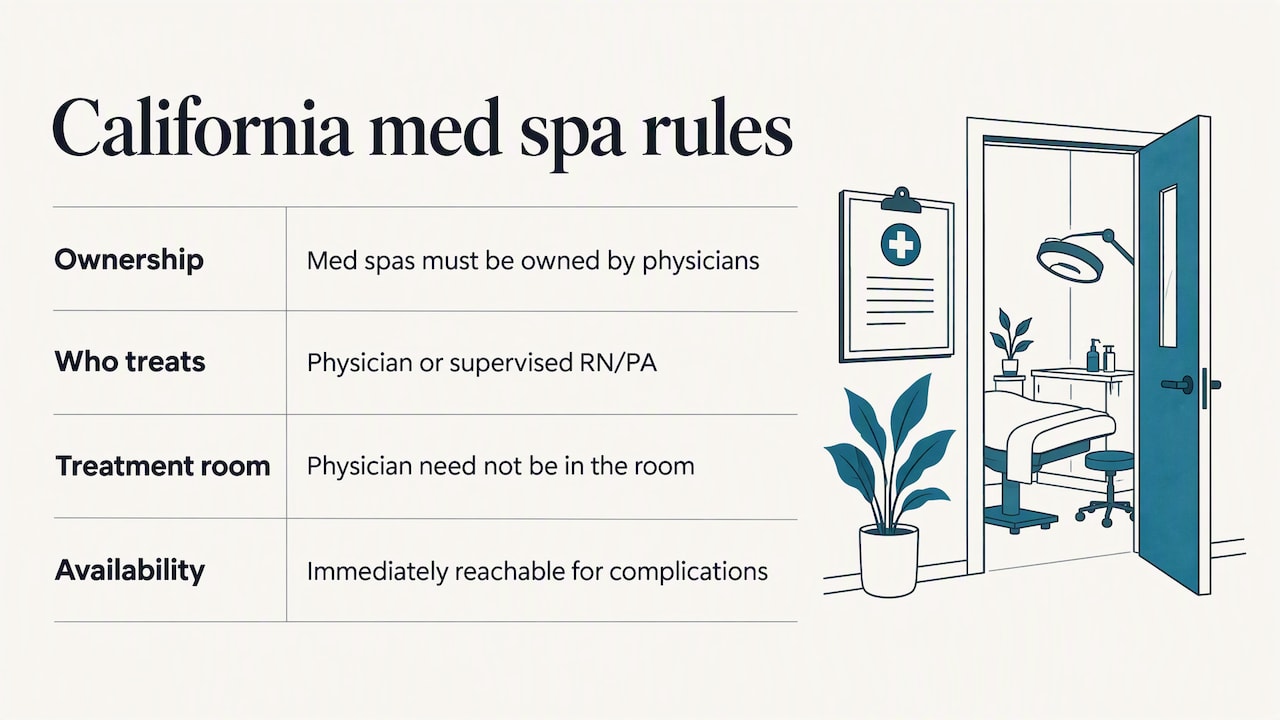
The Medical Board of California states that medical treatments must be performed by a physician, or by a registered nurse or physician assistant acting under physician supervision. The same page explains that med spas must be owned by physicians because they are engaged in the practice of medicine. So the answer to the question many people search, whether a non-doctor can own a med spa in California, is no.
The supervising physician does not have to stand in the treatment room. The Board says they must be immediately reachable for questions or complications. That distinction matters when you are choosing, because “supervised” can mean very different things in practice. Some clinics have a physician who is involved in every treatment plan. Others have a name on paper. You want to know which one you are walking into.
How to check a Danville med spa before you book
This takes about fifteen minutes and is the best protection you have.
Verify licenses and board certification
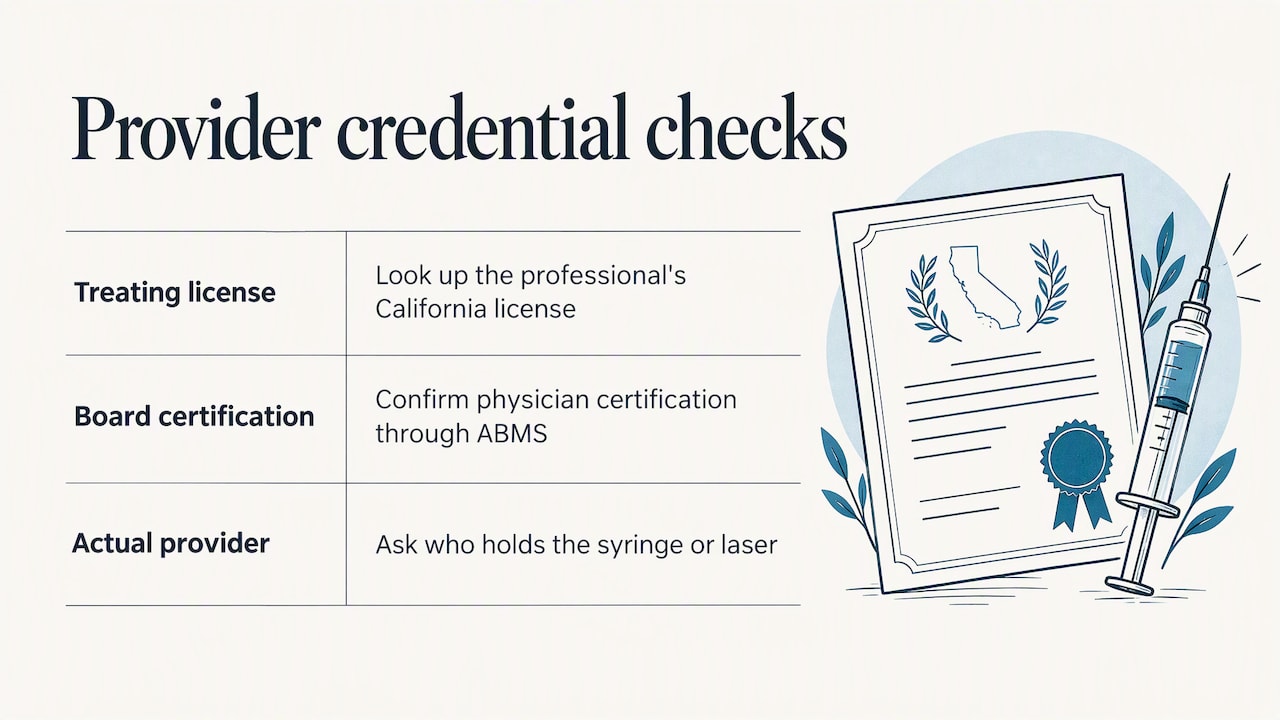
The Medical Board of California advises looking up the license of any professional performing a procedure on its website, and confirming the physician’s board certification through the American Board of Medical Specialties at abms.org. Do both. Ask for the name of the person who will actually hold the syringe or the laser handpiece, not just the name of the owner.
At LA ViE MD, care is led by Dr. Neetu Nebhwani, a board-certified Internal Medicine physician with more than ten years of experience. We encourage every new client to check that credential themselves.
Ask about experience with your exact procedure
General experience is not enough. The American Board of Cosmetic Surgery suggests asking how many of the specific procedures a provider has performed, what their training history is, and who is available to handle complications or emergencies. A provider who has done hundreds of neuromodulator treatments may be new to laser pigment work, and the reverse is also true.
Look at results on people who resemble you
The American Academy of Dermatology recommends asking to see before-and-after photos of previous patients with a similar skin tone and type to yours. This matters most for lasers and peels, where skin tone changes the settings and the risk profile. Photos should come from the clinic’s own patients, not manufacturer images.
Ask who responds if something goes wrong
The Board recommends asking about procedure risks, facility hygiene and who can help with complications. The American Board of Cosmetic Surgery adds that a good facility has a physician available to review medical history, monitor treatment plans and provide immediate care if a problem arises. Ask directly: if I have a reaction at 9 p.m., whom do I call, and will a physician see me?
Quick checklist
| Question | A good answer sounds like |
|---|---|
| Who performs my treatment? | A named, licensed provider you can look up |
| Who supervises, and how? | A physician who reviews your history and plan |
| How often have you done this procedure? | A specific, honest answer |
| Can I see photos like my skin? | Yes, from the clinic’s own clients |
| What happens if there is a complication? | A clear follow-up and emergency path |
| What will it cost in total? | A written estimate before treatment |
What treatments Danville med spas commonly offer
Most Danville-area med spas group their menu into a few families: injectables, skin rejuvenation, lasers, body and wellness services. Plastic surgery practices with med spa wings add surgical consultations on top. A medical spa without a surgeon focuses on non-surgical options, which is the model we follow.
At LA ViE MD, the menu breaks down like this:
- Injectables: Botox, dermal fillers, Sculptra, Kybella and non-surgical rhinoplasty. If you want a closer look, see our pages on Botox in Danville and dermal fillers in Danville.
- Skin rejuvenation: HydraFacial, microneedling, chemical peels, Morpheus8 and Forma. Our microneedling page explains what a session involves.
- Laser procedures: laser hair removal, tattoo removal, Tetra CoolPeel CO2 laser treatment and PicoWay for melasma and pigmentation.
- Hair restoration: PRP hair restoration for thinning hair.
- Esthetician services: HydraFacial Keravive.
- Wellness and weight loss: GLP-1 therapy with semaglutide, IV therapy, hormone replacement and vitamin B12 shots.
Not every client needs every service. Most people start with one concern, such as forehead lines, uneven tone or stubborn hair, and build a plan from there.
What a good consultation covers
The American Society of Plastic Surgeons says a thorough consultation should cover your medical history, your goals, a personalized plan, risks, expected results and costs. The AAD adds that dermatologists weigh your medical history and skin health when recommending a procedure, and that you may have several options to choose from. Those two points are a useful test. If someone recommends a single package before asking about your health, that is a warning sign.
Here is what to bring and expect:
- Your medical history. Medications, allergies, prior cosmetic work, pregnancy or plans for it, and any history of cold sores, keloids or autoimmune conditions. These change what is safe.
- Your goals in your own words. “I look tired in photos” is more useful than a treatment name.
- A plan with options. Often there is a gentler route and a more intensive one, with different downtime and cost.
- Risks and aftercare in plain language. Swelling, bruising, pigment changes and what is normal versus what needs a call.
- A written cost estimate. Including how many sessions you are likely to need.
If you are also curious about recovery habits or complementary tools, such as at-home red light therapy beds, raise them in the consultation. Your provider can tell you whether they fit with your skin concerns, medications and treatment schedule.
Understanding cost without guessing
Med spa pricing depends on the product, the area treated, the number of sessions and the experience of the provider. A neuromodulator is typically priced by the unit or by area, fillers by the syringe, lasers by session or package, and weight-loss programs by month. We do not publish a fixed menu price list on our site, because the right amount of product depends on your face and goals. We give you a written estimate at your consultation.
Two cautions from the regulators and specialists:
- The Medical Board of California notes that qualified treatments carry a substantial cost and that extremely low prices may mean the advertised product is not what will be delivered. A deep discount on filler or Botox deserves questions about the product and where it came from.
- The AAD advises asking whether insurance covers any part of a treatment, and notes that cosmetic procedures are typically not covered. Some medical conditions are handled differently. Our page on insurance and aesthetic procedures explains where the line usually falls.
Before you commit, ask whether a treatment is a one-time purchase or needs maintenance, since injectables and many skin treatments wear off or need repeat sessions.
Our perspective: what personalized care means in practice
We hear “personalized” from nearly every clinic, so here is what we mean by it.
It starts with a physician. Dr. Nebhwani trained in Internal Medicine, and that shapes how we work: we look at the whole person before we look at a wrinkle. Your medications, hormones, sleep, weight and skin all interact. A client asking about thinning hair may be helped by PRP, but it is worth asking first whether something systemic is involved. A client with melasma may be a candidate for PicoWay, but sun habits and hormones decide whether results last.
It means a plan, not a package. We would rather start with a modest treatment and adjust than overtreat on day one. Natural results are the goal, so we think about balance across the face instead of chasing one line.
It means technology chosen for a reason. We use advanced devices such as Morpheus8, Forma, PicoWay and Tetra CoolPeel because they target specific concerns: tightening, texture, pigment and resurfacing. A device is only as good as the judgment behind the settings.
And it means safety comes first, including saying no. If a treatment is not right for you, or can wait, we will tell you.
— Neesh
Choosing a plan by concern
If you are not sure where to start, this table maps common goals to the treatment families we offer. It is a starting point for the consultation, not a prescription.
| Your concern | Treatment families to discuss | Where to read more |
|---|---|---|
| Forehead lines, frown lines | Botox and other neuromodulators | Botox options compared |
| Lost volume, smile lines | Dermal fillers, Sculptra | Sculptra and fillers |
| Rough texture, acne scars | Microneedling, peels, Morpheus8 | Skin rejuvenation |
| Loose skin | Morpheus8, Forma | Skin rejuvenation |
| Dark spots, melasma | PicoWay, peels | Laser procedures |
| Unwanted hair or tattoos | Laser hair removal, tattoo removal | Laser procedures |
| Thinning hair | PRP hair restoration, exosome therapy | Exosome therapy |
| Weight management | Physician-supervised GLP-1 therapy | What to expect from GLP-1 treatment |
A note on filler and weight-loss medication
Two topics come up often enough to flag. If you have had fillers before, ask how migration is avoided; our guide to filler migration prevention covers the main points. And if you are on or considering a GLP-1 medication, rapid weight loss can change how your face and hair look, so it is worth reading about Ozempic-related hair loss and planning with a physician rather than treating the changes in isolation.
Practical tips for your first visit
- Book the consultation separately if you feel unsure. Pressure to treat the same day is not a good sign.
- Stop and ask about blood thinners and supplements. Some can increase bruising. Ask your provider what to pause, and do not stop prescribed medication without your own doctor’s advice.
- Plan around events. Allow time before weddings, reunions or photos. Injectables and lasers can cause swelling or redness for a few days, and some results take weeks to develop.
- Take your own before photos in consistent light so you can judge progress honestly.
- Keep your records. Ask for the product name, lot number and units or volume used.
Serving Danville and nearby communities
We are a boutique practice serving clients across the Bay Area, with pages for Danville, Dublin, Livermore and Los Gatos. Many clients combine a visit with their commute or errands, which is easier when treatments such as injectables, HydraFacials or IV hydration take a short appointment. If you are comparing options in the Tri-Valley, apply the checklist above to every clinic, including ours.
Ready to book a consultation?
If you want a physician-supervised plan built around your skin and your goals, start with a consultation at LA ViE MD. We will review your history, walk through options and risks, and give you a written estimate before anything is done. You can see the full range of services on our home page, or go straight to injectables, skin rejuvenation or laser procedures to see what fits your concern.
FAQ
Can a non-doctor own a med spa in California?
No. The Medical Board of California says med spas must be owned by physicians because they practice medicine. The supervising physician does not need to be physically present, but must be immediately reachable for questions or complications. Ask any clinic who owns it and who supervises.
Who can give Botox or fillers in California?
A physician, or a registered nurse or physician assistant acting under physician supervision, according to the Medical Board of California. You can look up any provider’s license on the Board’s website before your visit. If a clinic cannot tell you who your injector is, treat that as a reason to look elsewhere.
Does insurance cover med spa treatments?
Cosmetic procedures are typically not covered by insurance, as the American Academy of Dermatology notes. Some conditions with a medical component may be handled differently, so ask during your consultation and review our guide on insurance and aesthetic procedures. Get any coverage answer in writing from your insurer.
How do I know if a med spa’s price is too low?
The Medical Board of California warns that extremely low prices may mean the product you receive is not what was advertised. Ask for the product name, the number of units or syringes, and the provider’s credentials. A written estimate that lists these makes comparison fair.
What should I ask at a first med spa consultation?
Ask who will treat you, how often they have done your procedure, what the risks are, what results are realistic, what the total cost will be, and who to call if something goes wrong. Ask to see before-and-after photos on skin similar to yours. A good provider will welcome all of it.
Sources
- Medical Spas | Medical Board of California
- How to Choose a Safe Medspa for Non-Surgical Treatments | American Board of Cosmetic Surgery
- Best questions to ask when considering a cosmetic treatment | American Academy of Dermatology
- How to Choose the Right Medical Spa for You | American Society of Plastic Surgeons
- Red Light Therapy Beds | Recovery Warehouse HQ