Microneedling for Stretch Marks: What Results to Expect
Microneedling can make stretch marks less noticeable, including older, paler ones, but it does not erase them. Clinical studies show real improvement in texture and color across a series of sessions, and the best results come from professional treatment planned around your skin. Here is what the evidence says, what a session involves, how long results take and who should not have the treatment.
TL;DR
- Microneedling uses tiny needles to trigger new collagen and elastin. The American Academy of Dermatology lists stretch marks among the conditions dermatologists treat with it.
- Most people need three to six sessions, spaced about four to six weeks apart, and full results can take several months.
- Newer red stretch marks usually respond a bit better than older white ones, but both improve in clinical studies.
- Stretch marks fade rather than disappear completely, and maintenance sessions may be needed over time.
- Professional treatment is the safer route. At-home rollers and pens carry real risks of irritation, infection and scarring.
Table of Contents
- How microneedling works on stretch marks
- What the research shows
- Can microneedling remove stretch marks permanently?
- How many sessions and how long results take
- What a professional session looks like
- Recovery, side effects and aftercare
- Who should avoid microneedling
- Why at-home rollers are not the same thing
- Microneedling compared with other stretch mark treatments
- Book a stretch mark consultation
- Frequently asked questions
- Sources
How microneedling works on stretch marks
Stretch marks (striae) are bands of thinned skin where the dermis has been stretched or torn faster than it could repair itself. That happens in pregnancy, growth spurts, weight changes and muscle gain. The skin over them often looks different: smoother, crinkled or slightly sunken, and either red and purple or pale and silvery.
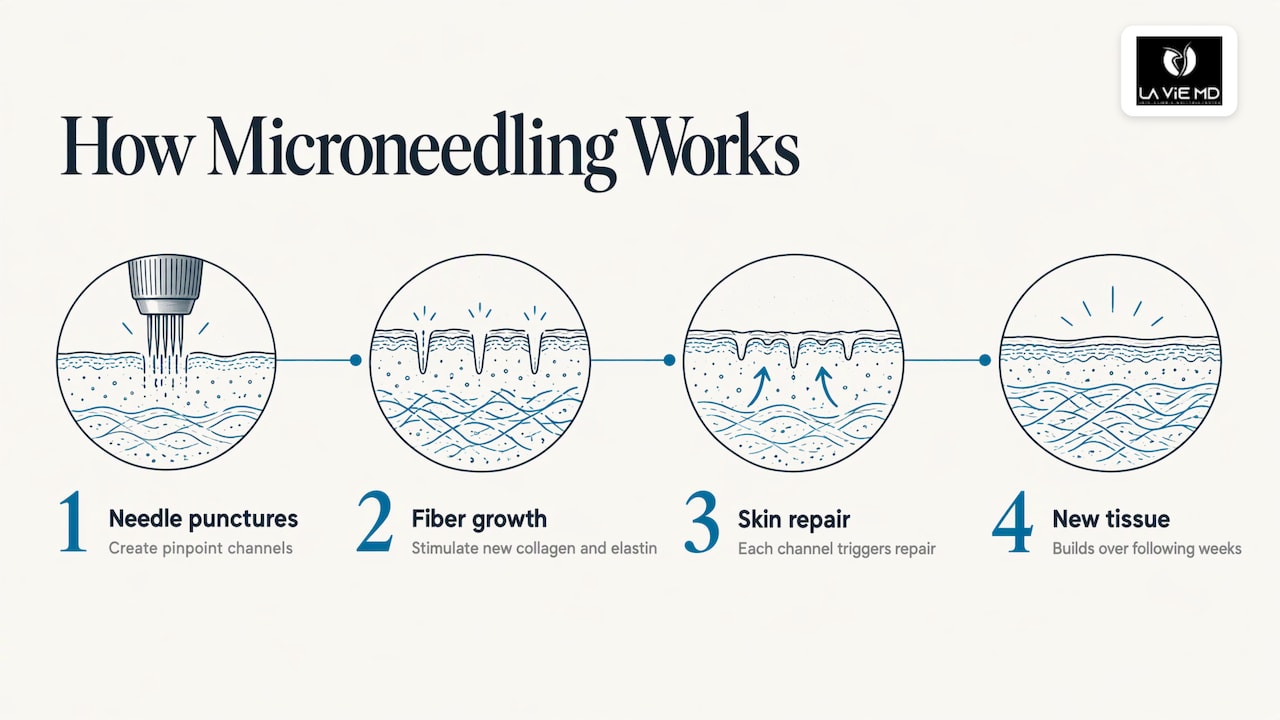
Microneedling goes after that underlying structure. A trained provider moves a device with fine needles over the skin. According to Cleveland Clinic, the tiny punctures stimulate new collagen and elastin fibers, which creates firmer skin. The skin treats each pinpoint channel as a small injury and starts to repair it. Over the following weeks, that repair response builds new tissue within and around the stretch mark.
That is why results are gradual. You are not applying something to the surface. You are asking your skin to rebuild itself, and that takes time.
Red versus white stretch marks
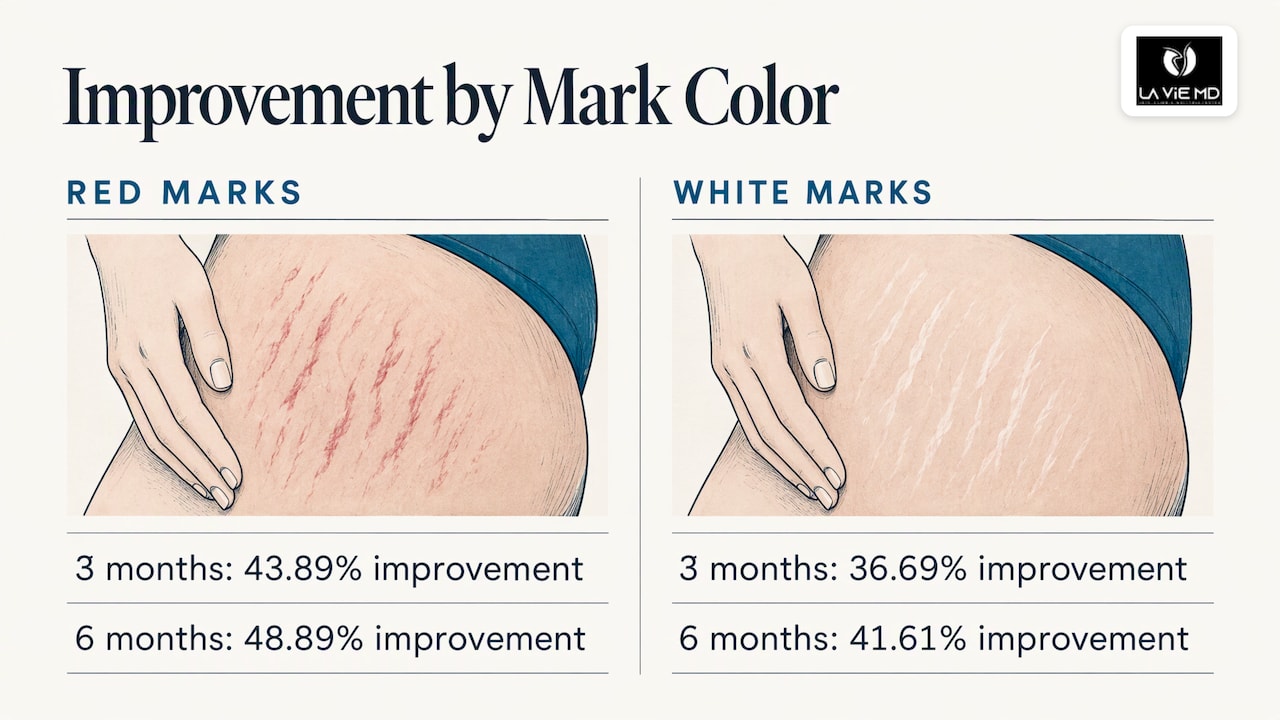
Color tells you a lot about age and response. Red or purple marks (striae rubrae) are newer and still have blood flow. White marks (striae albae) are older and more fibrotic. A 2026 review notes that red stretch marks are typically easier to treat because of increased blood flow and collagen turnover, while mature white ones need more intensive therapy and multiple sessions to show a noticeable change.
In practice, that means old stretch marks are not a lost cause. They just call for realistic expectations and a full course of treatment.
What the research shows
The evidence for microneedling and stretch marks is better than for many cosmetic treatments.
A 2025 clinical study. Researchers published a prospective study in Aesthetic Surgery Journal of 29 subjects with both red and white stretch marks. Each received four monthly microneedling sessions using FDA-cleared devices. Using the Manchester Scar Scale, red stretch marks improved by 43.89% at three months and 48.89% at six months. White stretch marks improved by 36.69% and 41.61% at the same points. Improvement kept going between the three- and six-month follow-ups, and no adverse events were reported.
A review across skin tones. The 2026 Chaudhury review describes a study of patients with Fitzpatrick skin types I to V in which every participant had at least 50% improvement, and 28% had more than 75% improvement. Side effects were limited to temporary redness, with no reported cases of post-inflammatory hyperpigmentation, infection or lasting pigment problems.
A meta-analysis. A 2024 systematic review and meta-analysis pooled 11 studies. It found microneedling and lasers about equally effective for stretch marks, while microneedling was significantly better than non-laser therapies. Post-inflammatory hyperpigmentation was less common with microneedling than with the comparison treatments. The same analysis found microneedling more painful than laser therapy, which is worth knowing going in.
These are published studies of specific devices and protocols, so your result will depend on your skin, the age of your stretch marks and how many sessions you complete. What they do show is a consistent direction: visible improvement, building over months.
Can microneedling remove stretch marks permanently?
No treatment completely removes stretch marks. Mayo Clinic says treatment can make them fade, though they may never disappear entirely. The FDA adds that results vary, that more than one procedure may be needed, and that any improvement may be temporary, with additional procedures sometimes needed to maintain it.
A useful way to think about it: the goal is a mark that is flatter, closer to your natural skin tone and far less noticeable in everyday light. Many people find that is a worthwhile outcome. Planning for a maintenance session once or twice a year after your initial series is a sensible way to protect it.
How many sessions and how long results take
The timeline is the most common thing people want to know, and sources agree closely.
| Question | What sources say |
|---|---|
| Sessions needed | Three to six for most people, per Cleveland Clinic |
| Spacing | About four to six weeks apart, per the American Institute of Alternative Medicine |
| First visible change | A few weeks, per the AAD |
| Full results | Several months; some people see complete results at four to six months, per Cleveland Clinic |
| Large or older marks | Up to six procedures, often combined with other treatments such as radiofrequency, per the British College of Aesthetic Medicine |
The spacing matters. Your skin needs those weeks to heal and build collagen before the next session. Booking sessions too close together does not speed things up. Treatment time itself is short: the AAD notes that fading stretch marks on both hips may take 15 to 30 minutes.
The British College of Aesthetic Medicine says it can take up to six weeks before visible signs of repair appear after a treatment. So if you look at your skin at week two and see little change, that is normal. Take photos in the same lighting at the start and before each session so you can judge progress fairly.
What a professional session looks like
A good microneedling visit starts before the needles come out.
- Consultation and skin assessment. The AAD describes this as a discussion of your health and expectations plus an exam to decide whether microneedling is safe and likely to help you. This is where stretch mark color, age, location and your skin tone shape the plan.
- Preparation. The AAD suggests following a skin-care routine for two to four weeks beforehand to improve your response. That may include pausing retinoids or other active ingredients for a few days and protecting the area from the sun.
- Treatment. The provider passes the device over the stretch marks in even patterns. Some discomfort is normal, and the 2024 meta-analysis found microneedling is more painful than laser, so ask about numbing options when you book.
- Aftercare. Your skin will be red and may feel like a sunburn. You can go back to work or school right away, but the AAD says to wait 24 hours before applying makeup.
Our own aftercare guidance is on our microneedling aftercare page, and you can see how we approach the treatment on our microneedling service page.
Recovery, side effects and aftercare
Expect your skin to look red or slightly darker and feel tight, with minor burning or swelling. The AAD says these reactions usually fade within a few days to a week. In the 2025 study, symptoms peaked in the first one to two days and were resolved within eight days. The most common complaints were mild redness and itching, and nearly a third of the red stretch mark group also felt burning or stinging.
The FDA lists bleeding, bruising, redness, tightness, itching and peeling as common effects that typically clear up within days or weeks. Less common risks include dark or light spots, a cold sore flare-up, swollen lymph nodes and infection.
A few habits protect your result:
- Use only the aftercare cream your provider recommends.
- Keep the area out of the sun and wear sunscreen, since the FDA notes skin may be more sensitive to sun afterward.
- Avoid products containing retinol, glycolic acid, menthol, capsaicin or alcohol until your provider says they are fine, also per the FDA.
- Do not pick at flaking skin.
If you notice spreading redness, warmth, pus or fever, contact your provider promptly, as these can signal infection.
Who should avoid microneedling
The AAD advises against microneedling if you heal slowly or poorly, have or have had a keloid, have a weakened immune system, or are being treated for skin cancer in the area. If you have a history of cold sores near the treatment area, tell your provider, because the FDA lists flare-ups as a possible effect.
One more detail worth knowing: the FDA has cleared microneedling devices for facial acne scars, facial wrinkles and abdominal scars in patients 22 and older. That is another reason to have treatment planned by a trained clinician who can judge whether it suits your age, body area and health history.
Why at-home rollers are not the same thing
Derma rollers and stamps sold online are tempting, but they are a different product. The AAD warns that at-home tools are not meant to puncture skin, give less noticeable results than professional treatment, and can cause irritation, infection or scarring. They can also spread warts, herpes and other viruses across the skin, and pressing too hard can change skin color or texture. The FDA has not authorized any microneedling device for over-the-counter sale and recommends seeing a health care provider with special training.
Stretch marks cover large areas like hips, thighs, abdomen and breasts, which makes consistent, safe at-home treatment even harder.
Microneedling compared with other stretch mark treatments
No single option wins for everyone, and the research says so plainly. A systematic review in Actas Dermo-Sifiliográficas concludes that evidence does not point to one best treatment and that combining approaches helps results.
| Option | What the evidence says |
|---|---|
| Microneedling | Comparable to lasers overall and better than non-laser therapy, per the 2024 meta-analysis |
| Fractional lasers | Similar effectiveness, less pain, but more pigment-change risk for darker skin |
| Radiofrequency | In a 2020 network meta-analysis, bipolar radiofrequency ranked among the most effective options |
| Topical tretinoin alone | Ranked lowest in that same analysis; ranked highest when paired with radiofrequency |
Skin tone matters here. Mayo Clinic says microneedling carries less risk of skin color changes than laser therapy, which makes it the preferred first approach for people with darker skin. The 2026 review also points to its lower risk of dyspigmentation and lower cost compared with fractional CO2 laser, and notes promising results when microneedling radiofrequency is combined with CO2 laser or PRP.
That last point is why a custom plan beats a one-size-fits-all package. Older white marks may call for more sessions, or microneedling paired with another modality, while newer red marks may respond to a simpler course. We explain how adding platelet-rich plasma changes the picture on our page about microneedling with PRP.
Our perspective on microneedling for stretch marks
Stretch marks are one of the most common skin concerns we hear about, and one of the most emotional. People often carry them for years before asking whether anything can help. Our answer is that something can, as long as the plan is honest and built around your skin.
We start with a physician-led consultation. Dr. Nebhwani is a board-certified Internal Medicine physician with more than ten years of experience, and every treatment plan at LA ViE MD is tailored to the individual: the age and color of the marks, where they are, your skin tone and your goals. That matters because the research shows stretch marks respond differently depending on those factors.
We favor a series of treatments over a single session, because collagen remodeling is a process, not an event. Where it makes sense, we talk through pairing microneedling with other options from our skin rejuvenation menu, such as radiofrequency-based treatments or PRP, since the literature points toward combinations for tougher, older marks.
The best outcomes come from patients who start with a clear plan, follow aftercare closely and take progress photos along the way. That is what we help you do.
Dr N
Book a stretch mark consultation
If you are in Danville, Livermore, Dublin or Los Gatos and want to know what microneedling can do for your stretch marks, we start with a physician-supervised consultation and build a plan around your skin. Microneedling sits alongside our other skin rejuvenation options, so your plan can grow with your needs. See the full list on our skin rejuvenation treatments page.

You can also read how we use the treatment for another common concern on our acne scar microneedling page, or visit LA ViE MD to request an appointment.
Frequently asked questions
How long does microneedling take to work on stretch marks?
You may notice early changes within a few weeks, but the full effect usually takes several months. The AAD says results appear gradually, and Cleveland Clinic notes that some people see complete results at four to six months. In the 2025 study, improvement kept growing between the three- and six-month check-ins.
Can you completely get rid of stretch marks?
Not with any current treatment. Mayo Clinic says treatment can make stretch marks fade, but they do not completely disappear. A realistic goal is a smoother texture and a color closer to your surrounding skin, so the marks are much harder to spot.
Is microneedling for stretch marks permanent?
The new collagen your skin builds is real, but the FDA notes improvement may be temporary and may need additional procedures to maintain. Many people plan an occasional touch-up session after finishing their initial series.
How deep are stretch marks?
Stretch marks form in the dermis, the middle layer of skin, not just on the surface. That is why creams alone rarely change them, and why treatments that stimulate collagen in the dermis, like microneedling, are used. In the 2020 network analysis, topical tretinoin on its own ranked lowest for effectiveness.
Does microneedling hurt on stretch marks?
Most people describe it as uncomfortable but tolerable. The 2024 meta-analysis found microneedling causes more pain than laser therapy, so talk with your provider about numbing options before your appointment. Redness and a sunburn feeling afterward typically ease within a few days.
Sources
- American Academy of Dermatology: Microneedling can fade scars, uneven skin tone, and more
- Cleveland Clinic: Stretch marks
- Marin et al. 2025: microneedling for striae rubrae and albae
- Chaudhury et al. 2026: Advancements in treating stretch marks across all skin types
- Sun et al. 2024: Microneedling therapy for striae distensae, meta-analysis
- Lu et al. 2020: Comparative effectiveness of different therapies for striae distensae
- Actas Dermo-Sifiliográficas: Stretch marks, systematic review of therapeutic options
- Mayo Clinic: Stretch marks, diagnosis and treatment
- FDA: Microneedling devices, benefits, risks and safety
- British College of Aesthetic Medicine: Microneedling
- American Institute of Alternative Medicine: Microneedling stretch marks