Botox for Chin Dimpling: How It Works and What to Expect
Botox smooths chin dimpling by relaxing the mentalis, the small muscle in the chin pad that bunches the skin into a pebbled, “orange peel” texture when it overworks. A trained injector places a few small, deep injections low on the chin. The effect builds over about one to two weeks and usually lasts three to four months. Here is how the treatment works, where it goes, what to expect and how to decide if it suits you.
TL;DR
- Chin dimpling, often called orange peel or cobblestone chin, is mostly caused by an overactive mentalis muscle pulling on the skin.
- Botox is injected deep into that muscle, usually at one or two points low on the chin, in a small total dose.
- Results begin within days, reach full effect in about 7 to 14 days and typically last 3 to 4 months.
- Placement matters: injections that sit too high or too far to the side can affect the lower lip or smile, so choose a physician-led practice.
- You can return to normal activities right away. Avoid rubbing or massaging the area.
Table of Contents
- What causes a dimpled or orange-peel chin
- How Botox smooths the chin
- Where Botox is injected for chin dimpling
- Other areas often treated alongside the chin
- What to expect: timing, results and longevity
- Safe use: side effects and how to lower your risk
- Aftercare in the first day or two
- If dimpling persists or comes back
- Choosing a neurotoxin
- Book a chin consultation at LA ViE MD
- FAQ
- Sources
What causes a dimpled or orange-peel chin
The mentalis is a paired muscle that starts at the lower jaw and inserts into the skin of the chin. It is the only muscle that lifts the lower lip and chin, and its fibers run vertically toward the middle of the chin (Creating Lift in the Lower Face With Botulinum Toxin A). Because some of its fibers attach to the deeper skin layer, a hyperactive mentalis tugs the skin inward every time it contracts. Researchers describe this cobblestone appearance as the result of mentalis hyperactivity (Novel anatomical guidelines for botulinum neurotoxin).
Muscle activity is not the only factor. The 2015 Global Aesthetics Consensus notes that a dimpled chin reflects the action of the mentalis together with loss of collagen and subcutaneous fat in the area (Consensus Recommendations on the Use of Botulinum Toxin Type A). That is why two people with the same muscle activity can look different, and why a plan that looks at both muscle and skin quality tends to work better than a single injection pattern.
You may notice it most when you:
- Purse or push up your lower lip
- Talk, smile or frown with the corners of your mouth
- Look at photos taken in side light, where the texture shows
- Feel the chin “bunch” when you concentrate
How Botox smooths the chin
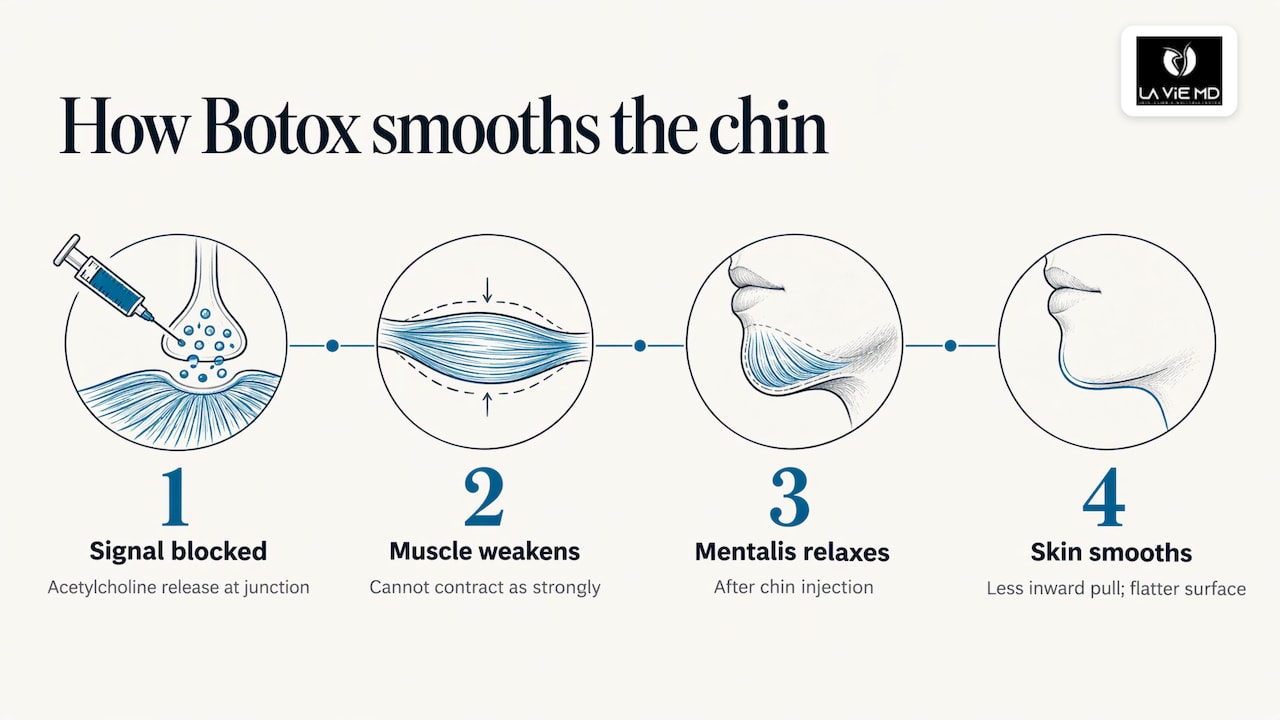
Botulinum toxin blocks the release of acetylcholine at the junction between nerve and muscle, so the muscle cannot contract as strongly. Injected into the mentalis, it relaxes the muscle and lessens the cobblestone look (Novel anatomical guidelines for botulinum neurotoxin). The skin is no longer pulled inward with each movement, so the surface looks flatter and the chin appears more relaxed.
The effect is temporary and it targets the muscle component. It is a refinement treatment, not a surgical change, and it does not alter your chin bone or profile.
A note on labeling: the FDA-approved indications for BOTOX Cosmetic cover glabellar lines, lateral canthal lines and forehead lines in adults (FDA label). Treating the chin is a widely taught technique that physicians apply based on anatomy and clinical judgment, which is one more reason the person holding the syringe matters.
Where Botox is injected for chin dimpling
The short answer: low on the chin pad, deep, and close to the midline. The goal is to deliver a small amount of product into the mentalis and keep it away from neighboring muscles that control the lip.
Typical injection pattern
Published guidance varies slightly, but the patterns are similar:
- One review describes two injection points of 2.5 units each, placed where the dimples appear on contraction, with the needle directed medially, up and deep along the muscle belly (Creating Lift in the Lower Face With Botulinum Toxin A).
- An anatomical study from South Korea describes a deep injection of 3 units per side about 0.5 cm lateral to the pogonion (the most forward point of the chin), followed by a superficial injection of 1 unit per side at the same point (Novel anatomical guidelines for botulinum neurotoxin).
- A peer-reviewed expert consensus recommends 3 to 4 units injected deep at two points beside the midline, close to where the mentalis originates. It also reports that the muscle sits roughly 6.7 to 10.7 mm below the skin surface (expert consensus on cobblestone chin).
The same South Korean study found only about 1.1 mm between the bone surface and the muscle, so the injector touches bone and then withdraws the needle slightly before depositing the dose (Novel anatomical guidelines for botulinum neurotoxin).
How many units
The 2015 consensus panel reported a typical starting dose of 5 to 6 units in total for a dimpled chin, with some experienced injectors going up to 12 units, and said 5 to 10 units is generally adequate (Consensus Recommendations on the Use of Botulinum Toxin Type A). The same panel favors a conservative start: one treatment, then reassess.
Your dose is not a number to shop for. It depends on how strong your mentalis is, how deep the dimpling runs and whether you also want other areas treated. Because it is a small dose, a measured first session leaves room to fine-tune at a follow-up.
Why “low and deep” matters
Injecting too high can affect the orbicularis oris, the muscle that circles the mouth, and may cause the lower lip to feel weak or leak. Care also has to be taken around the depressor labii inferioris, which pulls the lower lip down (Consensus Recommendations on the Use of Botulinum Toxin Type A). This is anatomy, and it is the main reason a physician who knows the lower face should do this treatment.
Not every chin needs treatment
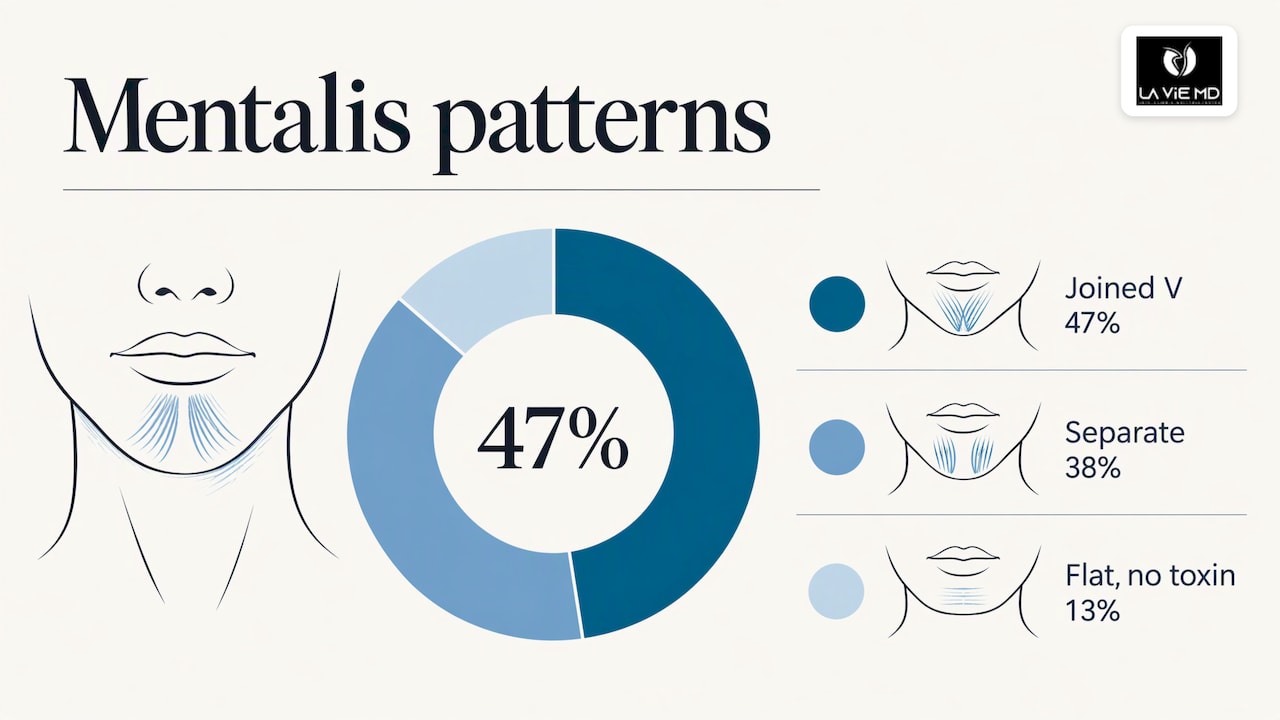
Researchers describe three common mentalis shapes: two vertical bellies that join in a V (47%), two parallel and separate bellies (38%) and a flat, thin muscle with few fibers (13%). The last pattern generally does not call for toxin (expert consensus on cobblestone chin). A simple exam helps: when you purse your lower lip, the mentalis contracts, and an examiner can see whether dimpling appears. That is how an in-person assessment separates a chin that will respond from one that will not.
Other areas often treated alongside the chin
When readers search for where Botox is injected, they usually want the wider map of treatment areas. The chin is one point in a larger picture of the lower face, and many plans combine it with other zones:
| Area | What it targets | Related reading |
|---|---|---|
| Mentalis (chin pad) | Orange-peel texture, dimpling when the lip pushes up | This article |
| Masseter | Jaw clenching, jaw width, TMJ tension | Masseter Botox for jaw slimming and TMJ relief |
| Upper lip and gum area | Gummy smile | Gummy smile Botox |
| Forehead, frown lines, crow’s feet | Expression lines in the upper face | Botox treatments at LA ViE MD |
Treating the chin often fits into a balanced plan rather than a standalone fix. If you also clench your jaw, for example, the masseter and mentalis may both be worth discussing, and this guide to masseter Botox explains how that treatment is approached.
What to expect: timing, results and longevity
The appointment itself is short. After a consultation and facial assessment, the injections take a few minutes. Nothing has to be cut or healed, and the American Society of Plastic Surgeons states there is no downtime, with normal activities possible right away (Botulinum Toxin Recovery, ASPS).
A typical timeline looks like this:
- Day 0: Injections. You may see small bumps or redness that settle quickly.
- Days 3 to 7: The chin starts to feel less “bunchy.”
- Days 7 to 14: Full effect. The ASPS notes that neurotoxin typically needs 7 to 10 days to show its full effect, with results lasting 3 to 4 months, and that a patient may be re-evaluated at 2 weeks to see whether more treatment is needed (ASPS Position Statement).
- Months 3 to 4: Movement gradually returns and the texture may come back. Retreatment is usually scheduled around this point.
The consensus panel says the usual retreatment interval for dimpled chin is 3 to 4 months, and it can stretch to as long as 6 months in some patients (Consensus Recommendations on the Use of Botulinum Toxin Type A). Some people find the interval lengthens as the habit of overusing the muscle eases.
Safe use: side effects and how to lower your risk
Botox is considered low risk and safe for most people when given by a trained provider. Common effects include pain, bruising or swelling at the injection site, headache, temporary nausea, muscle twitching and, in some cases, a crooked smile. Serious side effects are rare but need immediate medical attention (Healthline).
The chin-specific risks come from the toxin spreading into the muscles around the mouth. Reported issues include trouble with mouth function, uneven lower facial expressions and lower lip ptosis if the toxin reaches the orbicularis oris or depressor labii inferioris (Novel anatomical guidelines for botulinum neurotoxin). The practical steps that lower that risk:
- Choose a licensed medical provider who treats the lower face regularly and can explain where each injection goes and why.
- Share your medical history, medications and any prior reactions to neurotoxins. The FDA label lists hypersensitivity to any botulinum toxin and infection at the injection site as contraindications (FDA label).
- Begin with a conservative dose and plan a check-in at about two weeks.
- Contact the clinic promptly if you notice drooping, difficulty closing your mouth, or an asymmetric smile. If you have trouble swallowing, breathing or speaking, seek urgent care.
Any uneven effect from toxin fades as the product wears off. If you are pregnant or breastfeeding, or have a neuromuscular condition, tell your physician before booking, as they will advise whether treatment is appropriate for you.
Aftercare in the first day or two
Aftercare is simple. The ASPS advises against rubbing or massaging the treated area, since the product can migrate to another part of the face (Botulinum Toxin Recovery, ASPS). In practice:
- Skip facials, massage and tight chin straps or helmets for the rest of the day, unless your provider says otherwise.
- Wash your face gently and apply makeup lightly if needed.
- Expect a few small bumps that disappear within hours.
- Keep your follow-up visit so your physician can assess the result at the two-week mark.
If dimpling persists or comes back
If the chin still dimples after the full effect has set in, the answer is often a small adjustment. The consensus recommends starting conservatively and treating further if the result is not what you wanted, with an assessment at 2 weeks and possible touch-up injections (Consensus Recommendations on the Use of Botulinum Toxin Type A).
Some chins have a static component, meaning the texture or crease is visible even at rest. Botox addresses the muscle, but it does not add volume or rebuild skin. In those cases a physician may discuss pairing it with other options:
- Dermal fillers to soften a deeper crease or restore lost volume. See our overview of dermal fillers.
- Microneedling to improve skin texture. Here is how Botox and microneedling can work together.
- Chin structure treatments if the real concern is a recessed profile. Our guide to a recessed chin explains when filler helps.
- Kybella if submental fullness under the chin is part of what bothers you. Read about Kybella for a double chin.
Choosing a neurotoxin
Botox is the best-known name, but physicians also use other neurotoxins, and they differ in onset and duration. If you are curious how they compare, our guides cover Botox, Dysport, Xeomin and Daxxify, Daxxify versus Botox and what Dysport treats. Your physician can recommend the one that fits your anatomy and goals.
Our perspective on chin Botox
In our practice, a dimpled chin is a good example of why aesthetic medicine should start with anatomy, not a template. The same few units can look beautiful on one face and wrong on another, because the mentalis, the lip muscles and the skin quality are different in each patient.
That is why we build custom treatment plans under the direct supervision of a board-certified physician. We look at how your chin moves, how your lip sits at rest and what you want to change, then we choose where and how much to treat. A conservative first session with a follow-up check is our preferred approach, because it respects your natural expression.
We also look past the muscle. When skin texture, volume or the shape of the chin matter as much as movement, we can combine treatments such as injectables, microneedling and skin rejuvenation in a single plan, so you are not treating one detail in isolation.
Dr N
Book a chin consultation at LA ViE MD
If you are considering Botox for chin dimpling, a short physician-led consultation is the best first step. We assess how your mentalis moves, discuss your goals and outline a treatment plan designed for your face. Our injectables are provided at our Bay Area locations serving Danville, Livermore, Dublin and Los Gatos, and you can see everything we offer on our injectables page.

Ready to talk through your options? Start with our Botox treatments page or visit LA ViE MD to request a consultation. Pricing is discussed at your visit, because it depends on your individual treatment plan.
FAQ
How long does Botox for chin dimpling last?
Most people see results last about 3 to 4 months, according to the American Society of Plastic Surgeons (ASPS Position Statement). Some patients stretch that to as long as 6 months. Your physician will suggest a retreatment schedule based on how your chin responds.
Does chin Botox hurt?
Most people describe a quick pinch and mild pressure, and the treatment takes only a few minutes. Small bumps or bruising can appear at the injection points. Healthline lists pain, bruising and swelling among the common effects (Healthline). Tell your provider if you bruise easily so they can plan accordingly.
How many units of Botox go in the chin?
A consensus panel reported typical starting totals of 5 to 6 units for a dimpled chin, with 5 to 10 units generally adequate (Consensus Recommendations on the Use of Botulinum Toxin Type A). Your own dose depends on muscle strength and your goals, and it is set by your physician at the consultation.
Can Botox cause a crooked smile or lip droop?
It can if the product affects the muscles around the lower lip, which is why placement and depth matter. These effects are tied to toxin reaching the orbicularis oris or depressor labii inferioris, and they fade as the product wears off (Novel anatomical guidelines for botulinum neurotoxin). Choosing an experienced physician and a conservative dose is the best protection.
Can I go back to work after chin Botox?
Yes. There is no downtime, and you can resume normal activities immediately (Botulinum Toxin Recovery, ASPS). Just avoid rubbing or massaging the area so the product stays where it was placed.
Sources
- Novel anatomical guidelines for botulinum neurotoxin injection in the chin
- Consensus Recommendations on the Use of Botulinum Toxin Type A
- Creating Lift in the Lower Face With Botulinum Toxin A
- Expert consensus on cobblestone chin treatment (Dove Press)
- ASPS Position Statement on Administration of Botulinum Toxin Neuromodulators
- Botulinum Toxin Recovery, American Society of Plastic Surgeons
- Botox for the Chin: What to Expect, Healthline
- BOTOX Cosmetic FDA label