

Forehead Wrinkles Treatment: What Works and When
The most effective way to soften horizontal forehead lines is to relax the muscle that creates them, then support the skin with a retinoid and daily sunscreen. Which neurotoxin, how many units and whether you also need resurfacing or filler depends on your anatomy, your brow position and whether the lines show only when you raise your eyebrows or also at rest. That is a medical judgment, and it is why a physician-supervised plan beats a one-size-fits-all product. At LA ViE MD, Dr. Neetu Nebhwani, a board-certified Internal Medicine physician, builds custom treatment plans for each patient’s skin concerns and goals.
TL;DR
- Forehead lines start as expression lines from repeated frontalis muscle movement, and over time can become lines that stay visible at rest.
- Neurotoxin injections such as Dysport and Botox treat the cause, with results in about 3 to 7 days and a duration of roughly 3 to 4 months.
- Prescription retinoids and daily SPF 30+ sunscreen improve skin quality over months and protect your results.
- Etched-in lines often need a combination: injectables plus resurfacing, microneedling or filler, planned by a physician.
Table of Contents
- Why forehead wrinkles form
- Treatment options at a glance
- Dysport and Botox for forehead lines
- Skincare that supports smoother skin
- When resurfacing, microneedling or filler make sense
- A realistic plan by line type
- Book a forehead consultation
- FAQ
- Sources
Why forehead wrinkles form
A wrinkle is not just a surface crease. A 2023 review in JAMA Dermatology explains that facial lines form from repeated contraction of the muscles underneath, and that horizontal forehead lines are largely tied to the frontalis muscle and the glabellar complex (the muscles between the brows). Every time you lift your brows, the skin folds in the same place.
Two kinds of lines matter for your treatment choice:
- Dynamic lines appear only when the muscle contracts: raising your eyebrows, looking surprised, concentrating.
- Static lines remain visible when your face is relaxed. The same review notes that dynamic lines can progress to static ones over time.
The skin itself also changes. The authors point to loss of elasticity, collagen and fat atrophy, and bone loss as internal factors, and to sun exposure and smoking as external ones. That is why the best plans address both the muscle and the skin.
As for the genetics question people often ask: your face shape, how expressive you are and how your skin ages are all partly inherited, but sun exposure is the part you can control starting today.
Treatment options at a glance
| Option | What it does | Typical timeline |
|---|---|---|
| Dysport, Botox, Daxxify | Relaxes the muscle that folds the forehead skin | Results in days; lasts months |
| Prescription retinoid | Improves skin texture and fine lines | Weeks to months of steady use |
| Chemical peel | Removes top skin layers to refresh texture | Outpatient, with downtime that depends on depth |
| Laser resurfacing | Resurfaces skin to soften fine and moderate lines | Recovery depends on laser type |
| Microneedling, Morpheus8 | Stimulates collagen remodeling | Series of sessions |
| Dermal filler or Sculptra | Adds support under a deeper, static line | Lasts months or longer, depending on product |
Mayo Clinic’s wrinkle treatment guide lists most of these options and adds that a doctor may suggest two or more treatments together for the best result.
Dysport and Botox for forehead lines
Neurotoxin injections are the first-line answer for dynamic forehead lines because they act on the cause. A tiny amount is placed in the frontalis muscle so it contracts less, and the skin above stops creasing as deeply.
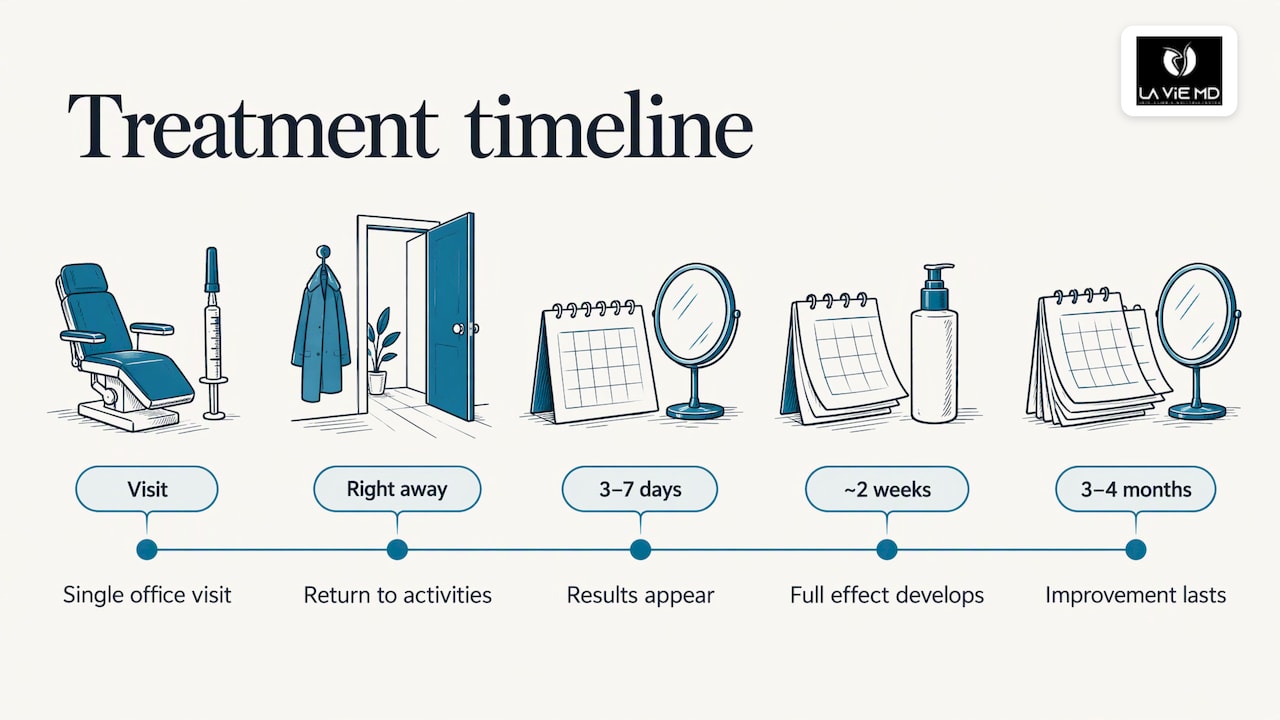
What to expect. The American Academy of Dermatology says botulinum toxin therapy is done in a single office visit, that most people return to everyday activities right away, that results show within 3 to 7 days and that improvement lasts about 3 to 4 months, sometimes longer. The American Family Physician’s May 2026 clinical review adds that the full effect takes about two weeks to develop.
Dysport or Botox? Both are botulinum toxins, and both are offered at LA ViE MD, along with Daxxify. Dysport is a popular choice for the forehead because it tends to spread softly across a broad, flat area, which suits a wide forehead. Your injector chooses based on your muscle strength, brow shape and how natural you want the movement to look. We would rather you leave with a forehead that still moves and looks like yours than a frozen one.
Why the injector matters. The same AFP review notes that drooping of the eyelid or eyebrow is technique-dependent and becomes less common as injector skill improves. The forehead is the area where this matters most: the frontalis is the muscle that lifts your brows, so too much product, or product in the wrong place, can leave brows heavy. Dosing the forehead in balance with the muscles between the brows is a matter of anatomy and training. Our injections are performed under the supervision of a board-certified physician, which is the standard we hold for every treatment plan.
Does it work if the lines are already deep? It still helps. The AFP review notes that treating dynamic wrinkles gives more dramatic results than treating static ones, so deep lines may soften rather than vanish. Relaxing the muscle also stops the repeated folding that deepens them, and the lines often respond better when combined with resurfacing, microneedling or filler.
Safe use. Neurotoxin treatment should be done by a trained medical professional after a consultation. Tell your provider if you are pregnant or breastfeeding, have a neuromuscular condition, take blood thinners, or have had a reaction to a toxin before. Mild redness, swelling or a small bruise at injection points can happen.
If you live in the East Bay or South Bay, you can book at our Dublin, Livermore or Los Gatos Botox pages, or see all injectables we offer.
Skincare that supports smoother skin
Injectables relax the muscle. They do not rebuild collagen. Your daily routine does that job, and two products carry most of the evidence.
Prescription retinoids
A peer-reviewed photoaging review states that tretinoin and tazarotene are the two topical retinoids FDA-approved for photoaging, and that tretinoin showed significant improvement in fine wrinkles within the first 4 to 10 months of use. Retinoids work by increasing collagen production and blocking the breakdown of the skin’s supporting matrix after sun exposure.
Mayo Clinic notes that retinoids can cause rash, burning or dryness, increase sun sensitivity and should not be used during pregnancy. Adapalene is now sold without a prescription, while tretinoin and tazarotene need one. Because retinoids are slow and benefits fade after you stop, they are a long-term habit, not a quick fix. A physician can choose a strength that fits your skin and tell you how to start gradually. We also carry medical-grade skincare products.
If you are exploring light-based devices at home too, read about red light therapy contraindications first, so you know who should avoid it.
Daily sunscreen
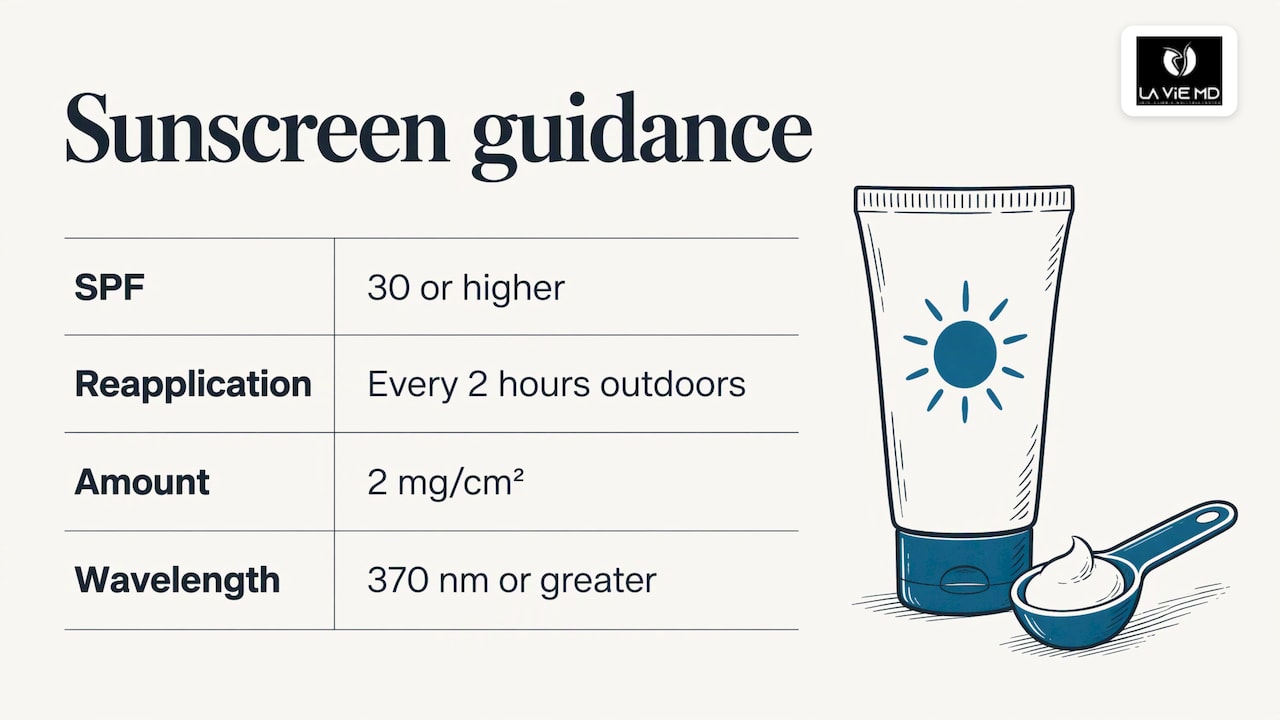
Sun is the largest outside factor in photoaging. The American Academy of Dermatology’s recommendation, as reported in a patient-directed rejuvenation review, is SPF 30 or higher, reapplied every 2 hours when you are outdoors. The photoaging review stresses that the amount you apply matters most: typically 2 mg per square centimeter, which is more than most people use. Choose a broad-spectrum product, which the FDA defines by a critical wavelength of 370 nm or greater.
What about home remedies?
Facial massage, gua sha, taping patches and dermarollers are popular, and some feel relaxing. None of them has the evidence behind it that retinoids, sunscreen and medical treatments do, so think of them as extras at most, not a replacement for treating the muscle and the skin.
When resurfacing, microneedling or filler make sense
If your lines are visible at rest, you are looking at static lines, and the skin needs more than muscle relaxation.
- Chemical peels remove the top layers of skin. Mayo Clinic lists them as outpatient procedures, with risks that include scarring, infection and color changes, which is a reason depth and skin type should be chosen by a physician.
- Laser resurfacing comes in ablative forms, with a 7 to 10 day recovery, and nonablative forms, with shorter recovery and subtler results, according to Mayo Clinic. Our laser menu includes the Tetra coolpeel CO2 laser, and our chemical peel or laser comparison walks through how to choose.
- Microneedling and radiofrequency microneedling (Morpheus8) stimulate collagen. See our skin rejuvenation treatments.
- Fillers can support a deeper crease. Mayo Clinic lists products such as Radiesse, Sculptra, Restylane and Juvederm, typically in 1 to 3 sessions, repeated after about six months. Learn more about dermal fillers and how Sculptra compares with fillers.
A realistic plan by line type
- Light lines that show when you lift your brows. A neurotoxin, a retinoid and daily sunscreen is often the whole plan.
- Lines that linger after the expression fades. Neurotoxin plus a skin-renewal series such as microneedling, a peel or a laser.
- Deep, etched lines. Neurotoxin, resurfacing and possibly filler or collagen stimulation, staged over several visits.
Planning in stages also lets us check how your brows respond before adding anything else. Insurance generally does not cover cosmetic treatment, according to both Mayo Clinic and the American Academy of Dermatology, so ask for a plan that fits your goals and budget at the consultation.
Our perspective
Forehead lines are one of the most common concerns patients bring us, and the most common mistake we see in the way people think about them is treating them as one problem. They are really two: a muscle that folds the skin, and skin that has lost some of its support. A single product rarely answers both.
That is why we start with a physician consultation, not a menu. We look at how you move your face, where your brows sit and how your skin is aging, then build a plan around you. For many patients that means a carefully dosed neurotoxin so the forehead stays expressive, paired with skincare or a resurfacing treatment for texture.
Our approach rests on individualized care under the supervision of a board-certified physician, with advanced technology across our procedures. The goal is not a frozen face. It is skin that looks like yours on a good day.
Dr N
Book a forehead consultation
LA ViE MD is a boutique medical spa serving Danville, Livermore, Dublin and Los Gatos. Our wrinkle treatment page outlines how we approach lines and creases, and our injectables page covers Botox, Dysport, Daxxify, fillers and more. Prices are not published on our site, so your consultation is where you get a plan and a quote.

Book a consultation with Dr. Nebhwani through LA ViE MD and bring a few photos of how your forehead looked when you were happiest with it. They help us set a realistic goal.
FAQ
How long does Dysport last on forehead lines?
Botulinum toxin results typically last about 3 to 4 months, sometimes longer, according to the American Academy of Dermatology. You usually notice a change within 3 to 7 days, and the full effect takes about two weeks. Many patients schedule maintenance visits before the effect has fully worn off.
Is Dysport better than Botox for the forehead?
Neither is better for everyone. Both relax the frontalis muscle, and the choice depends on your muscle strength, forehead size and the look you want. Your injector will recommend one at your consultation, and we offer both.
Can I treat forehead wrinkles without injections?
Yes, to a degree. Prescription retinoids and daily SPF 30+ sunscreen improve skin quality and protect it over months, and in-office options such as microneedling, peels and lasers refresh texture. Injections remain the approach that targets the muscle movement behind expression lines, so many plans combine both.
Will I look frozen or have drooping brows?
Not when the dose and placement are matched to your anatomy. Brow or eyelid drooping is technique-dependent and less common with skilled injection, according to the American Family Physician. A conservative dose, planned by a physician, keeps natural movement.
Does insurance cover forehead wrinkle treatment?
Usually not. Mayo Clinic and the American Academy of Dermatology both note that treatments for appearance and signs of aging are generally not covered. Ask for a written plan at your consultation so you know what to expect.
Sources
- Treatment of crow’s feet lines and forehead lines, JAMA Dermatology review (2023)
- Wrinkles: diagnosis and treatment, Mayo Clinic
- Botulinum toxin therapy overview, American Academy of Dermatology
- Botulinum Toxin Procedures, American Family Physician (May 2026)
- Mechanisms and treatments of photoaging, Photodermatology, Photoimmunology & Photomedicine (2015)
- Noninvasive Facial Rejuvenation. Part 1: Patient-Directed (2016)


