Laser Tattoo Removal: How It Works, Sessions and Risks
Laser tattoo removal uses very short pulses of light to break tattoo ink into particles small enough for your body to clear. Most tattoos need several sessions spaced weeks apart, and results depend on ink color, depth, your skin type and who holds the laser. Below is what the treatment involves, what to expect from start to finish, and how to judge a provider before you book.
TL;DR
- Laser energy shatters ink in the skin, and your immune system carries the fragments away over the following weeks.
- Expect multiple sessions: clinical sources describe anywhere from one to 10 or more, spaced roughly six to eight weeks apart.
- Black and dark blue ink respond best. Green, red and yellow are harder, and white or flesh-toned ink can darken.
- Redness, swelling and blistering are normal. Scarring and pigment changes are more likely when treatment is done by someone without medical training.
- Sun protection and following aftercare instructions matter as much as the laser itself.
Table of Contents
- How laser tattoo removal works
- How many sessions will you need?
- Which tattoos clear best
- What a session feels like
- Recovery and aftercare
- Risks and side effects
- What does it cost?
- Our perspective
- How to choose a provider
- Book a tattoo assessment
- FAQ
- Sources
How laser tattoo removal works
A tattoo is ink placed in the dermis, the layer beneath the surface of the skin. The FDA explains that ink there stays relatively stable, which is why tattoos are meant to be permanent. Your body cannot simply shed it the way it sheds surface skin cells.
A tattoo removal laser delivers extremely brief pulses of light energy that the ink absorbs. The energy shatters the pigment into tiny particles, and the immune system then clears them gradually, according to the same FDA guidance. That clearing is why you do not see the full result right after a session. The tattoo fades over the weeks that follow.
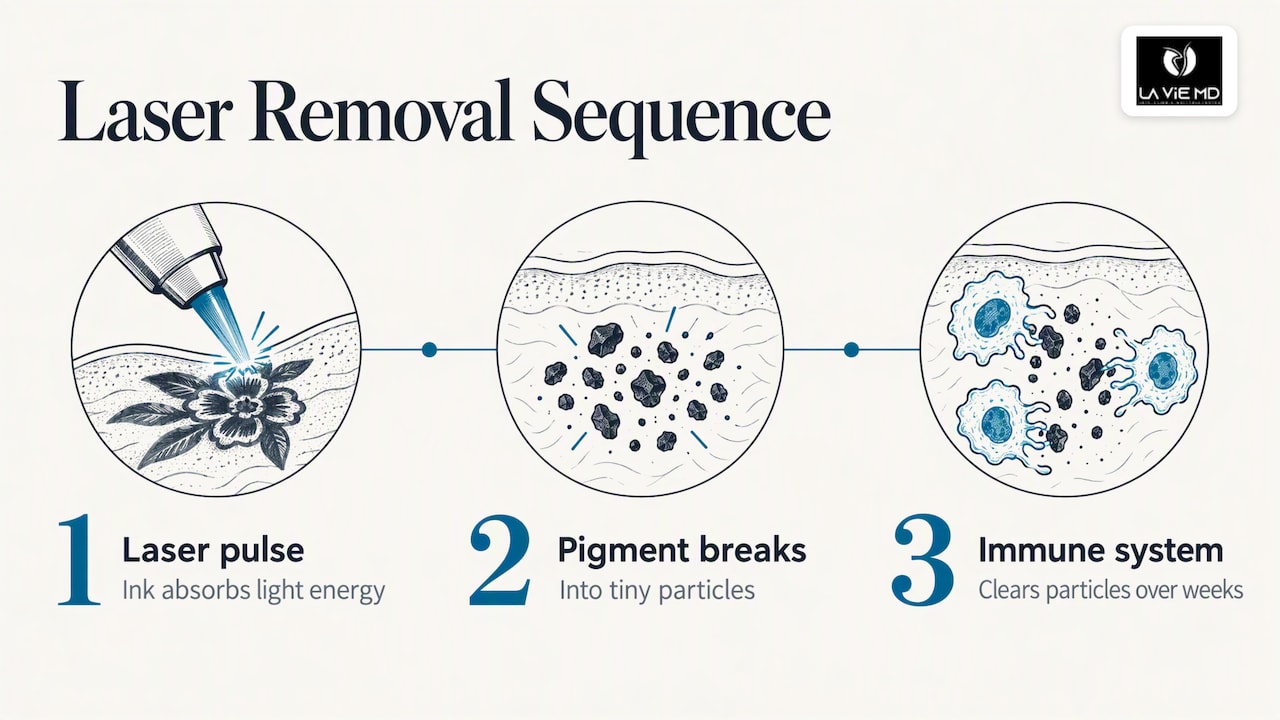
The laser and wavelength are chosen according to the ink colors. A single-color black tattoo can often be treated with one wavelength, while a multicolored piece may need more than one laser, the FDA notes. This is one practical reason to ask what devices a provider has before you commit.
If you are comparing options, the FDA also covers other removal methods such as surgical excision and dermabrasion. Lasers are the approach the American Academy of Dermatology describes in its guidance on tattoo removal as outperforming the alternatives, mainly because they target ink without cutting away skin.
How many sessions will you need?
This is the question almost everyone asks, and no honest provider can give an exact number from a photo alone.
Published figures vary:
- A peer-reviewed clinical update in PMC reports that an average of seven to 10 treatments is often needed, with sessions repeated about every eight weeks.
- The American Society of Plastic Surgeons says some tattoos may need one to 10 sessions, with about six weeks between them so the skin can heal and the body can clear ink.
- A 2026 systematic review of Nd:YAG lasers found that most included studies reached at least 75% clearance of black and blue pigment in four to eight sessions.
The spacing is not a suggestion. The AAD points out that ink is layered in the skin and that both healing and immune clearance take time, which is why rushing sessions does not speed things up and can raise the risk of skin damage.
What changes the number
The clinical update lists several factors clinicians use to estimate treatment needs:
| Factor | Why it matters |
|---|---|
| Skin phototype | Darker skin carries more pigment that competes for laser energy, so settings are adjusted with care |
| Location | Ink on areas farther from the heart, such as ankles and hands, is generally slower to clear than ink on the chest or upper back |
| Ink color | Black and dark blue respond best, others need specific wavelengths |
| Amount of ink | Dense, heavily saturated work holds more pigment to break up |
| Scarring or tissue change | Scar tissue can change how light is absorbed |
| Layering | Cover-ups and overlapping designs have ink at several depths |
The location point reflects general clinical understanding of circulation and immune clearance. Your provider should assess your own tattoo in person rather than quote a number from a photo.
Which tattoos clear best
Color is the biggest practical variable. According to the FDA, green, red and yellow are among the hardest colors to remove, while dark blue and black are generally easier. The 2026 review reached a similar conclusion: black and blue pigments cleared well, while professional tattoos and colored pigments showed less favorable or more variable results.
There is one more warning worth knowing before you book. The FDA cautions that flesh-colored and white inks, as well as permanent makeup, may oxidize and turn black when lasered. Once pigment has oxidized, it may no longer be treatable by laser. This matters for eyebrow, lip and eyeliner tattoos, and for any tattoo with white highlights. If that describes yours, ask for a test spot and an honest discussion first. We cover this in more detail in our guide to eyebrow tattoo removal.
Practically, that means:
- Small, black, older tattoos usually fade fastest.
- Heavy professional tattoos with several colors take longer and may leave a faint ghost image.
- Amateur tattoos often have less ink, though depth can be uneven.
- Permanent makeup and white ink need extra caution before any laser pulse.
Full removal is possible for many tattoos, but it is not guaranteed, and anyone promising a specific outcome should make you wary.
What a session feels like
A typical visit starts with a consultation: your tattoo is examined, your medical history and skin type reviewed, and a treatment plan outlined. Before the laser, the area is cleaned, and you and the provider wear protective eyewear. Then the provider passes the handpiece over the tattoo.
Most people describe the sensation as a quick snap or sting, like a rubber band flicking the skin, repeated across the tattoo. Cooling and topical numbing can make it more comfortable, and your provider should explain what is used. Sessions are brief. Practices commonly quote 15 to 30 minutes for typical tattoos, though large pieces take longer. Right after the pulses, the skin may look white or frosted for a short time, then turn red and swollen.
A small caveat: the frosting effect is common and is the visible sign of the laser interacting with the ink. It fades quickly. If you see anything unexpected, such as intense pain, bleeding or lasting blistering, call your provider.
Recovery and aftercare
The AAD says redness, swelling and some blistering can occur because the skin needs time to heal and the body needs time to clear the fragmented ink. Treat your skin gently during that window.
The AAD’s core advice is straightforward:
- Keep every scheduled appointment.
- Follow the at-home care instructions your provider gives you.
- Protect the treated skin from the sun for three months.
In practice, that usually means keeping the area clean, not picking at scabs or blisters, covering it as directed, and using broad-spectrum sunscreen once the skin has closed. Your own instructions may differ depending on the laser used and your skin, so follow those over any general list. For a related look at how treated skin should be handled after laser work, our guide to skin care after laser hair removal covers principles that overlap, such as sun protection and avoiding irritants, though tattoo aftercare is its own protocol.
Risks and side effects
Laser tattoo removal is a medical procedure, and it carries real, if usually manageable, risks.
The AAD reports that light or dark spots can occur and tend to fade within six to 12 months. It also says scarring, texture changes, burns and wounds are more common when treatment is performed by someone without medical training. Other possible effects include infection if blisters are picked open, and the ink-darkening reaction described above.
What that means for you:
- If you have a history of keloid or raised scarring, tell your provider before treatment.
- If you have darker skin, ask directly how settings are adjusted. Pigment changes are a known concern, and an experienced clinician should be able to explain their approach.
- If you are on medications that increase sun sensitivity, or you are pregnant, raise it at the consultation. A physician should decide whether and when to proceed.
- If a treated area looks infected (spreading redness, warmth, pus, fever), contact your physician promptly.
The consistent message from the AAD is that who performs the procedure matters. Insurance generally does not cover cosmetic removal, so you want to be sure the money goes toward a supervised, medically run treatment rather than a bargain that leaves a scar.
What does it cost?
Price is the other question people search for, and the honest answer is that it depends on the tattoo. Providers generally price by size, color and complexity, and some charge per session while others sell packages. Because most tattoos need multiple visits, the number to compare is the total plan, not the single-session figure.
We do not publish a flat price for tattoo removal, because a fair quote requires seeing the tattoo. At LA ViE MD the consultation is where we assess the size, colors and likely number of sessions, and then give you a plan you can actually budget for. When you compare quotes anywhere, ask:
- Is the price per session or for a package?
- What happens if you need more sessions than estimated?
- Which laser will be used, and who operates it?
- Is a physician involved in your care?
Our perspective
We see people for tattoo removal for many reasons: a design that no longer fits their life, a career change, a faded piece they want to cover, or a first tattoo done years ago in a hurry. What they all share is a worry that removal will scar them. Our view is that this worry is exactly the right one to bring to a consultation.
Laser removal is a medical treatment, not a beauty add-on. That is why we treat it as one: your skin type, your history and the specific ink in your tattoo shape the plan before any laser is switched on. We would rather tell you that your tattoo will take many sessions, or that a particular ink may be stubborn, than promise a quick result. Slow, spaced treatment with proper aftercare is what protects your skin.
We also encourage patience with the calendar. The body does the clearing, and the timing between sessions is part of the treatment. If you want a fuller picture of how our team approaches this, our page on laser tattoo removal in Danville explains the process, and our article on erasing a tattoo with laser goes deeper into the essentials. For a look at what a very large removal project involves, see our write-up on a celebrity tattoo removal.
— Dr N
How to choose a provider
The quality gap between providers is wide, so a short checklist helps.
- Medical oversight. Ask who supervises treatment and what their credentials are. At LA ViE MD, care is led by Dr. Neetu Nebhwani, a board-certified Internal Medicine physician.
- The right technology. Because ink colors respond to different wavelengths, ask what lasers are available and whether they can handle your colors.
- A real assessment. Be cautious about anyone who quotes a number of sessions without examining the tattoo.
- Clear aftercare. You should leave with written instructions and a way to reach someone if something looks wrong.
- Honest expectations. A good provider will discuss the chance of a faint shadow, pigment changes and ink that may not clear fully.
Those points apply wherever you live. If you are in Danville, Livermore, Dublin or Los Gatos, you can see our full range of laser procedures, including tattoo removal, and book a consultation to have your tattoo assessed.
Book a tattoo assessment
If you are weighing removal, the most useful next step is a consultation where a clinician looks at your tattoo, your skin and your goals, then maps out a plan with realistic timing. We offer tattoo removal alongside other laser and skin treatments, so if you also want to talk about pigment, texture or other concerns, we can address those in the same conversation.

Start on our laser procedures page to see what we offer and request a consultation.
FAQ
Does laser tattoo removal hurt?
Most people feel a quick, snapping sting as each pulse hits, and discomfort varies by location and tattoo size. Cooling and numbing options can help, so ask your provider what they use. The skin may feel like a sunburn afterward, with redness, swelling or some blistering, which the AAD describes as expected.
Can a tattoo be removed completely?
Many tattoos fade substantially, and some clear fully, but no provider can promise that. Black and dark blue ink tend to respond best, while green, red and yellow are harder, according to the FDA. A faint shadow or texture change can remain in some cases.
How long between laser tattoo removal sessions?
Sources give a range of about six to eight weeks. The ASPS suggests around six weeks, and the clinical update in PMC describes roughly every eight weeks. The gap lets your skin heal and your immune system clear the shattered ink, and your provider may adjust it to your skin.
How long should I protect the skin from the sun?
The AAD recommends protecting treated skin from the sun for three months. Sun exposure on healing skin raises the chance of uneven pigment, so use sunscreen and cover the area as your provider directs.
Is laser tattoo removal safe for darker skin?
It can be, but it requires more care, since pigment changes are a known risk and settings must be adjusted. The AAD notes that light or dark spots tend to fade within six to 12 months. Ask any provider how they treat your skin type, and tell us about it at your consultation.
Sources
- Tattoo Removal: Options and Results, FDA
- Laser Tattoo Removal: A Clinical Update, PMC
- Tattoo Removal, American Society of Plastic Surgeons
- Tattoo removal: Lasers outshine other methods, American Academy of Dermatology
- Efficacy of Nd:YAG Lasers for Tattoo Removal, Journal of Cosmetic Dermatology