
Facial Balancing: How to Create Harmony Without Overdoing It
Facial balancing is a way of treating the whole face as one design instead of fixing one feature at a time. A clinician looks at how your chin, cheeks, jawline, lips, brow and skin relate to each other, then uses a small number of well-placed treatments, usually injectables, to soften what stands out and support what is missing. The goal is better proportion and a more even look, not a different face.
This guide explains how it works, how clinicians decide what to treat, which options exist beyond filler, what it costs in the U.S., and what the risks are, so you can walk into a consultation knowing what to ask.
TL;DR
- Facial balancing improves proportion and can make the face look more symmetrical, but perfect symmetry is not the goal and not what a good plan aims for.
- A good plan starts with assessment of the whole face from several angles, not with a syringe and a target area.
- Treatments can include hyaluronic acid filler, neurotoxins and deoxycholic acid, with skin tightening and surgical options in some cases.
- The American Society of Plastic Surgeons reports an average of $715 for hyaluronic acid fillers, and your total depends on how much and where you are treated.
- Filler risks are real, and the most serious relate to blood vessels. Choose a provider who knows facial anatomy in depth.
Table of Contents
- What facial balancing actually means
- Can facial balancing improve facial symmetry?
- How a clinician assesses your face
- Treatments used in facial balancing
- Who is a good candidate
- What to expect at the consultation and treatment
- How long results last
- What facial balancing costs in the U.S.
- Risks, and how to lower them
- Our perspective
- Facial balancing at LA ViE MD
- FAQ
- Sources
What facial balancing actually means
The American Society of Plastic Surgeons describes facial balancing as giving the face better proportions by subtly enhancing or softening features, with attention to how features relate to one another rather than a chase for perfection. That last part matters. A small chin is only a small chin next to a prominent nose or a wide midface. A flat cheek looks flatter next to a strong jaw.
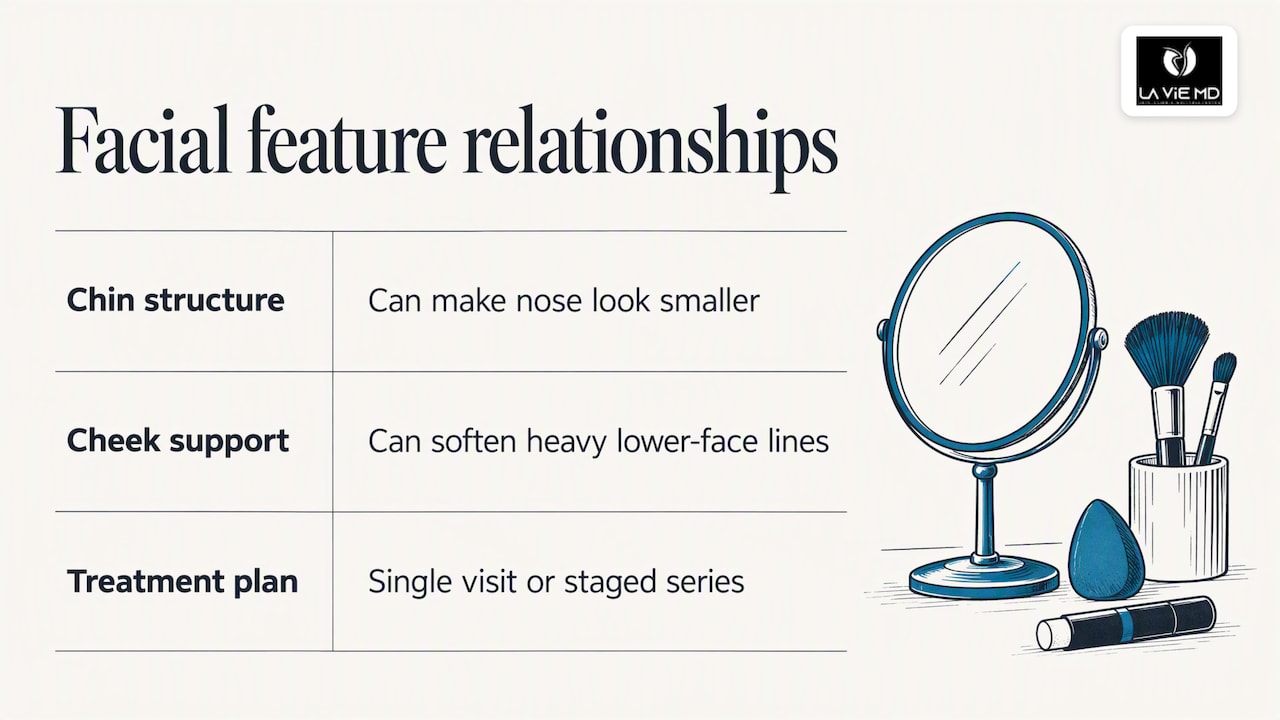
So instead of asking “what do I want to change?”, a balancing approach asks “what is the relationship between these features, and which one adjustment would improve several of them at once?” Sometimes the answer is surprising. Adding structure to the chin can make a nose look smaller. Supporting the cheeks can soften the look of heavy lower-face lines without treating the lines at all.
This is also why facial balancing is not a single procedure. It is a plan, and the plan can be a single visit or a staged series over months.
Can facial balancing improve facial symmetry?
Yes, to a degree. If one cheek is flatter, one side of the jaw is less defined or the lips are uneven, careful placement of product can reduce the visible difference. Many people searching for ways to improve facial symmetry are noticing exactly this: a difference that is more obvious in photos or in a certain light.
Two honest caveats:
- Nobody has a perfectly symmetrical face. Mild asymmetry is normal. Complete symmetry can look robotic, and facial balancing is typically used to create subtle results instead.
- Not all asymmetry is a volume problem. Differences in bone structure, teeth, muscle activity or skin laxity respond to different tools. A clinician who only reaches for filler may miss the real cause.
A realistic target is “less noticeable and more harmonious”, not “mirror image”.
How a clinician assesses your face
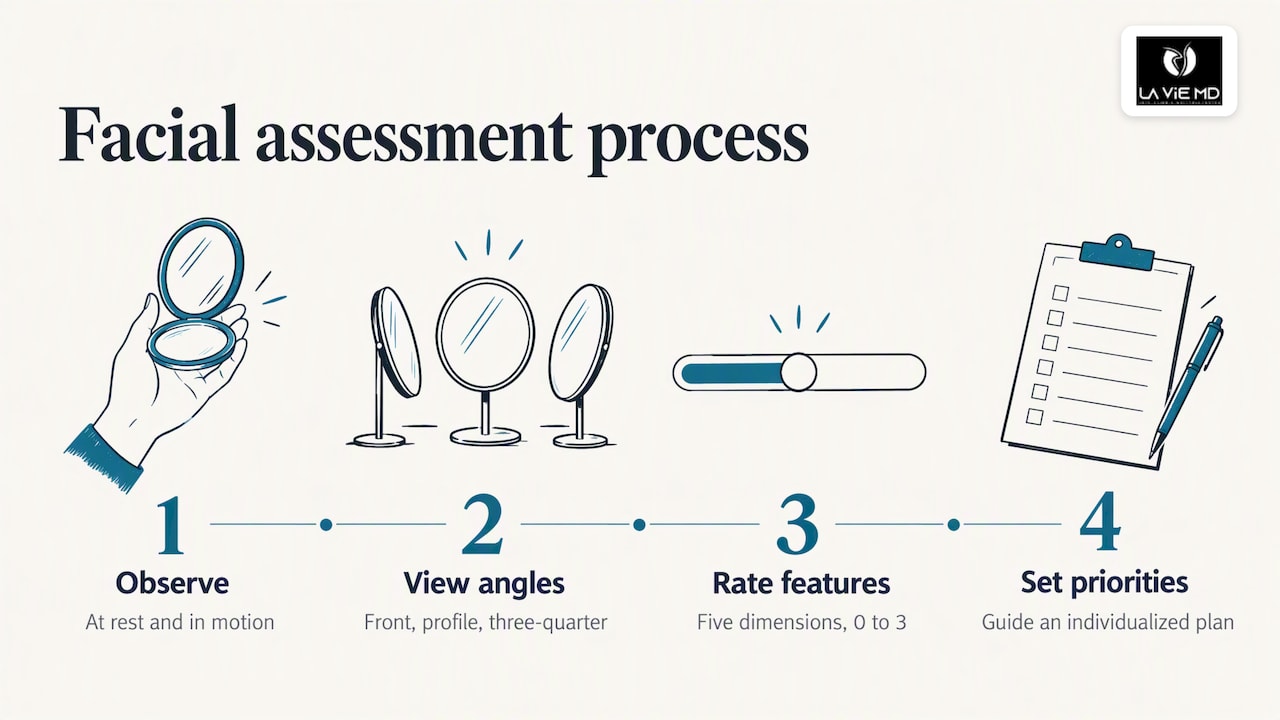
The best consultations are slow. Before anyone discusses product, a trained provider should look at your face at rest and in motion, from the front, in profile and at a three-quarter angle.
Structured assessment tools exist for this. One example in the dermatologic literature is the Galderma Facial Assessment Scale (FAS), which rates skin quality, shape, proportions, symmetry and expression on a 0 to 3 scale to identify concerns and guide an individualized plan. The same source notes that assessment includes frontal, profile and three-quarter views. You do not need to know the scale by name, but the principle is useful: each dimension of the face is looked at on its own, then the priorities are set.
Researchers writing in a 2024 paper on facial contours and volume also point out that a panfacial approach helps prevent overtreatment of isolated areas, so that enhancements in the cheeks or chin fit with the rest of the face. That is the practical heart of facial balancing: you stop one area from drifting out of proportion with the others.
What a good assessment covers
- Skin quality: texture, thickness, laxity, pigmentation. Skin that has lost firmness changes how volume sits on top of it.
- Shape and proportion: the relationship between forehead, midface, jaw and chin.
- Symmetry: which differences are visible and which only show in photos.
- Expression: how your face looks when you smile, talk and frown, since muscles pull on everything around them.
Treatments used in facial balancing
The 2024 review lists the main tools: hyaluronic acid fillers, neurotoxins, deoxycholic acid, and surgical cheek and chin procedures such as implants. Fillers may be combined with neurotoxins or deoxycholic acid in a multimodal plan. Here is what each does in practice.
Hyaluronic acid filler
Filler is the backbone of most balancing plans. It can add projection to a recessed chin, restore support to flattened cheeks, define a soft jawline or refine lips. Results are visible quickly and, because hyaluronic acid fillers can be adjusted, they allow a gradual approach. If you want to understand the product category first, our guides to dermal filler benefits and lasting results and filler options at our practice are a good place to start. Under-eye hollows are a specialty area of their own, covered in our page on undereye filler.
Neurotoxins
Neurotoxins relax specific muscles. In balancing, they are frequently combined with fillers to slim the masseter muscle or correct chin dimpling. They can also soften a brow that pulls unevenly or a downturned mouth corner. If you are weighing the different brands, see our comparison of Botox, Dysport, Xeomin and Daxxify, or read about wrinkle treatment more broadly.
Deoxycholic acid
Deoxycholic acid breaks down small pockets of fat under the chin. Where a heavy submental area hides the jawline, reducing it can do more for proportion than adding filler to the jaw. We offer Kybella for this purpose.
Biostimulators and skin tightening
Balance is not only about adding volume. Dr. Naghshineh of the ASPS notes that addressing skin laxity and using tools like skin tightening can reset the foundation for more natural results. In some faces, loose skin is the reason features look uneven, and filler alone would only add weight to a tired structure. Collagen-stimulating options such as Sculptra, radiofrequency microneedling such as Morpheus8 and Forma can play a supporting role. Our page on Sculptra and fillers explains how to tell which one suits which concern.
Surgical and other options
The same ASPS article notes that plans may include Renuva, a product that mimics natural fat, or surgical options such as implants and facelifts. These are outside what a medical spa performs, and an honest consultation should tell you when your goals are better served by a surgeon.
Skin health as the foundation
Balanced structure looks best on healthy skin. Regular facials, peels and a good home routine matter, and so does what you put on your face every day. If you are curious about gentler complements, read about antioxidant facial treatments that support skin quality between in-clinic visits.
Who is a good candidate
According to ASPS guidance on dermal fillers, a suitable candidate is physically healthy, does not smoke, and has a positive outlook with specific, realistic goals. Good candidates for balancing tend to share a few traits:
- They like their face overall but notice a feature that seems out of step with the rest.
- They are noticing early volume loss or softening and want a conservative refresh.
- They want gradual change and are comfortable with a staged plan.
It is a poor fit if you want to look like someone else, if you expect one treatment to correct a structural issue that needs surgery, or if you are pregnant or have conditions your provider needs to review first.
What to expect at the consultation and treatment
The same ASPS source says a consultation may cover health history, desires and lifestyle, and may include examining and measuring the face, discussing options and reviewing likely outcomes and risks. Bring this information:
- Your health conditions, allergies and current medications
- Any prior filler or facial procedures, including where and when
- Photos of yourself that you like, and of the feature that bothers you
- Your priorities, in your own words
Treatment itself is usually a series of small, precise injections, and many plans are staged: a first session addresses the structural priority, then a follow-up lets your provider refine. A staged approach is a feature, not a delay. Filler settles, swelling resolves and the face looks different once it does. Ask your provider for specific aftercare instructions, and ask what you should do if something feels wrong in the days after.
How long results last
Duration depends on the product, the area and your own metabolism. The studies cited in the 2024 review report hyaluronic acid filler benefits at 1 year in the chin and beyond 18 months in the chin and jaw. Areas with more movement, like the lips, typically need maintenance sooner. Neurotoxin effects wear off on a shorter cycle, so your plan should include a maintenance schedule you can sustain.
What facial balancing costs in the U.S.
There is no single price, because there is no single treatment. The ASPS reports an average of $715 for hyaluronic acid fillers and $901 for non-hyaluronic acid fillers, and notes that costs vary with provider expertise and qualifications, procedure type, time and effort, and office location. Those figures are per treatment, so a plan that addresses chin, cheeks and jaw can add up.
What drives your total:
- How many areas you treat, and how much product each needs
- Whether you combine tools, such as neurotoxin or skin tightening
- How many sessions your plan spreads across
- Who is injecting. Experience with facial anatomy is the one place not to economize
We do not publish set prices for facial balancing because every plan is custom. After your consultation you will have a clear quote for the plan before you decide anything.
Risks, and how to lower them
Facial balancing is a medical procedure, and the risks are worth knowing before you book.
The most serious complication is filler entering or blocking a blood vessel. The FDA’s briefing materials state that nearly every facial anatomic location carries a risk of blindness, and that frequently reported sites of vision complications include the glabella (between the brows), the nasal region, the forehead and the nasolabial folds. The FDA stresses that visual impairment and stroke are the most severe and irreversible risks, which is why a provider’s knowledge of vascular anatomy matters so much.
What that means for you:
- Ask who will inject and what their training is. A physician-led practice with detailed anatomical knowledge is a safer starting point.
- Ask how they handle complications. A good provider can describe the warning signs and their emergency plan without hesitating.
- Know the urgent signs. Sudden vision changes, severe pain, or skin that turns white, gray or dusky after an injection need immediate medical attention. Call your provider and go to emergency care right away.
- Be careful with higher-risk zones. Be wary of anyone who treats the nose, glabella or forehead casually.
More common issues are bruising, swelling, lumps and asymmetry while product settles. Over time, poorly placed or excessive filler can shift or look puffy. Our guide to filler migration and how to prevent it covers what causes it and what a careful technique looks like.
Our perspective
We see facial balancing as a subtraction exercise as often as an addition one. Most people who come in asking for a feature to be “fixed” are better served when we step back and look at the whole face, including their skin. Often the most flattering change is not the one they first asked about.
A few principles guide how we plan:
- Skin comes first. Volume placed on poor-quality or lax skin rarely looks as good as volume placed on skin that has been treated, which is why we consider skin tightening, microneedling and medical-grade facials alongside injectables.
- Less, then reassess. A conservative first session leaves room to refine. It is much easier to add than to take away.
- Your face, not a formula. Ideal ratios are a reference, not a target. We would rather keep what makes you look like you.
- Physician oversight matters. Dr. Neetu Nebhwani is a board-certified Internal Medicine physician with over ten years of experience, and every treatment plan is medically supervised and based on your concerns and goals.
If we think a different approach, or a surgeon, would serve you better, we will tell you.
— Neesh
Facial balancing at LA ViE MD
We are a boutique medical spa serving Danville, Livermore, Dublin and Los Gatos. Facial balancing plans start with a physician consultation where we assess your face, your skin and your goals, then build a custom plan from the tools above: fillers, neurotoxins, Kybella, Sculptra, and skin-tightening treatments.

Ready to talk through your options? See our injectables and filler services or visit our home page to book a consultation at the location nearest you. If you are in the area, we also have local pages for dermal fillers in Danville.
FAQ
How much does facial balancing cost?
The ASPS reports average costs of $715 for hyaluronic acid fillers and $901 for non-hyaluronic acid fillers per treatment. Your total depends on the number of areas, the amount of product, any added treatments like neurotoxin and your provider’s experience. A consultation is the way to get a quote for your own plan.
Will facial asymmetry go away?
Mild asymmetry is normal and does not fully go away, but treatment can make it much less noticeable. Filler can even out volume differences, and neurotoxin can balance muscle pull. Differences caused by bone structure or dental alignment may need other specialists.
What is the riskiest place for fillers?
According to FDA briefing materials, nearly every facial area carries some risk of vision complications, and frequently reported sites include the glabella, nose, forehead and nasolabial folds. This is why you should choose a provider with deep knowledge of vascular anatomy. Seek emergency care immediately if you notice vision changes after an injection.
What is the most effective type of facial treatment?
There is no single best one, because the right treatment depends on what is causing your concern. Volume loss responds to filler or biostimulators, muscle-driven lines to neurotoxin, and loose skin to tightening treatments. Facial balancing is effective precisely because it matches the tool to the cause.
Sources
- What you need to know about facial balancing procedures, American Society of Plastic Surgeons
- Facial Balancing Is a Holistic Approach to Filler, Marie Claire
- Putting it all Together: Assessing the Whole Face, Dermatologic Surgery
- A Unified Approach to Facial Contours and Volume, PMC
- Dermal Fillers guide, American Society of Plastic Surgeons (PDF)
- Dermal Fillers Cost, American Society of Plastic Surgeons
- FDA Executive Summary, General Issues Panel Meeting on dermal fillers