Under Eye Wrinkles Treatment: What Works and What to Expect
The skin under your eyes can be softened, but not erased for good, and the right treatment depends on what kind of line you have. Fine lines respond to daily sun protection and a retinoid. Squint lines respond to Botox. Hollows respond to filler. Crepey texture and deeper static lines respond to collagen-building treatments such as microneedling, radiofrequency and laser. At LA ViE MD, Dr. Neetu Nebhwani, a board-certified Internal Medicine physician, builds a custom plan from that diagnosis for patients in Danville, Livermore, Dublin and Los Gatos.
TL;DR
- Under eye wrinkles are mostly normal aging plus sun exposure. The realistic goal is to soften them and slow new ones, not to remove them permanently.
- Daily SPF 30 or higher, sunglasses and a retinoid are the foundation. Retinoids take months to show their full effect.
- Botox smooths lines caused by muscle movement. Filler restores volume in hollows. Microneedling, radiofrequency and lasers rebuild texture.
- The skin around the eye is thin and close to delicate structures, so injections and lasers belong in the hands of a physician-supervised clinic.
- A consultation sorts out which lines are movement, volume or texture, so you pay for the treatment that fits.
Table of Contents
- Why wrinkles form under the eyes
- Which kind of under eye line do you have?
- Daily habits that protect the skin under your eyes
- At-home treatments: what the evidence supports
- Professional under eye wrinkles treatment options
- Which treatment fits which goal?
- Safety around the eyes
- Our perspective
- Plan your under eye treatment at LA ViE MD
- What a consultation looks like
- FAQ
- Sources
Why wrinkles form under the eyes
Lower eyelid skin is among the thinnest on the body. A 2024 PubMed review of infraorbital wrinkles and pigmentation describes it as thin, sun-exposed and structurally distinct from the skin on the rest of the face. The same review names the usual causes: genetics, aging, sun exposure, lack of sleep and stress.
In practice, three things happen at once:
- The skin thins and loses collagen. It crinkles when you smile or squint, then stays creased.
- Volume shifts. Hollows and shadows near the tear trough make the skin above and below look more lined.
- The muscle around the eye keeps working. Every squint and smile folds the same skin thousands of times a day.
That is why one cream rarely fixes everything. Different causes need different tools.
Which kind of under eye line do you have?
You can make a rough guess in a mirror. A physician will confirm it at an exam.
| What you see | Likely cause | Treatment direction |
|---|---|---|
| Fine, shallow lines that show when skin is dry | Dehydration, early sun damage | Daily SPF, moisturizer, retinoid |
| Lines fanning from the outer corner that deepen when you smile | Muscle movement (dynamic lines) | Botox |
| Lines that stay when your face is relaxed | Static wrinkles, collagen loss | Microneedling, radiofrequency, laser, sometimes filler |
| Hollow, shadowed groove under the lid | Volume loss at the tear trough | Hyaluronic acid filler |
| Thin, crinkled, “crepey” skin | Thinning and lost elasticity | Collagen-stimulating treatments plus skincare |
| Bulging pockets under the eye | Fat prolapse and weak support | Needs a physician evaluation; surgery is the reference treatment for substantial cases |
Most people have a mix of two or three. That is normal, and it is the reason a custom plan beats a single product.
Daily habits that protect the skin under your eyes
No treatment lasts if sun damage keeps stacking on top of it. The American Academy of Dermatology’s guidance on reducing premature skin aging recommends:
- Broad-spectrum, water-resistant sunscreen of SPF 30 or higher on all uncovered skin every day.
- Shade, protective clothing, a wide-brimmed hat and sunglasses with UV protection.
- No tanning and no smoking.
- A balanced diet and a daily facial moisturizer.
- Awareness of repetitive facial expressions, which is where Botox comes in.
In the Tri-Valley and South Bay, where sunny days run most of the year, the sunglasses and the daily SPF do more for your eyes than any serum.
At-home treatments: what the evidence supports
Over-the-counter eye creams are worth using as a base, but set your expectations by the research.
Retinoids are the best-studied option. A 2012 randomized, double-blind trial in the Journal of Drugs in Dermatology followed 34 people for three months. Both a non-prescription retinol cream and prescription tretinoin 0.025% significantly improved fine and coarse wrinkles around the eyes, with no significant difference in efficacy between them. The authors explain that tretinoin works by blocking enzymes that break down collagen and by stimulating new collagen and fibrillin.
Other ingredients help at the margins. A 2026 review of dermocosmetics for periocular aging found that retinoids, peptides and antioxidants can improve hydration, firmness and pigment evenness, though the studies are mostly short-term.
How to use a retinoid around the eyes:
- Start two to three nights a week and build up as your skin tolerates it.
- Keep it off the lash line and the lid margin.
- Pair it with daily sunscreen, since retinoids make skin more sun-sensitive.
- Give it months. Improvements in studies of prescription tretinoin were measured at 16 to 48 weeks.
- Do not use retinoids if you are pregnant or breastfeeding. Ask your physician first if you could become pregnant or are unsure.
Eyelid skin also reacts easily. The same 2026 review notes it is prone to irritant and allergic contact dermatitis, so introduce one new product at a time. If you get redness, burning or swelling, stop and tell us.
A prescription-strength option is part of what a physician visit adds. Starting on a plan you have chosen yourself can mean wasted months on a product that is too weak or too irritating for this area.
Professional under eye wrinkles treatment options
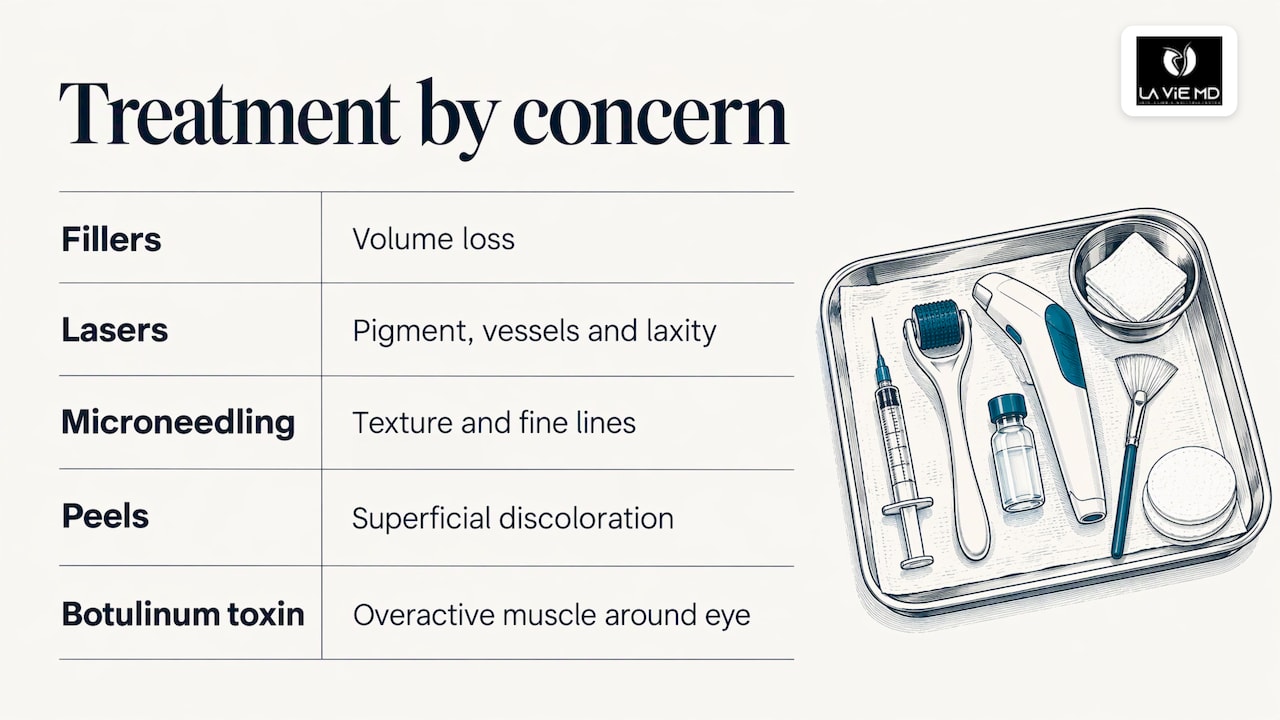
When lines are set in, or when you want faster change, professional treatments address what creams cannot reach. A 2026 multispecialty systematic review matched each tool to a problem: fillers for volume loss, lasers for pigment, vessels and laxity, microneedling for texture and fine lines, peels for superficial discoloration, and botulinum toxin for overactive muscle around the eye.
Botox for squint lines
Botulinum toxin type A softens dynamic lines by reducing the nerve signal that tells a muscle to contract. A review of periocular rejuvenation notes that side effects such as bruising, temporary eyelid droop, double vision or dry eye are uncommon with proper technique. That phrase “proper technique” is the point: placement and dose around the eye are a matter of anatomy and judgment.
Botox is on our injectables menu, and our wrinkle treatment page explains how we approach it. Patients near us can also see local pages for Botox in Dublin, Livermore and Los Gatos.
Filler for hollows and shadows
If the groove under your eye makes the skin look creased and tired, the problem is volume, not just surface lines. Ophthalmologists Lee and Levitt, in a paper on periocular neurotoxin and filler, name hyaluronic acid as their filler of choice around the eyes because it is well tolerated and can be dissolved with an enzyme called hyaluronidase if there is a contour problem or a blocked vessel. They also list the rare risks: lumps, a bluish tint under thin skin, and, very rarely, tissue damage or vision loss from vascular occlusion.
Those risks are the reason the injector matters more than the syringe. Our undereye filler page and our guide to under eye hollows treatment describe the approach, and our dermal fillers page lists the products we use.
Collagen stimulators
Treatments such as Sculptra, which we offer, aim to build gradual tissue remodeling. The 2026 periocular review says small early studies report improvement, but they do not yet settle the best protocol or long-term performance. That makes them a good topic for a physician conversation about whether they suit your area, rather than a default choice.
Microneedling and radiofrequency for texture
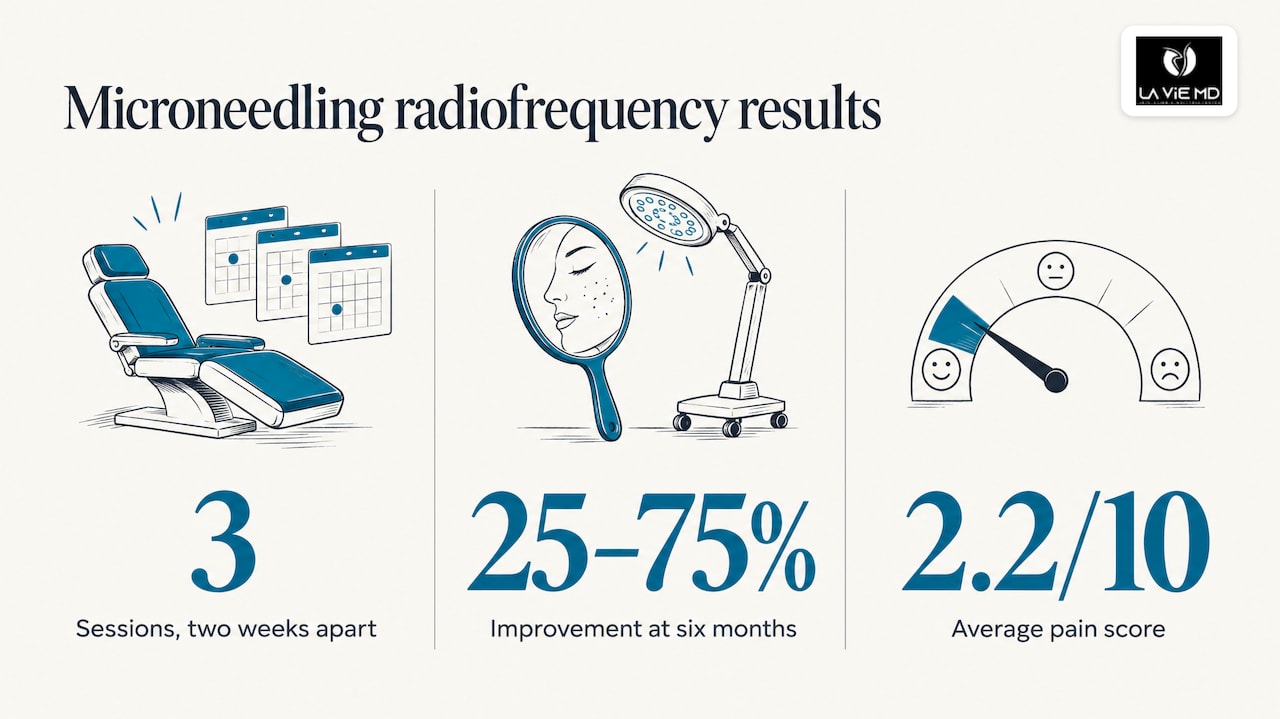
For lines that stay when your face is relaxed, collagen-building treatments are the logical next step. In a 2022 randomized split-face trial, microneedle radiofrequency over three sessions two weeks apart was safe and effective for wrinkles around the eyes. Most participants reported 25 to 75 percent improvement at six months, average pain was 2.2 out of 10, and there were no serious adverse events.
We offer microneedling, exosome microneedling, microneedling with PRP and Morpheus8 radiofrequency microneedling. If you are comparing the first two, our article on microneedling versus microneedling with PRP explains the difference, and our aftercare guide covers the days after a session. Whether a given device suits the thin skin around your eyes is something Dr. Nebhwani decides at your consultation.
Laser resurfacing and pigment lasers
Fractional CO2 laser resurfaces skin to smooth texture and fine lines. In a 2023 trial of 26 patients that combined fractional CO2 laser with collagen applied through the laser channels, lower eyelid wrinkles dropped 47.3 percent at three months. About a quarter of patients had redness for two weeks, and a few had mild darkening that lasted around three months. If your under eye area is shadowed by pigment rather than volume, a pigment laser may matter more than a wrinkle treatment. We offer the Tetra CoolPeel CO2 laser and PicoWay for pigmentation, listed on our laser procedures page.
Which treatment fits which goal?
| Goal | Treatment we would discuss | What to expect |
|---|---|---|
| Soften crow’s feet when you smile | Botox | Gradual softening of movement lines, repeated on a schedule your provider sets |
| Fill a tear-trough hollow | Hyaluronic acid filler | Immediate volume change that can be adjusted or dissolved |
| Improve crepey texture | Microneedling, radiofrequency | A series of sessions, with results building over months |
| Smooth deeper static lines | Laser resurfacing, radiofrequency | Downtime varies by device and depth |
| Even tone and fade pigment | PicoWay, peels, medical-grade skincare | Several visits, with daily SPF throughout |
Many patients combine two: Botox for movement plus a texture treatment for what is already etched in. That layered approach is what “custom” means in practice.
Safety around the eyes
This is where choosing a physician-led clinic matters. The periocular review states that laser and light procedures need wavelength-appropriate eye protection, and that injections near the eye call for explicit consent about rare visual and neurological complications.
Before any treatment, tell your provider about:
- Pregnancy or breastfeeding, which affects retinoids and many procedures.
- Prior eye surgery, dry eye, or vision problems.
- Blood thinners, supplements that increase bruising, or a history of cold sores near the treatment area.
- Any product you are already using, especially retinoids and acids.
Seek urgent medical care at once if you notice vision changes, severe pain or a spreading pale or dusky patch of skin after an injection near the eye, and tell the clinic that treated you.
Our perspective
Patients often come in asking for one thing, such as a filler or a cream, when their under eye area is actually a mix of volume loss, muscle movement and thin skin. The most useful thing we do is separate those causes before treating anything.
The skin here is unforgiving. A few units of Botox too many, or filler placed too superficially, shows. That is why we believe injections and energy-based devices around the eyes belong with physician supervision and a plan built for your face, not a package.
We also tell patients plainly that the goal is softer, fresher and slower to age, not frozen or erased. A good result looks like you on a well-rested day. Sun protection and a sensible home routine make every in-office treatment last better, so we build them into the plan.
Dr N
Plan your under eye treatment at LA ViE MD
LA ViE MD is a boutique medical spa serving the Bay Area. Dr. Nebhwani is a board-certified Internal Medicine physician with more than ten years of experience, and every plan is individualized to your skin concerns and goals. We offer Botox, dermal fillers, Sculptra, microneedling, Morpheus8, laser treatments and medical-grade skincare in one place, so your plan does not have to be limited to a single tool.

To see which approach fits your under eye area, start with our injectables and skin rejuvenation pages, or book a consultation through LA ViE MD.
What a consultation looks like
Bring a few things to get the most from a visit:
- Photos of your face in different light. Overhead light exaggerates shadows, and natural window light shows the true contour.
- Your current products. Name and strength of any retinoid, acid or prescription cream.
- Your timeline. An event in a few weeks changes the plan compared with a gradual approach.
- Your comfort level. Tell us whether you want subtle change or a more noticeable one.
Expect your provider to examine the area while you smile, squint and relax, because that shows which lines are movement and which are static. You should leave with a clear sequence: what to do first, what to add later and what to keep doing at home.
FAQ
Can under eye wrinkles be removed permanently?
Not permanently. Lines are part of normal aging, and the skin keeps aging after treatment. What you can do is soften existing lines and slow new ones with sun protection, a retinoid and in-office treatments, repeated as needed.
What is the fastest way to reduce wrinkles under the eyes?
It depends on the cause. Botox shows its effect on movement lines over days, and filler changes a hollow right away. Retinoids and collagen-building treatments take months to build. A consultation tells you which one applies to you.
Can you rebuild collagen under your eyes?
Yes, to a degree. Retinoids stimulate new collagen, and microneedling, radiofrequency, lasers and collagen-stimulating injectables are designed to encourage it. Results build gradually, and early studies in the eye area are small, so your plan should be paced and monitored by a physician.
Is filler safe under the eyes?
Hyaluronic acid filler is the type ophthalmologists favor around the eyes because it can be dissolved if there is a problem. Serious complications are rare but real, which is why technique and anatomy knowledge matter. Choose a physician-supervised provider and go over the risks at your consultation.
Do eye creams work for wrinkles?
Some do. Retinoids have the strongest evidence, and peptides and antioxidants show benefit in short studies. Use them with daily SPF and give them several months before judging.
Sources
- Clinical Assessment, Diagnosis, and Management of Infraorbital Wrinkles and Pigmentation (PubMed, 2024)
- 11 ways to reduce premature skin aging (American Academy of Dermatology)
- Randomized, double-blind comparison of non-prescription tri-retinol cream and tretinoin (J Drugs Dermatol, 2012)
- Dermocosmetics for Periocular Aging (PMC, 2026)
- What’s New With Under Eye Treatment: A Multispecialty Systematic Review (PubMed, 2026)
- Periocular rejuvenation: current concepts (PMC, 2026)
- Periocular rejuvenation with neurotoxin and dermal filler (OAE Publish, 2018)
- Noninsulated microneedle radiofrequency for periorbital wrinkles (PMC, 2022)
- Fractional CO2 laser with recombinant human collagen for periocular aging (PubMed, 2023)