
Med Spa in the Bay Area: How to Choose One You Can Trust
The best med spa in the Bay Area is a medical practice first and a spa second: physician-owned, staffed by licensed providers, and built around a consultation that ends in a plan made for your skin and your goals. In California that is not a luxury. It is how the law defines a med spa. At LA ViE MD, Dr. Neetu Nebhwani, a board-certified Internal Medicine physician with more than ten years of experience, supervises every treatment and builds custom plans for clients in Danville, Livermore, Dublin and Los Gatos.
This guide explains what a med spa really is, what California requires, which treatments you will see on a menu, how to size up any provider in one visit, and what to expect on cost, recovery and maintenance.
TL;DR
- “Medical spa” is a marketing term. In California, injections, lasers and medical-level peels are the practice of medicine, and the Medical Board of California says spas offering them must be physician-owned.
- Ask who performs your treatment, who supervises, and whether you will have a real consultation with a licensed provider before anything is done.
- Botox-type results take about two weeks to develop and last three to four months, so plan for maintenance, not a one-time fix.
- A price far below the going rate is a warning sign, not a bargain.
- LA ViE MD offers physician-supervised injectables, lasers, skin tightening, facials and GLP-1 weight management, each planned around your concerns.
Table of Contents
- What a med spa is, and how it differs from a day spa
- What California law requires
- What Bay Area med spas offer
- How to vet any Bay Area med spa in one visit
- What to expect on cost, results and maintenance
- Choosing by location
- Where LA ViE MD fits
- Our perspective
- FAQ
- Sources
What a med spa is, and how it differs from a day spa
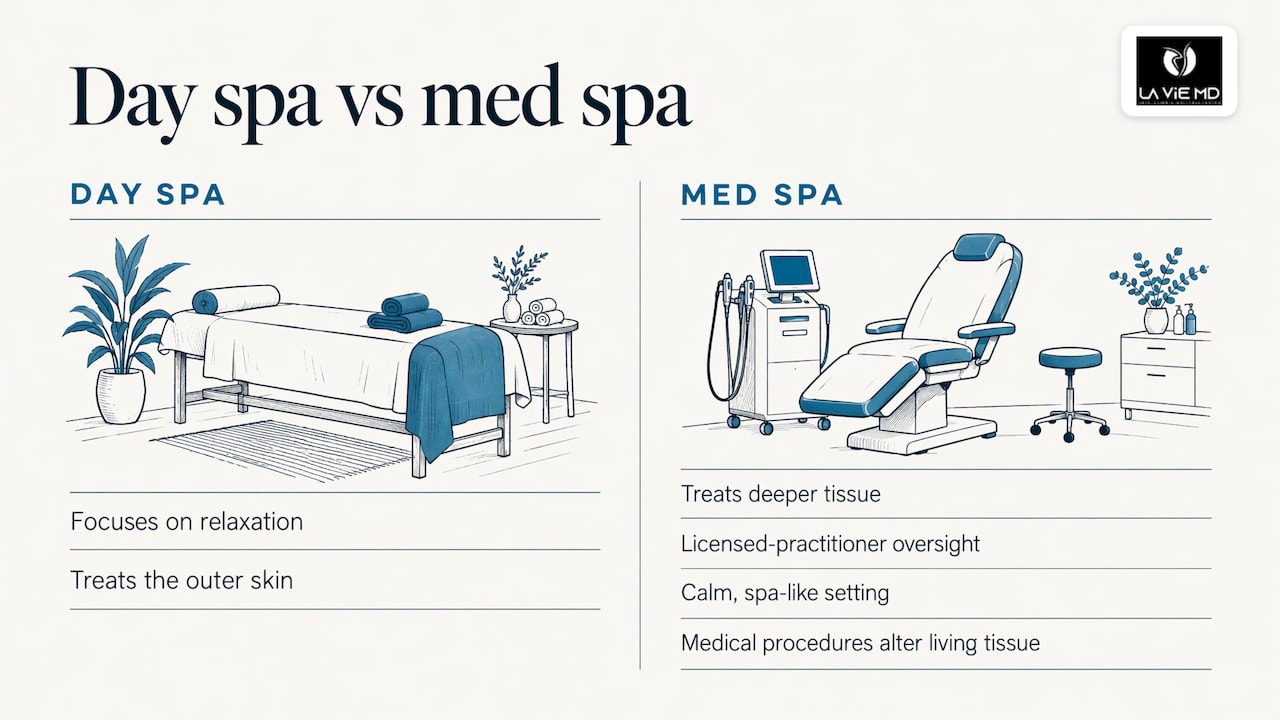
The American Med Spa Association’s patient guide describes a medical spa as a blend of an aesthetic medical center and a day spa: non-invasive or minimally invasive aesthetic treatments, delivered under licensed-practitioner oversight, in a calm, spa-like setting. A day spa works on relaxation and the outer layer of the skin. A medical spa treats deeper tissue.
That difference matters because of what the treatments do. The American Society of Plastic Surgeons notes that cosmetic medical procedures stimulate, alter or destroy living tissue, which is why they take real training and a plan for handling complications. Cosmetic injections, fillers and laser skin procedures are legally classified as the practice of medicine.
A 2026 peer-reviewed article in Aesthetic Surgery Journal adds a point every shopper should hear: the label “med spa” does not by itself imply regulatory monitoring. The name tells you nothing about who is holding the device or the syringe. The people behind the name do.
What California law requires
The Medical Board of California is direct about this. On its medical spa page, it states that:
- “Medical spa” is a marketing term for the practice of medicine.
- A medical spa offering medical procedures must be owned by physicians.
- Injections, lasers and medical-level dermabrasion or peels must be performed by a physician, or by a registered nurse or physician assistant working under a physician’s supervision.
- Cosmetologists may only perform superficial treatments such as facials and microdermabrasion.
The Board’s Bottom Line document on medical spas goes further: lasers, other prescriptive devices and prescription drugs may be used only by licensed physicians, nurse practitioners or physician assistants. Unlicensed staff, including medical assistants, may not use them.
For you as a patient, that turns into three plain questions you can ask at any front desk:
- Who owns the practice, and is a physician involved?
- What is the license of the person who will treat me today?
- Who is the supervising physician, and how quickly can they be reached if something goes wrong?
At LA ViE MD, care is medically supervised by Dr. Nebhwani, so those answers are on the table from your first conversation.
What Bay Area med spas offer
The ASPS says most med spas focus on anti-aging and skin rejuvenation, such as injectables, chemical peels and lasers, while some add body contouring, hormone therapy, weight loss, IV therapy or sexual wellness. A Bay Area menu usually falls into a few groups. Here is how ours maps onto them.
Injectables
Neuromodulators such as Botox, Dysport and Daxxify soften lines caused by muscle movement. Dermal fillers restore volume. Sculptra, Kybella and non-surgical rhinoplasty sit in the same family. You can see what we offer on our injectables page, and each has its own page, such as Sculptra injections for facial volume and dermal fillers.
Skin rejuvenation and tightening
HydraFacial, microneedling, Xerf, Morpheus8 and Forma address texture, tone, pores and laxity. Radiofrequency and ultrasound devices are the usual route to non-surgical tightening. The skin rejuvenation page covers the full set, and Morpheus8 has dedicated pages for Livermore and Los Gatos.
Lasers
Laser hair removal, tattoo removal, the Tetra CoolPeel CO2 laser and PicoWay for melasma and pigmentation make up our laser procedures. Acne is a common reason people book a laser consult, and we explain our approach on the acne laser treatment page.
Weight management and wellness
GLP-1 therapy with semaglutide, IV therapy, hormone replacement and vitamin B12 shots are listed on our services page. Because these involve prescription medicine, they begin with a physician consultation, which is exactly how the rules above intend it.
Hair and esthetician services
PRP hair restoration is on its own page, and the HydraFacial Keravive is part of our esthetician services.
How to vet any Bay Area med spa in one visit
Most people choose a med spa from a star rating and a photo gallery. Ratings help, but they cannot tell you who is licensed to do what. Use this checklist, built from guidance by the Medical Board of California, the ASPS and the American Academy of Dermatology.
1. Confirm credentials
The Medical Board advises you to know who will perform the procedure and to check their license, whether physician, registered nurse or physician assistant, and to confirm the supervising physician is immediately reachable. Physician and board-certification status can be verified through the Board’s public lookup. Dr. Nebhwani is board certified in Internal Medicine, and she supervises care at LA ViE MD.
2. Expect a real consultation
The ASPS says a quality med spa should offer a thorough consultation covering your medical history and goals, a personalized treatment plan, and an open discussion of risks, expected results and costs. You should also be asked to sign an informed consent form before any procedure. In most states, the AMSA patient guide adds, patients must have an initial face-to-face consultation with a doctor, nurse practitioner or physician assistant before treatment.
This is where individualized care shows itself. Our approach is to build a custom plan around your specific skin concerns and aesthetic goals, rather than hand you a standard package. Come with your priorities in order, such as pigmentation first, lines second, or volume around the midface, so the plan can be sequenced.
Bring your full medication and supplement list too. If your plan touches on supportive options, ask what is being used and at what dose; an overview of photobiomodulation benefits and dosage shows the kind of detail worth asking about.
3. Ask the risk and recovery questions
The American Academy of Dermatology suggests asking what a procedure will cost, whether insurance covers any part, how long recovery takes, and what to expect before and after. Add one more: what happens if you have a complication, and who do you call after hours?
4. Keep the setting appropriate
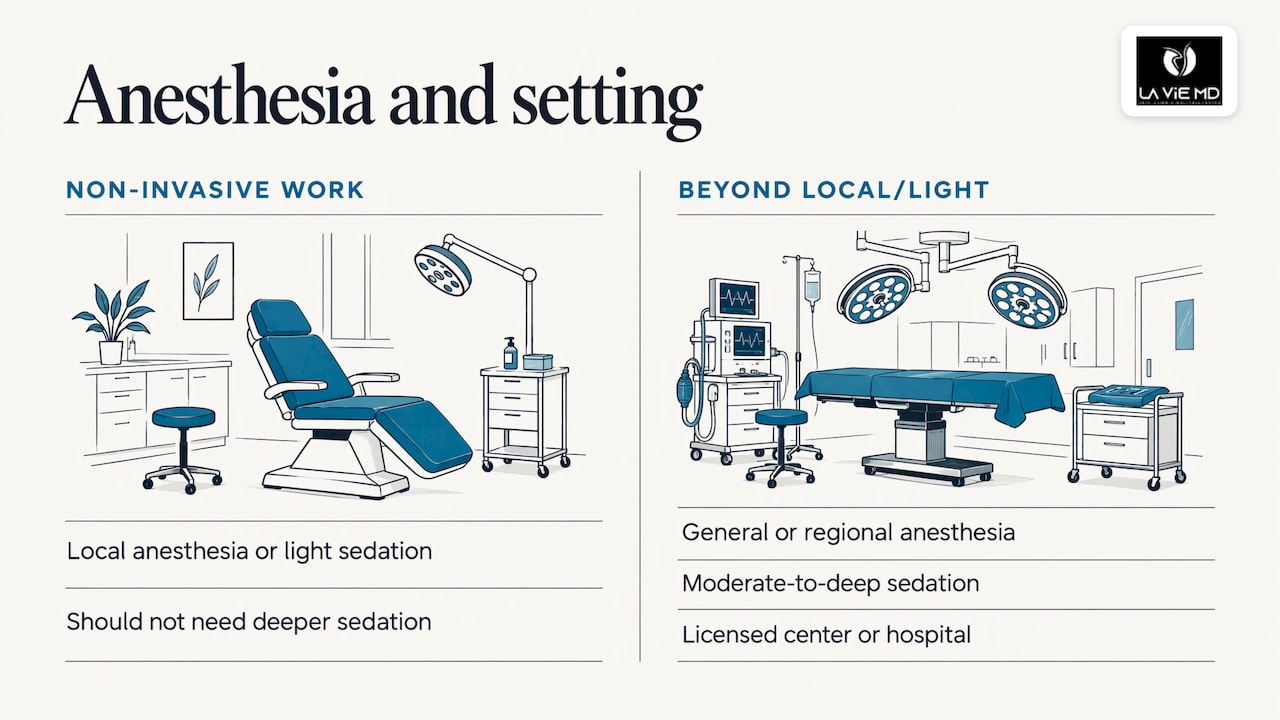
The ASPS advises avoiding any med spa procedure that needs more than local anesthesia or light sedation, because general anesthesia, regional anesthesia and moderate-to-deep sedation belong in a licensed surgical center or hospital. Non-invasive aesthetic work should not need them.
5. Treat very low prices as a flag
The Medical Board of California warns that a $50 injection when the physician-office rate is $500 is not the real product, and it cites cases of industrial silicone and toxic counterfeit drugs causing critical illness, disfigurement or death. The product in the syringe and the person administering it are what you are paying for.
What to expect on cost, results and maintenance
Cosmetic treatments are paid for out of pocket. Cosmetic botulinum toxin is not covered by insurance, and the AAD notes cosmetic procedures are typically not covered, though it is worth confirming with your plan.
On price, we do not publish fees on our site, because the total depends on your plan: which treatment, how many areas, how much product or how many sessions. A consultation is where you get a figure for your own case. For a sense of how pricing scales, a 2014 review in American Family Physician reported fees of $250 to $550 per treatment area for facial botulinum toxin injections. Those are 2014 figures, and Bay Area prices today are set by each practice, so treat them as a reminder that cost is counted per area, not per visit.
The same review gives useful timing for injectables:
| Treatment type | What the sources say |
|---|---|
| Botulinum toxin (Botox-type) | Effects take about two weeks to develop and last three to four months. Complications are uncommon and usually mild and brief. Bruising can take up to two weeks to clear. |
| Ultrasound skin tightening | Modest results appear within 2 to 6 months after one treatment, per AAD guidance cited in a 2026 comparison. |
| Radiofrequency tightening | Results peak at about 6 months and can last 2 to 3 years. |
| Laser tightening | Usually 3 to 5 treatments, with results appearing 2 to 6 months after the last. |
Two practical conclusions follow. First, schedule around the calendar: if you have a wedding or photo shoot, start a neuromodulator at least two weeks ahead and leave room for bruising to settle. Second, think in programs. Tightening and laser results build over months, which is why a plan with a sequence beats a single appointment.
If you are in your twenties or early thirties, your plan might lean toward skin quality: HydraFacial, microneedling, pigment correction and preventive neuromodulator. In your forties and fifties, it often shifts toward volume, laxity and texture. We map this to you, not to an age bracket.
Choosing by location
Bay Area traffic makes proximity part of the decision. Maintenance visits repeat every few months, so a clinic you can reach easily is a clinic you will actually return to. LA ViE MD serves clients in Danville, Livermore, Dublin and Los Gatos. If you live in the Tri-Valley, you can start from our Livermore page, or look at location-specific pages such as Botox in Dublin and Botox in Los Gatos.
Where LA ViE MD fits
If you want a Bay Area med spa where a physician is accountable for your care, start with a consultation at LA ViE MD. We pair physician supervision with advanced technology across our procedures, and every plan is built around your skin concerns and goals. Whether you are weighing injectables, a laser series, skin tightening or a GLP-1 program, you can see the full range on our services page or go straight to the LA ViE MD homepage to book.
Bring your questions from the checklist above. They are the right ones, and we are glad to answer them.
Our perspective
The word “spa” makes people expect a menu. We think the better starting point is a diagnosis. Two people can ask for the same treatment and need different things: one has sun-related pigment, the other has lost volume, and the right device, depth and spacing are different for each.
That is why we run LA ViE MD as a medical practice under physician supervision. Dr. Nebhwani is a board-certified Internal Medicine physician with more than ten years of experience, and a medical lens matters when your plan includes prescription products, injectables or a GLP-1 program, because your overall health, medications and goals all belong in the conversation.
Our approach is to listen first, then build a custom plan using the technology that suits your skin. We would rather you leave with a clear sequence, realistic timing and a skincare routine you can follow than a bag of one-off treatments. Good aesthetic medicine looks like you, on a good day, for a long time.
Dr N
FAQ
Is a medical spa the same as a regular spa?
No. A day spa focuses on relaxation and the outer layer of skin, while a medical spa offers non-invasive or minimally invasive medical treatments that reach deeper tissue, under licensed-practitioner oversight, per the American Med Spa Association. In California, injections and lasers count as the practice of medicine.
Who is allowed to give Botox and use lasers in California?
According to the Medical Board of California, injections, lasers and medical-level peels must be performed by a physician, or by a registered nurse or physician assistant under a physician’s supervision. Ask to see who your provider is and who supervises them.
How long do Botox results last?
Botulinum toxin takes about two weeks to reach its full effect and lasts three to four months, according to American Family Physician. Most people book maintenance visits on that cycle, and your provider can tailor the interval to you.
Does insurance pay for med spa treatments?
Cosmetic treatments are generally not covered. The American Academy of Dermatology still suggests asking your insurer whether any part applies. Ask for a written cost estimate at your consultation so you know the total before you begin.
What should I bring to my first consultation?
Bring your medical history, a list of current medications and supplements, and your top two or three goals. A good consultation covers your history, goals, a personalized plan, risks, expected results and costs, and ends with informed consent before any treatment.
Sources
- Patient Guide, American Med Spa Association
- Med Spas: Patient Safety and Accreditation, Aesthetic Surgery Journal, 2026
- Appropriate Business and Clinical Management of Medical Spas, ASPS, 2023
- How to Choose the Right Medical Spa for You, ASPS
- Medical Spas, Medical Board of California
- The Bottom Line: The Business of Medicine, Medical Spas, Medical Board of California
- Botulinum Toxin Injection for Facial Wrinkles, American Family Physician, 2014
- Best questions to ask when considering a cosmetic treatment, American Academy of Dermatology
- Skin Tightening: RF vs Ultrasound vs Surgery, 2026
- Photobiomodulation benefits and dosage


