Gummy Smile Botox: How It Works, Who It Suits, What to Expect
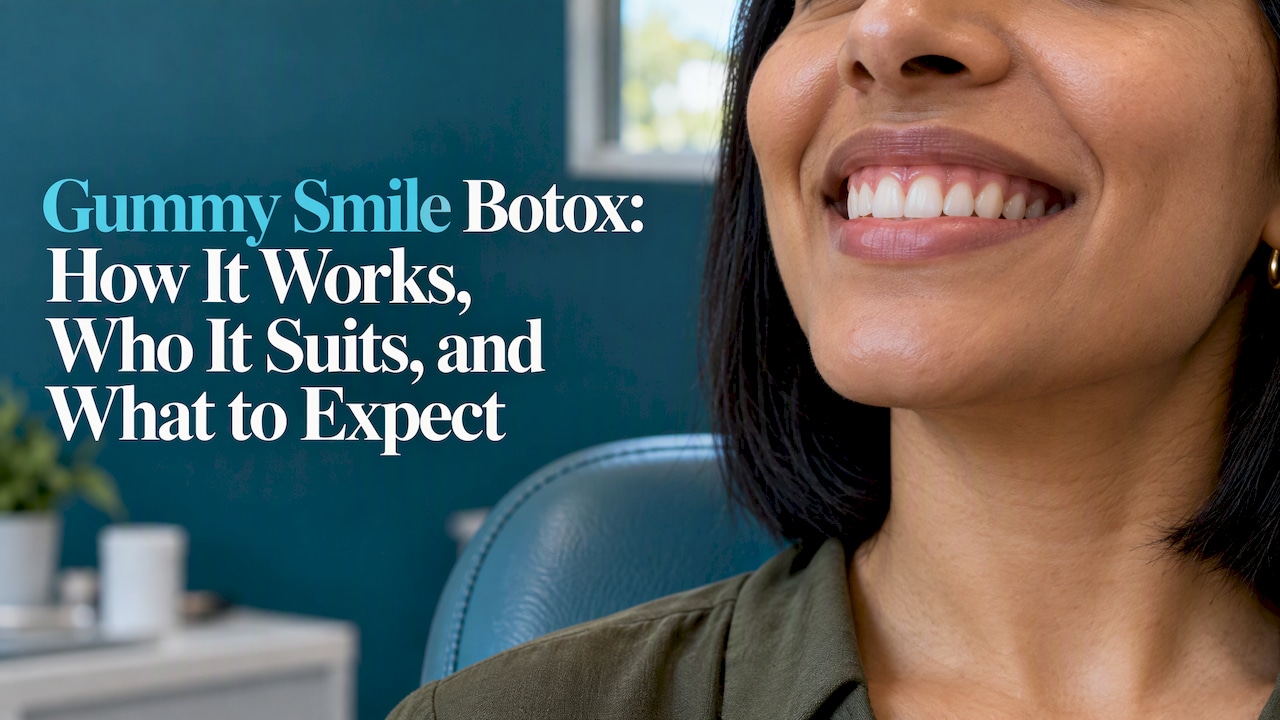
Botox can reduce a gummy smile when the cause is an upper lip that lifts too high. A few small injections relax the muscles that pull the lip upward, so less gum shows when you smile. The result is temporary, and it only works for the muscular type of gummy smile. If your gums show because of the shape of your jaw or the size of your teeth, a different treatment fits better. This guide explains how to tell the difference, what the appointment involves and how long it lasts. It also covers the risks and the alternatives.
TL;DR
- Botox treats a gummy smile caused by an overactive upper lip. It does not change the jaw, the teeth or the gum tissue itself.
- Treatment usually takes 10 to 15 minutes. Visible change appears at around 2 weeks and typically fades over 4 to 6 months.
- Side effects are usually mild and short-lived, such as bruising, swelling or a slightly tight-feeling lip. Serious spread of the toxin is rare but is listed in the FDA label.
- A proper exam comes first. If the cause is skeletal or dental, surgery, orthodontics or other options may be a better match.
- Results depend on the injector’s anatomical knowledge, so choose a physician-supervised practice.
Table of Contents
- What counts as a gummy smile
- How Botox reduces a gummy smile
- Are you a good candidate?
- What happens at the appointment
- When results appear and how long they last
- Risks and side effects
- What if Botox isn’t the right fit?
- Our perspective
- Choosing who treats you
- Book a consultation in the Bay Area
- FAQ
- Sources
What counts as a gummy smile
Some gum showing when you smile is normal. Clinicians generally define a gummy smile as more than 2 to 3 mm of gum exposed during a full smile, according to a 2023 review of botulinum toxin for gummy smile. Anything under that is usually considered a natural part of a smile.
The cause is rarely just one thing. Academic research on non-surgical gingival smile management describes a mix of skeletal, dental and soft tissue factors. Four patterns come up most often:
- Muscular: the muscles that lift the upper lip are overactive or pull too far. This is the type Botox treats.
- Skeletal: the upper jaw sits too far down or grows too long, which pushes the teeth and gums into view.
- Dental: the teeth are short, or they have not fully emerged from the gum, so more gum surrounds each tooth.
- Soft tissue: the lip is short or the gum tissue is thick.
Many people have more than one of these at once. That is why a good consultation matters more than the injection itself.
How Botox reduces a gummy smile
When you smile, a group of muscles lifts the upper lip. In a muscular gummy smile, those muscles contract strongly and expose extra gum. Botox (botulinum toxin type A) blocks the nerve signal to the targeted muscle fibers. The muscle pulls with less force, and the lip rises less. The 2023 clinical review describes this as chemical denervation of the hyperactive elevator muscles, including the levator labii superioris alaeque nasi, which reduces gum exposure.
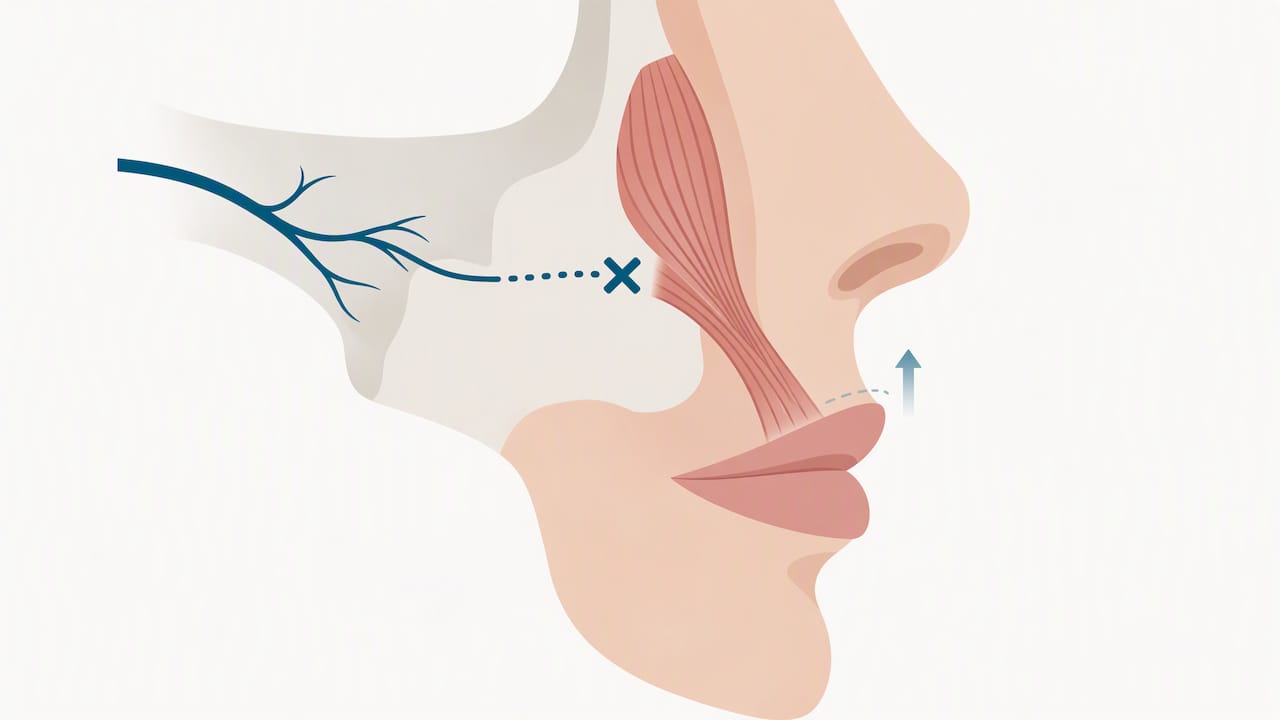
Nothing is cut or removed, and nothing is added to the lip. You keep a natural smile, and your lip simply travels a little less far. The same review calls the approach non-surgical, minimally invasive and temporary.
Where the injections go
The common target is a spot called the Yonsei point, about 1 cm to the side of the nostril, where several upper-lip lifting muscles meet, as described in a 2023 review on cosmetic botulinum toxin in the oral region. Your provider typically asks you to smile so they can see and feel which muscles contract and where.
A 2025 systematic review of gummy smile treatments reports Botox doses in the range of roughly 1.25 to 6 units per side of the face, depending on how severe the gummy smile is. A newer 2026 review of cosmetic management with botulinum toxin A notes that dose and injection depth are not standardized, and it calls for more research. In practice, that means there is no universal number of units. A conservative, tailored dose is the safer starting point.
Are you a good candidate?
You are most likely a good candidate if:
- Your gums show mainly when you smile broadly, and your lip visibly lifts high.
- The exposure is mild to moderate.
- You want a reversible, non-surgical option, or you want to test the look before considering anything permanent.
Botox is less likely to be enough if your gummy smile comes from your jaw or your teeth. The non-surgical management review notes that skeletal or dental causes may need surgery or other interventions. The 2023 clinical review adds that if a patient actually needs surgery, Botox is not recommended because it only offers a temporary result.
A few other situations call for a conversation with a physician before treatment. Tell your provider if you have a neuromuscular disorder. The FDA label for botulinum toxin states that these patients may be at higher risk of clinically significant effects. Also mention if you are pregnant or breastfeeding, have had a reaction to a toxin before, or take medications that affect bleeding, since your provider needs the full picture.
What happens at the appointment
- Consultation and exam. Your provider watches you smile and talk, looks at your gums, teeth and lip length, and asks what bothers you. This is when they decide if Botox is the right tool.
- Marking and cleansing. The skin is cleaned and injection points are identified, often with you smiling so the contracting muscle is easy to find.
- Injections. A few tiny injections go in on each side of the nose. Many clinics describe the visit as taking 10 to 15 minutes. Most people describe a quick pinch.
- Aftercare. You can usually return to normal activity. Providers commonly advise avoiding rubbing or pressing the area, hard workouts and lying flat for a few hours, but follow your own provider’s instructions.
If this is your first neurotoxin treatment, our guide on how to prepare for your first Botox appointment walks through what to avoid beforehand and what to ask.
When results appear and how long they last
Botox does not work instantly. The 2026 review reports visible improvement at about 2 weeks. The effect then fades gradually, usually over 4 to 6 months. The result depends on the dose, the technique and how pronounced your gummy smile was to begin with.
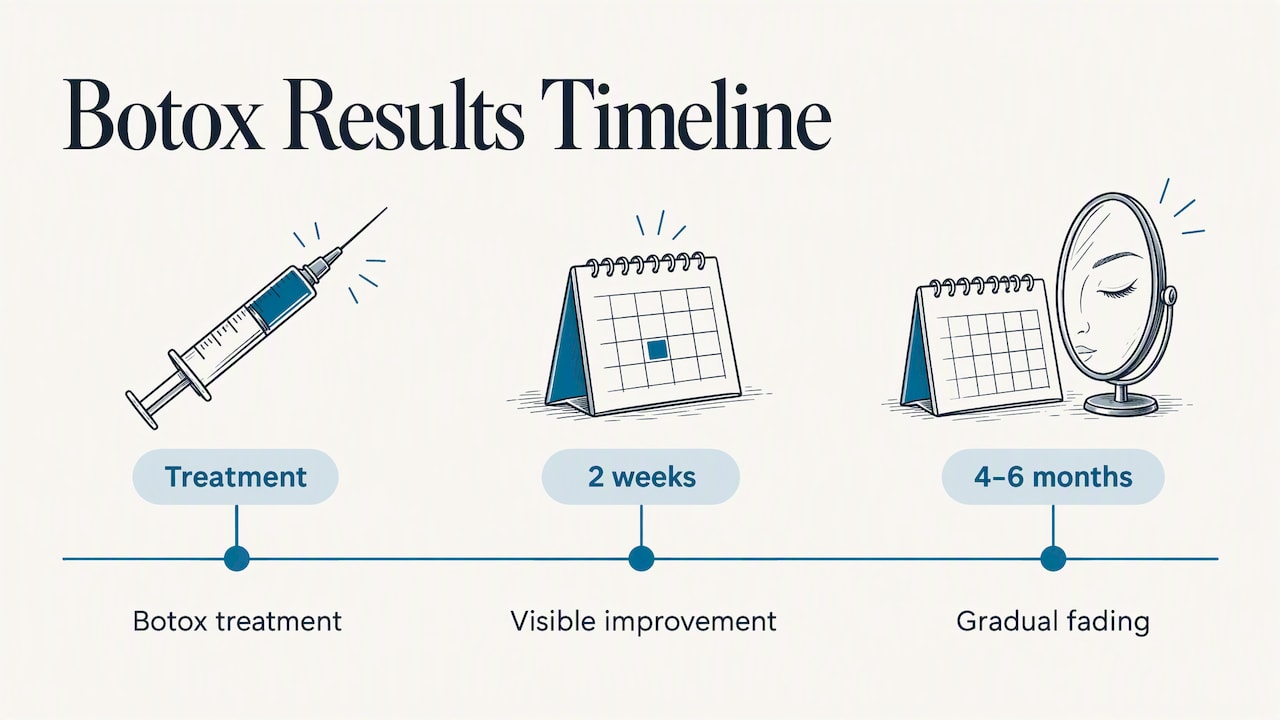
Plan for a short follow-up around the 2-week mark. If one side lifts more than the other, a small adjustment can often even things out. Because the effect is temporary, keeping the look means repeating the treatment. Many patients like that: there is no permanent commitment, and the dose can be refined each time.
What the first few weeks look like
| Timeframe | What you may notice |
|---|---|
| Day 0 to 3 | Possible small bumps, redness or tiny bruises near the nostrils |
| Around 2 weeks | Upper lip lifts less, with less gum visible when you smile |
| Months 2 to 4 | Result holds, and the lip movement gradually returns |
| Months 4 to 6 | Effect typically fades and the original smile returns |
This table summarizes the timing reported in the research above. Your own timeline may differ.
Risks and side effects
Complications from Botox for a gummy smile are uncommon and usually temporary. The 2023 review lists pain, bruising, swelling, hematoma, infection, inflammation, nerve palsy and loss of muscle strength. It also reports mild asymmetry and lip weakness among the possible effects.
The most common concern is over-treatment. Too much toxin, or toxin in the wrong spot, can leave the upper lip feeling stiff or flat, make your smile look different, or affect how you pronounce certain sounds. The effect wears off, but you wait it out. This is the main reason to start with a lower dose and add more at the follow-up if needed.
There is also a safety warning that applies to every botulinum toxin product. The FDA label warns that the toxin’s effects can spread from the injection site to other parts of the body, which can lead to life-threatening swallowing or breathing difficulties. This is rare at cosmetic doses. Still, if you notice trouble swallowing, speaking or breathing, or generalized muscle weakness after any Botox treatment, seek urgent medical care.
What if Botox isn’t the right fit?
If the cause is not purely muscular, or if you want a lasting fix, there are other routes. Which one fits depends on the cause, as listed in a 2020 stepwise approach to excessive gingival display:
- Orthodontic treatment to reposition teeth.
- Orthognathic (jaw) surgery for skeletal causes.
- Aesthetic crown lengthening or gingivoplasty, which reshapes gum tissue when the teeth are partly covered.
- Lip repositioning surgery, which limits how far the lip can rise. The 2025 systematic review notes that people with very little attached gum are generally poor candidates for it because of a higher risk of relapse and complications.
The surgical options are done by dentists, periodontists, orthodontists or oral surgeons. The right first step is often a dental exam to understand your bite and gum levels.
Filler as another non-surgical option
Researchers are also testing hyaluronic acid filler for gummy smile. In a registered Egyptian trial, the filler group kept a statistically significant 26.4% improvement at six months, while the Botox group showed near-complete relapse. Botox patients, however, reported higher categorical satisfaction. This is early evidence from one trial, so treat it as a promising area rather than a replacement for Botox. If you want to learn how fillers work in general, see our overview of dermal fillers and their lasting results.
Our perspective
We see gummy smile as a question of cause first and product second. At LA ViE MD, care is physician-supervised and led by Dr. Neetu Nebhwani, a board-certified Internal Medicine physician with more than ten years of experience. Our approach is to build a plan around your specific concerns and goals rather than hand everyone the same protocol.
For a gummy smile, that means we look at how you actually smile before anyone picks up a syringe. If the movement of your lip is the main driver, a conservative neuromodulator plan is a reasonable, reversible place to start. If your exam points to a jaw or tooth issue, we would rather tell you so and point you to a dentist or specialist than sell you a result that will not hold.
We also like starting low. A small dose can be added to at a follow-up, but an over-treated lip cannot be undone for months. If you are weighing neuromodulators in general, our comparison of Botox, Dysport, Xeomin and Daxxify explains how they differ.
— Neesh
Choosing who treats you
Because results hinge on muscle anatomy, injector skill matters a great deal. Ask these questions before you book:
- Who will perform the injections, and who supervises them?
- Will you assess my smile in motion, not just a photo?
- How many units do you plan to start with, and do you offer a follow-up check?
- What happens if the result is uneven or my lip feels too stiff?
- Will you tell me if Botox is not the right option for my cause?
Dentists also offer this treatment. The American Dental Association lists continuing education workshops on Botox and fillers for dental professionals and advises them to check with their state dental board on scope of practice. In California, any provider you see should be able to explain their training and supervision plainly.
Book a consultation in the Bay Area
If you live in Danville, Livermore, Dublin or Los Gatos and want to know whether Botox suits your smile, we can assess it in person. Our team offers medically supervised Botox and other injectables, and your consultation is where we decide on the plan together. You can also read about our Bay Area Botox treatments before you come in.
FAQ
Can Botox fix a gummy smile?
Yes, when the cause is an overactive upper lip. Botox relaxes the muscles that lift the lip, so less gum shows. It is not suited to gummy smiles caused mainly by jaw structure or tooth size, and the effect is temporary.
Where is Botox injected for a gummy smile?
The usual spot is the Yonsei point, about 1 cm to the side of each nostril. Your provider locates it by watching and feeling the muscles as you smile. Doses reported in research range from about 1.25 to 6 units per side, depending on severity.
How long does gummy smile Botox last?
You typically see the change at about 2 weeks, and it generally lasts 4 to 6 months. Dose, technique and how strong your lip movement is can all shift that. After it wears off, you can repeat the treatment or explore longer-lasting options.
Is Botox for a gummy smile safe?
When it is administered by a trained provider, complications are uncommon and usually temporary, such as bruising, swelling or a stiff-feeling lip. The FDA label warns about rare spread of the toxin to other body areas. Seek urgent care for any trouble breathing or swallowing, and tell your provider about any neuromuscular condition before treatment.
What is the riskiest place for Botox?
Any area close to muscles that control swallowing, breathing or facial expression carries more risk if the dose or placement is off. Around the mouth, too much toxin can make the lip feel stiff or change your smile. Choosing an experienced, supervised provider and starting with a conservative dose lowers that risk.
Sources
- An Approach for Gummy Smile Treatment Using Botulinum Toxin
- Non-Surgical Management of the Gingival Smile
- Cosmetic Treatment Using Botulinum Toxin in the Oral and Perioral Region
- Gummy Smile Treatment: Systematic Review of Therapeutic Options (2025)
- Cosmetic Management of Gummy Smiles with Botulinum Toxin A
- FDA label for botulinum toxin
- A stepwise approach to the correction of excessive gingival display
- Botulinum Toxin Type A Versus Cross-Linked Hyaluronic Acid trial
- ADA CE Live Workshops on Botox and dermal fillers