Crepey Skin Treatment: What Works, What Doesn’t
Crepey skin is thin, finely wrinkled skin that looks like crinkled tissue paper. Creams can improve how it looks on the surface, but they can’t lift or rebuild it. Real tightening usually comes from in-office treatments such as radiofrequency, ultrasound, microneedling, lasers and peels, paired with daily sun protection. The right choice depends on where the crepiness is, how much laxity you have and how much downtime you’ll accept.
This guide covers why skin turns crepey, what home care can realistically do, how the professional options compare, and how to decide.
TL;DR
- Crepey skin comes mainly from aging and accumulated sun exposure, which thin the skin and reduce collagen and elastin.
- Retinoids and vitamin C have the best evidence among topical ingredients, but their effect is modest. Lotions alone can’t lift sagging skin.
- Radiofrequency, ultrasound, microneedling, laser resurfacing and peels act below or on the skin’s surface, and each trades off results against downtime.
- Sun protection is non-negotiable, both before and after any procedure.
- A physician consultation is the fastest way to match a treatment to your skin, your area and your schedule.
Table of Contents
- What makes skin look crepey
- What home care can and can’t do
- Professional crepey skin treatments compared
- How to choose: a simple decision guide
- Our perspective
- Protecting your results with sun protection
- Treatment for crepey skin at LA ViE MD
- FAQ
- Sources
What makes skin look crepey
Crepey skin isn’t a diagnosis. It’s a description of skin that has lost thickness, elasticity and moisture. Two forces do most of the work: time and sun.
The National Institute on Aging says normal aging makes skin thinner, less elastic and drier. Loss of collagen and elastin contributes to wrinkles and fragility. Hormonal changes such as menopause can also leave skin thinner and drier, which is one reason many women notice crepiness on the arms, neck and chest in their late 40s and 50s.
Sun damage compounds this. According to NIH News in Health, UV exposure can make skin less elastic, thickened and leathery, wrinkled, or thin like tissue paper. The American Academy of Dermatology calls the visible changes from accumulated UV exposure, including wrinkles and loose skin, photoaging, and notes that tanning beds can bring these changes on within a few years or sooner.
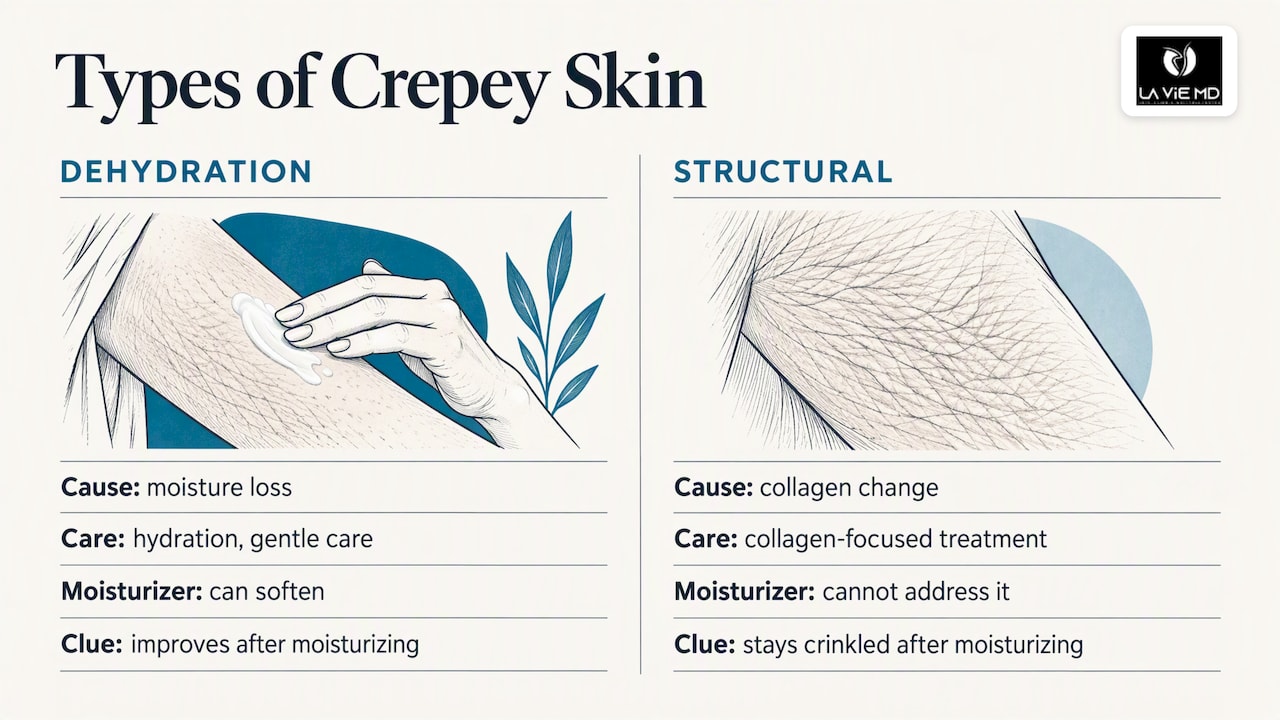
Harvard Health adds a useful distinction. Sun heat dries unprotected skin by depleting its natural oils, while UV radiation causes longer-term structural and collagen changes that produce fine lines, wrinkles and a thicker texture. So some of what you see is dryness, which a good moisturizer can soften, and some is structural change, which a moisturizer can’t touch.
That split matters for choosing treatment. Dehydrated crepiness responds to hydration and gentle care. Structural crepiness, the kind that stays crinkled after you’ve moisturized, needs something that works on collagen.
Where it shows up first
The skin on the upper arms, inner thighs, knees, décolletage, neck and the under-eye area tends to show crepiness first. These areas have thinner skin, less oil production or heavy sun exposure. If you’re asking whether loose neck skin at 40 is normal, it’s common. Genetics, sun history, weight changes and smoking all shape when it appears, so the age varies widely from person to person.
What home care can and can’t do
Most of what ranks for this search is about products. Some of it is useful, but it needs honest framing.
The AAD is direct on the limit: topical creams and lotions cannot lift sagging skin, though retinoid products may produce subtle results by helping the body make more collagen. That’s the realistic ceiling for a drugstore routine.
Ingredients with evidence behind them
- Retinol and vitamin C. A 2024 systematic review of 32 clinical studies gave Grade A antiaging recommendations to topical retinol and vitamin C. Bakuchiol and growth factors earned Grade C, and several other ingredients were inconclusive.
- A caution on retinol. A review of over-the-counter retinol trials found very little trustworthy evidence overall: a mild effect on fine facial wrinkles at best, with methodological flaws weakening the findings. Prescription-strength retinoids are a different conversation to have with a physician.
- Vitamin C. A 2023 review found that studies generally reported improvements in wrinkles or photodamage, but every included study combined vitamin C with other ingredients. Its independent effect is uncertain.
- Niacinamide. In a 12-week double-blind study of 50 women, twice-daily 5% niacinamide improved fine lines, wrinkles and measured elasticity, along with pigmentation, redness and sallowness. It’s a small, older study, but a gentle option if retinol irritates you.
- Humectants and ceramides. These don’t rebuild collagen. They plump the surface with water, which can make fine crinkling look softer within days. That’s a cosmetic effect, and a pleasant one.
What about supplements and vitamins?
Readers often ask which vitamin helps crepey skin on the arms. A 2025 meta-analysis of randomized trials found that oral collagen, cocoa flavanols and other polyphenols improved some photoaging outcomes, including elasticity. Oral hyaluronic acid, lycopene and carotenoids showed no significant benefit, and evidence for several supplements remained limited. In short, there’s no single vitamin that fixes crepey arms. Check with your physician before starting supplements, especially if you take medication.
The Merck Manual makes the broader point that many cosmetic products are marketed for photoaged skin, yet significant evidence is often lacking for their ability to improve chronic sun-induced changes. Coconut oil falls in the same bucket: it can moisturize, and it won’t change collagen.
A realistic daily routine
- Cleanse gently. Skip hot water and harsh scrubs, which strip oils from skin that’s already thin.
- Apply a vitamin C serum in the morning and a broad-spectrum sunscreen on top.
- Use a retinoid at night if your skin tolerates it. Start a few nights a week.
- Moisturize body and face with a cream containing humectants and ceramides.
- Exfoliate lightly and infrequently. More isn’t better on thin skin.
If you have this routine in place and the crepiness persists, that’s the point where professional treatment makes sense.
Professional crepey skin treatments compared
In-office treatments work by delivering energy or controlled injury below the surface, which prompts the skin to produce new collagen. The AAD’s guidance on firming sagging skin is the best neutral map of the options and their trade-offs.
| Treatment type | How it works | Typical timeline | Downtime |
|---|---|---|---|
| Radiofrequency (RF) | Heats deeper skin layers to prompt collagen remodeling | Best results around 6 months | Minimal |
| Ultrasound | Focused energy heats deep tissue | Modest lift within 2 to 6 months after one treatment | Minimal |
| Non-ablative laser | Sends heat deep without wounding the top layer | Often 3 to 5 sessions | Low |
| Laser resurfacing | Removes outer layers and heats deeper tissue | Tightening and wrinkle reduction within about 2 weeks of healing | More, such as 5 to 7 days |
| Chemical peel | Controlled exfoliation of the surface | Depends on peel depth | Varies by depth |
The timelines come from the AAD’s guide to firming sagging skin. It also reports that ultrasound and RF results can last 2 to 3 years with the right skin care. Individual results vary, and no treatment stops aging.
Radiofrequency and ultrasound skin tightening
These are the usual starting point for crepey skin on the neck, jawline, arms and abdomen, because they tighten without breaking the skin. They suit people who want gradual improvement and can’t take a week off. The trade-off is patience: results build over months, not days.
At LA ViE MD we offer radiofrequency and ultrasound skin tightening, including Forma and Morpheus8, which we describe on our skin rejuvenation treatments page. For a broader look at how tightening options differ, see our guides to skin tightening treatments and loose skin tightening.
Microneedling and medical-grade facials
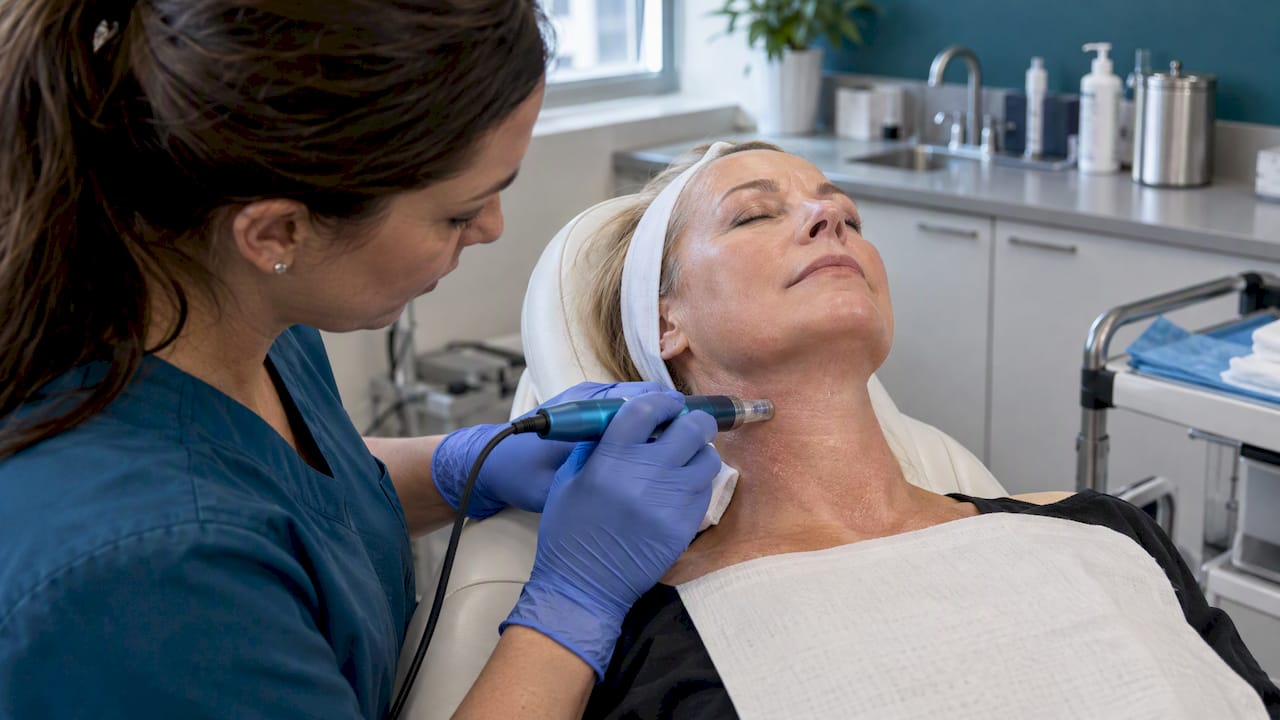
Microneedling creates tiny controlled channels in the skin that trigger the repair response. It’s widely used for texture, fine lines and overall skin quality, and sessions are typically spaced weeks apart. Medical-grade facials such as HydraFacial won’t tighten loose skin, but they hydrate, exfoliate and keep the surface looking fresh between stronger treatments. That makes them a good maintenance layer for dry, crinkled skin.
Lasers for sun-damaged skin
If your crepiness comes with brown spots, uneven tone or rough texture, sun damage is likely the main driver. Lasers and light-based treatments can address both pigment and texture. The AAD notes that laser resurfacing is considered the most effective procedure for tightening loose skin, with more downtime and a higher chance of side effects than non-ablative laser or RF.
Our laser procedures include CO2 laser treatment (Tetra CoolPeel) and PicoWay for melasma and pigmentation. If you’re weighing light-based options for spots and tone, our comparison of IPL versus laser for sun damage explains the differences.
Chemical peels
Peels can refine the surface texture of sun-damaged skin. The AAD lists the risks plainly: peels can cause redness, swelling, blisters, temporary pigment changes or, rarely, scarring. Aftercare varies by peel, and medium or deep peels require sun avoidance while healing. Peels suit surface texture and tone more than true laxity. If you’re torn between a peel and a laser, our guide to choosing between a chemical peel and laser walks through it.
Injectables for crepey skin
Injectables don’t tighten skin the way energy devices do, but they have a role. Neuromodulators such as Botox can soften expression lines, and fillers and collagen-stimulating products can restore lost volume that makes skin look hollow and crinkled. We cover these on our injectables page, and our wrinkle treatment guide explains how they fit with other options. Which product suits you depends on the area, so this is a decision for an in-person exam.
How to choose: a simple decision guide
Start with what you see in the mirror.
- Fine crinkling that looks better after moisturizer: your skin is partly dehydrated. Begin with hydration, sunscreen and a retinoid, then add a medical-grade facial.
- Crinkling with mild looseness on the neck, arms or knees: RF, ultrasound or microneedling are the common first steps, with minimal downtime.
- Crepiness with brown spots, roughness or visible sun damage: a laser or peel that targets pigment and texture, possibly followed by tightening.
- Pronounced laxity and deep lines, and you can accept downtime: laser resurfacing is the strongest option the AAD describes, with the trade-offs above.
- Hollow, lined areas such as the cheeks, temples or under the eyes: volume and neuromodulator treatments may help more than energy devices.
Most people do best with a combination: a tightening treatment for structure, a surface treatment for tone and texture, and home care to hold it all together. A plan built around your goals is more effective than any single device.
Our perspective
We see the same pattern again and again: people spend months and a lot of money on firming creams, then arrive frustrated. The creams weren’t useless. They were asked to do a job that only collagen-stimulating treatment can do.
Our approach starts with a physician consultation. Dr. Neetu Nebhwani is a board-certified Internal Medicine physician with more than ten years of experience, and she supervises every treatment plan we build. That medical view matters here, because crepey skin isn’t only a surface issue. Hormonal shifts, hydration, weight changes and medications can all play a part, and they shape which treatment will actually work and how safe it is for you.
We don’t believe in one device for everyone. Skin on the neck behaves differently from skin on the knees, and a 28-year-old with early sun damage needs a different plan from a 52-year-old in menopause. We’d rather start gentle, set honest expectations about timelines, and add intensity only if you want more. We also tell clients plainly what a treatment can’t do. Nothing stops aging, and sunscreen does more for your skin over ten years than any single procedure.
— Dr N
Protecting your results with sun protection
Treatment without sun protection is money wasted. The AAD says unprotected sun and tanning-bed exposure damage skin, that the damage builds up over time and that sun protection is essential after treatment to prevent side effects and further damage.
In practice:
- Wear broad-spectrum sunscreen on the face, neck, chest and hands every day, and reapply when outdoors.
- Cover arms and legs with clothing or shade during peak sun hours, which matters in the sunny Tri-Valley and South Bay climates.
- Avoid tanning beds entirely.
- After a laser or peel, follow your provider’s aftercare exactly, including sun avoidance while the skin heals.
Also, any new, changing or non-healing spot should be examined by a physician or dermatologist rather than treated as cosmetic. Sun-damaged skin can hide growths that need medical attention.
Treatment for crepey skin at LA ViE MD
If you live in Danville, Livermore, Dublin or Los Gatos, we can assess your skin in person and build a plan around it. Our menu includes radiofrequency and ultrasound skin tightening, microneedling, medical-grade facials, chemical peels, laser treatments, injectables and medical-grade skincare to support your results at home. Your plan starts with a consultation, where we look at the areas that bother you, your sun history, your schedule and your tolerance for downtime.

Ready to talk through your options? Explore our skin rejuvenation treatments or book a consultation through LA ViE MD.
FAQ
What helps remove crepey skin?
Nothing removes it completely, but several things improve it. Daily sunscreen, a retinoid and good hydration help the surface. In-office treatments such as radiofrequency, ultrasound, microneedling and laser can tighten and improve texture by stimulating collagen. A consultation will tell you which fits your skin.
Can creams fix crepey skin?
Creams can soften the look of dryness and, with retinoids, may deliver subtle collagen-related improvement. The AAD says topical products cannot lift sagging skin. If your skin is structurally loose, creams work best as a supporting routine rather than the main treatment.
How long do results from crepey skin treatments last?
It depends on the treatment. The AAD reports that ultrasound and radiofrequency results can last 2 to 3 years with the right skin care. Ongoing sun exposure and natural aging will continue to affect the skin, so maintenance and sun protection extend your results.
Is loose, crepey neck skin at 40 normal?
Yes, it’s common. Genetics, sun history, weight changes and smoking all affect when the neck starts to show aging. If it bothers you, tightening treatments and consistent sun protection are the usual places to start, and a physician can tell you what’s realistic for your skin.
Sources
- Skin Care and Aging, National Institute on Aging
- Sun and Skin, NIH News in Health
- Sun-Damaged Skin, Harvard Health
- How dermatologists treat sun-damaged skin, American Academy of Dermatology
- Many ways to firm sagging skin, American Academy of Dermatology
- Chemical peels: FAQs, American Academy of Dermatology
- Cosmeceuticals for antiaging: a systematic review
- Evidence for the efficacy of over-the-counter vitamin A
- Clinical efficacy of topical vitamin C on skin appearance
- Niacinamide and aging facial skin
- Dietary supplements for skin photoaging, meta-analysis
- Chronic Effects of Sunlight, Merck Manual