Dry Skin Treatment: What Works, Step by Step
The most effective dry skin treatment is a routine, not a single product: shorter lukewarm showers, a gentle fragrance-free cleanser, and a thick cream or ointment applied while your skin is still damp. Most mild dry skin responds to those changes within a few weeks. If it does not, or if it itches, cracks or keeps getting worse, the cause may be something a clinician should look at, and that is where medical-grade care comes in.
This guide walks through the home steps dermatology groups recommend, how to read a moisturizer label, which habits quietly make dryness worse, and when it is time to book a visit.
TL;DR
- Keep showers and baths to 5 to 10 minutes in warm, not hot, water, then moisturize within minutes while skin is damp.
- Choose creams or ointments over thin lotions, and look for humectants, emollients and occlusives working together.
- Skip fragrance, deodorant soaps and harsh products, and add a humidifier if your indoor air is dry.
- If self-care does not help or symptoms worsen, see a healthcare professional. Persistent dryness can point to a skin condition or a medication effect.
- Our Bay Area clinic offers physician-supervised skin care when a routine alone is not enough.
Table of Contents
- Why skin gets dry in the first place
- Fix your bathing routine first
- How to choose a moisturizer
- Habits that make dry skin worse
- Add moisture to the air
- A simple daily dry skin routine
- When dry skin is more than dry skin
- Our perspective on dry skin
- When a professional treatment makes sense
- Book a skin consultation with LA ViE MD
- FAQ
- Sources
Why skin gets dry in the first place
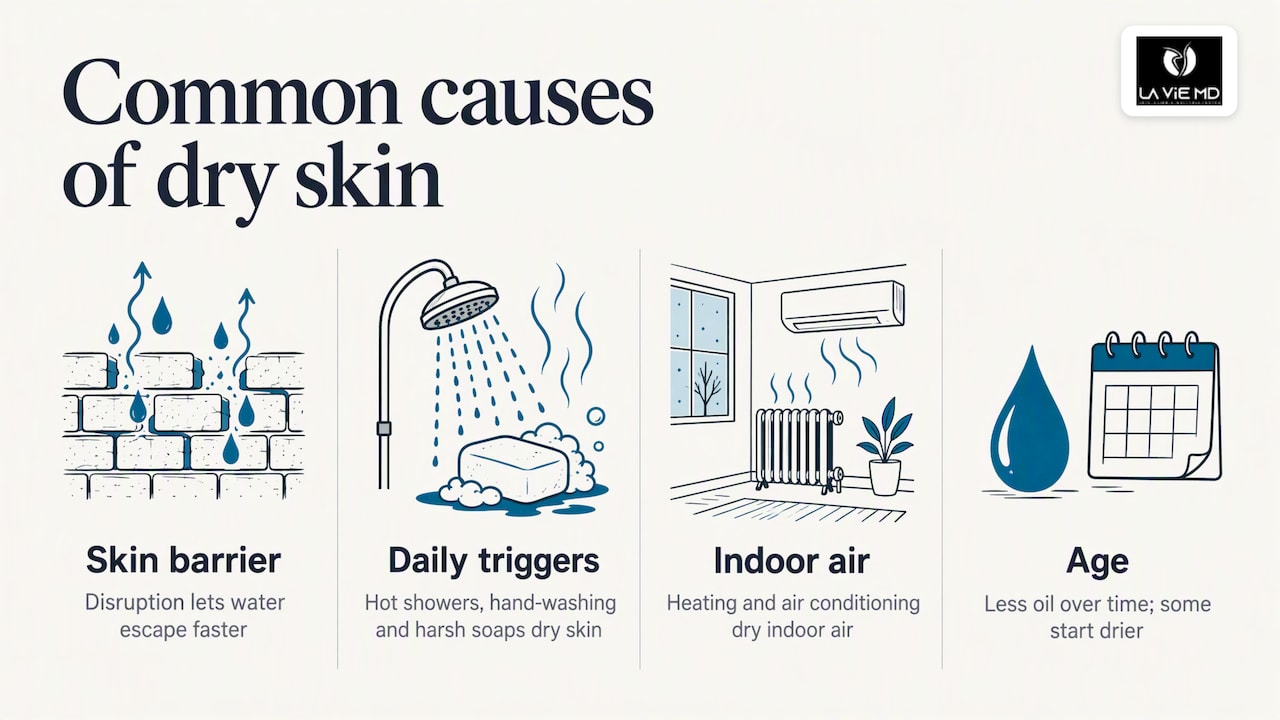
Healthy skin holds water because its outer layer works like a wall: cells packed together with natural oils between them. When that barrier is disrupted, water escapes faster than your body can replace it. The skin feels tight, looks dull or flaky, and may itch.
The usual triggers are everyday ones: long hot showers, frequent hand-washing, harsh soaps, dry indoor air from heating or air conditioning, and sun exposure. Age plays a role too, because skin makes less oil over time. Some people simply have a drier baseline.
The Bay Area adds its own twist. Our climate is mild, but indoor heating in winter, air conditioning in the long dry summers in Livermore and Danville, and frequent hand-washing at work all strip moisture without you noticing. If your skin feels fine outdoors and tight indoors, the air around you is a good place to start.
Fix your bathing routine first
Bathing is the habit most people can change fastest, and the American Academy of Dermatology (AAD) puts it first. Dermatologists advise limiting baths and showers to 5 to 10 minutes using warm water, with a gentle cleanser, rather than hot water and heavy scrubbing.
A practical version:
- Lower the temperature. Warm should feel comfortable, not steamy. Hot water pulls oils from the skin.
- Set a timer. Five to ten minutes is the target. A long soak feels relaxing, but it is the opposite of what dry skin needs.
- Use cleanser only where needed. Face, underarms, groin, hands and feet. Your arms and legs rarely need soap every day.
- Pat, do not rub. Leave a little moisture on the skin.
- Moisturize right away. The same AAD guidance says to apply fragrance-free moisturizer immediately while your skin is still damp. That locks in water the skin has just absorbed.
The same applies to your hands. After washing them, apply moisturizer while they are still damp, and keep a small tube where you will actually use it.
How to choose a moisturizer
The aisle is crowded, so it helps to know what you are looking for. Two rules cover most of it.
Texture: cream or ointment beats lotion
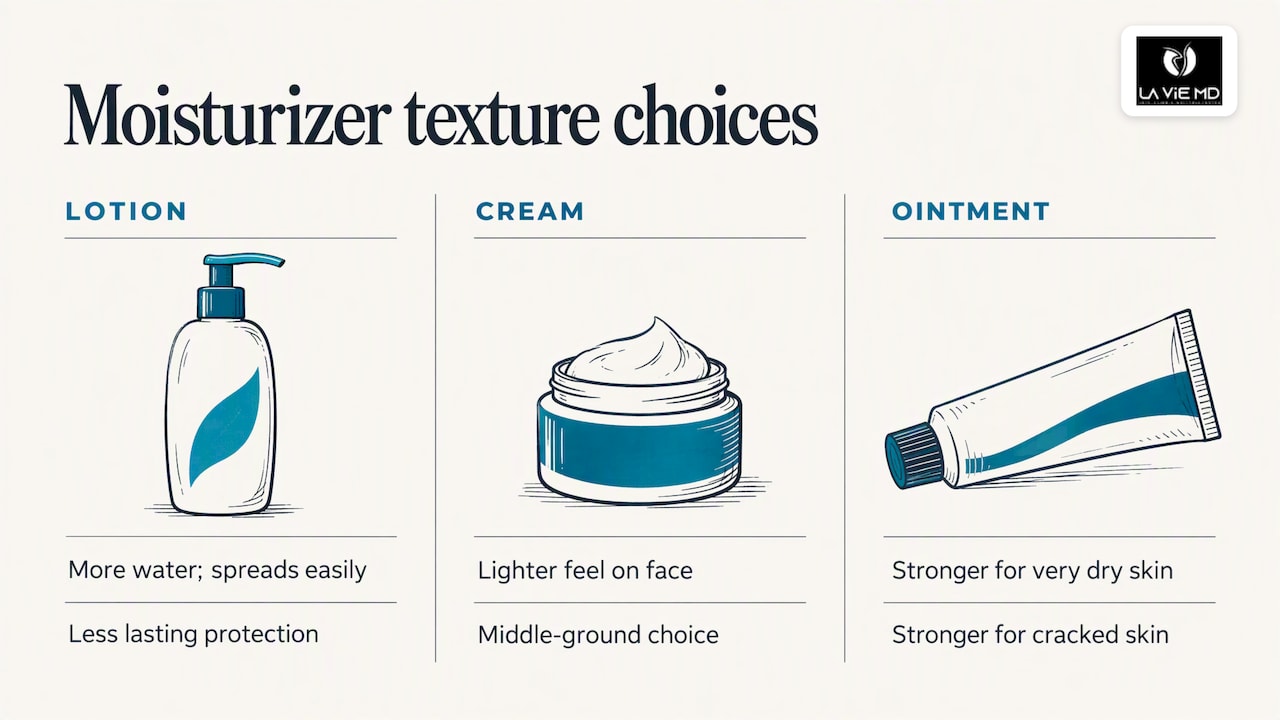
The AAD notes that creams and ointments are more effective than lotions for dry skin. Lotions contain more water and spread easily, which is nice, but they tend to give less lasting protection. If your skin is very dry or cracked, an ointment in a tub or tube is usually the stronger choice. If you prefer a lighter feel on your face, a cream is a good middle ground.
Ingredients: a system, not a single hero
Cleveland Clinic dermatologists describe an ideal moisturizer as a system: humectants to pull water into the skin, occlusives to trap it, and emollients to smooth the barrier. The AAD lists ingredients to look for, including dimethicone, glycerin, hyaluronic acid, lactic acid, lanolin, mineral oil, petrolatum and shea butter.
Here is how those fit together:
| Job | What it does | Ingredients from the AAD list |
|---|---|---|
| Humectant | Draws water into the skin | Glycerin, hyaluronic acid, lactic acid |
| Emollient | Smooths and softens rough skin | Dimethicone, shea butter, lanolin |
| Occlusive | Forms a seal so water stays in | Petrolatum, mineral oil |
A product that combines at least one from each row covers the bases. If you want to read more about peptide-type ingredients that often come up in skin barrier conversations, there is background on oligopeptide 10 and skin health.
One more detail for those wondering about natural butters and oils: AAD guidance on darker skin tones notes that butters and oils tend to liquefy on the skin, which makes them less effective as moisturizers on their own. They can sit comfortably inside a formula, but a well-built cream or ointment usually does more.
Habits that make dry skin worse
Sometimes the fix is removing what is irritating the skin. The AAD lists several common culprits: deodorant soaps, alcohol, fragrance, tight clothes, wool and polyester can all irritate dry skin. In practice:
- Switch to fragrance-free cleansers, laundry detergent and moisturizers. “Unscented” can still contain masking fragrance, so read the ingredient list.
- Reach for cotton next to the skin and loosen tight waistbands and cuffs.
- Go easy on exfoliation. Scrubs and strong acids can strip an already compromised barrier. Save them until your skin feels comfortable again.
- Watch hand sanitizer and alcohol-based toners, which dry out quickly.
- Do not forget the lips. The AAD says petroleum jelly can help keep dry lips hydrated.
Add moisture to the air
If your skin is worse at home than anywhere else, the air may be the issue. The AAD says a humidifier can boost the humidity level in your home to help relieve dry skin. A portable unit in the bedroom works well because you spend hours there. Clean it regularly as the manufacturer directs, since a dirty humidifier is a problem of its own.
A simple daily dry skin routine
If you want something you can follow without thinking, use this:
Morning
- Rinse or cleanse gently with lukewarm water.
- Apply a hydrating serum if you like one, with hyaluronic acid or glycerin.
- Apply a cream or ointment while skin is still slightly damp.
- Finish with sunscreen on exposed areas, since sun damage dries and ages skin.
Evening
- Remove makeup and sunscreen with a gentle, fragrance-free cleanser.
- Moisturize immediately. For very dry patches, use an ointment on top.
- After a shower, moisturize your body within a few minutes.
Give the routine two to four weeks before judging it. Change one thing at a time so you can tell what is helping.
When dry skin is more than dry skin
Home care solves a lot, but not everything. Mayo Clinic advises that you make an appointment with a healthcare professional if self-care steps do not relieve dry skin or symptoms get worse.
Persistent dryness can have an underlying cause. The AAD says it may be due to conditions such as atopic dermatitis, psoriasis or kidney disease, and recommends seeing a board-certified dermatologist if it continues after you try the tips above. Signs worth a visit include:
- Dryness that does not improve after a few weeks of consistent care
- Intense itching that disturbs sleep
- Red, scaly, cracked or weeping skin
- Dryness that appeared suddenly or covers large areas of the body
If dry skin becomes itchy, Mayo Clinic notes that a clinician may suggest a prescription cream with hydrocortisone. Do not start steroid creams on your own for ongoing problems, especially on the face, without guidance.
Medications can be a cause
Some prescription drugs dry the skin. Isotretinoin, for example, can cause dry skin, chapped lips, dry and irritated eyes and nosebleeds. If you take it, follow your prescriber’s moisturizing and lip-care advice and ask before adding new active products. Never stop a prescribed medication on your own because of dryness. Call the prescriber instead.
Psoriasis and other skin conditions
With psoriasis, Mayo Clinic experts note that keeping the skin well moisturized helps control dryness and discomfort. A diagnosis still needs a clinician, because treatment goes beyond moisturizer.
Our perspective on dry skin
In our practice, dry skin is rarely just a surface problem. Patients tell us they have tried several creams and still feel tight, dull or rough. When we look closer, the barrier has often been weakened by a mix of things: harsh cleansers, active ingredients layered too fast, sun exposure, hormonal shifts or simply years of under-hydrating routines.
That is why we start with a conversation and an exam, not a product list. As a physician-led clinic, we can tell the difference between dryness that needs a better routine and dryness that deserves a medical workup. Our custom treatment plans are built around your skin concerns and your goals, and we use advanced technology and medical-grade skin care in a supervised setting.
Once the basics are in place, in-office treatments can help skin look smoother, more even and more radiant, and a physician-guided plan keeps the results on track. Home habits do the daily work. Professional care helps you get further, with safety as the priority.
Dr N
When a professional treatment makes sense
After the barrier is calm and you are moisturizing consistently, some people want to go further: skin that looks dull, textured or aged along with being dry. That is a different goal from relieving dryness, and it is where in-office options can fit. Which one suits you depends on your skin, your health history and what you want to change, so these are starting points for a consultation, not promises.
- Medical-grade facials. Treatments like HydraFacial and HydraFacial Keravive are performed by our estheticians and are part of how we help skin look fresher. Read about them on our esthetician services page.
- Skin rejuvenation. Options such as microneedling and Morpheus8 are used to improve skin quality and texture. You can see the full range on our skin rejuvenation treatments page. If rough texture is your main concern, our guide on uneven skin texture explains what smooths it.
- Resurfacing. If you are weighing peels against lasers, our comparison of chemical peel or laser can help you choose.
- Skin tightening. For looseness that comes with dryness over time, see our skin tightening treatments or our guide to crepey skin treatment.
- Light-based care. Our red light therapy page explains how it is used.
- Fine lines. Dry skin makes lines more visible. Our wrinkle treatment page covers the options.
One safety note: dry, irritated or inflamed skin is not a good candidate for many procedures. We may ask you to calm and repair your skin first, so do not be surprised if your plan starts with a routine like the one above.
Book a skin consultation with LA ViE MD
If you have tried the basics and your skin still is not where you want it, we would like to take a look. LA ViE MD is a boutique medical spa serving Danville, Livermore, Dublin and Los Gatos, led by Dr. Neetu Nebhwani, a board-certified Internal Medicine physician with over ten years of experience. We build custom plans around your skin concerns and goals.

Browse our skin rejuvenation treatments or visit LA ViE MD to request a consultation. We do not publish prices online, so your plan and its cost are discussed at your visit.
FAQ
What is the best treatment for very dry skin?
Start with a short, warm shower, a gentle fragrance-free cleanser and a thick cream or ointment applied while your skin is damp. The AAD says creams and ointments work better than lotions. If this does not help within a few weeks, see a healthcare professional.
Should I use a cream, a lotion or an ointment?
For dry skin, a cream or an ointment is generally the better pick because it holds moisture longer. Lotions are lighter and easier to spread, but they tend to be less effective. Look for a mix of humectants, emollients and occlusives on the label.
Does a humidifier really help dry skin?
It can. A humidifier raises the humidity in your home, which can help relieve dry skin, especially in a bedroom overnight. Clean it regularly so it does not become a source of irritation.
When should I see a doctor about dry skin?
Book a visit if self-care does not relieve your dryness or if symptoms get worse, especially with intense itching, cracking or redness. Persistent dryness can be linked to conditions like atopic dermatitis, psoriasis or kidney disease, or to a medication you take. A board-certified dermatologist or your primary care physician can sort out the cause.
Can a medical spa help with dry skin?
A physician-led medical spa can assess your skin, recommend medical-grade skin care and, once your barrier is healthy, discuss treatments that improve texture and glow. Dryness that looks like a medical condition should be evaluated by a clinician first. At LA ViE MD, we start with a consultation to decide what is right for you.
Sources
- Dermatologists’ top tips for relieving dry skin, American Academy of Dermatology
- Dry skin: Diagnosis and treatment, Mayo Clinic
- Choosing the best moisturizer for dry skin, Cleveland Clinic
- Dry skin remedies for darker skin tones, American Academy of Dermatology
- Isotretinoin side effects, American Academy of Dermatology
- Mayo Clinic Q and A: Psoriasis, Mayo Clinic News Network