Eyebrow Tattoo Removal: Options, Sessions, Risks and Cost
Laser is the standard way to remove an eyebrow tattoo, whether it is microblading, powder brows or full cosmetic tattooing. It usually takes several visits spaced weeks apart. Clearing is often good but not always total, and the color of your ink changes how safe and predictable the result will be. Below you will find how the process works, how many sessions to plan for, what can go wrong, what it costs, and how to heal.
TL;DR
- Eyebrow ink sits in the dermis, so it does not simply fade away. Removal is done with laser light that breaks the ink into particles your body clears over time.
- One study of cosmetic eyebrow tattoos found an average of 3 laser sessions met patients’ goals, with more needed for warm, visible pigments such as red or orange tones.
- Some inks, especially white or flesh-toned ones, can darken when lasered, so a test spot and an experienced provider matter before you commit.
- The ASPS lists $697 as the average cost of laser skin treatments such as tattoo removal. Your total depends on the number of sessions.
- Plan on sun protection and patience: brows can take weeks to settle, and you should wait for full healing before any new brow work.
Table of Contents
- Why eyebrow tattoos do not just fade away
- How laser eyebrow tattoo removal works
- How many sessions and how far apart
- Can laser remove it completely?
- Risks and side effects to know about
- What the treatment feels like
- Healing and aftercare
- Laser versus other removal methods
- What eyebrow tattoo removal costs
- Our perspective
- Planning your brows after removal
- Eyebrow tattoo assessment at LA ViE MD
- FAQ
- Sources
Why eyebrow tattoos do not just fade away
Many people hope a faded or orange-tinted brow will disappear by itself. Some do lighten, but they rarely vanish. The FDA explains that tattoos, including permanent makeup for eyebrows, are designed to be permanent: ink is deposited into the dermis, the skin’s second layer. Your skin sheds its top layer constantly, but the dermis does not turn over the same way.
What you see in practice is a color shift. Microblading and some pigments tend to go gray, blue or salmon-pink as they lighten, and the shape stays put. That is why a brow you loved three years ago can look off today even though the lines are unchanged. UV exposure can fade some inks too, and the AAD notes that UV light can fade some tattoo inks. That is no removal plan, though, because it fades unevenly and does not clear shape.
It also helps to separate two situations:
- Shape or placement you dislike. The ink may be fine, but the arch, thickness or spacing is wrong.
- Color you dislike. The shape may work, but the tone has turned ashy, red or blue.
Both are removal candidates. In the first case you may want only part of the tattoo lightened, which is a conversation to have with your provider before the first pass.
How laser eyebrow tattoo removal works
The FDA describes the principle: laser light shatters tattoo ink into small particles, and the body’s immune system clears them over time. The laser type depends on the tattoo’s colors, and multicolored work may need more than one laser.
That last point matters for brows, because they are rarely one pure color. Cosmetic brow pigments are usually mixed browns, sometimes with red or orange undertones to avoid looking gray.
Wavelengths and pigment color
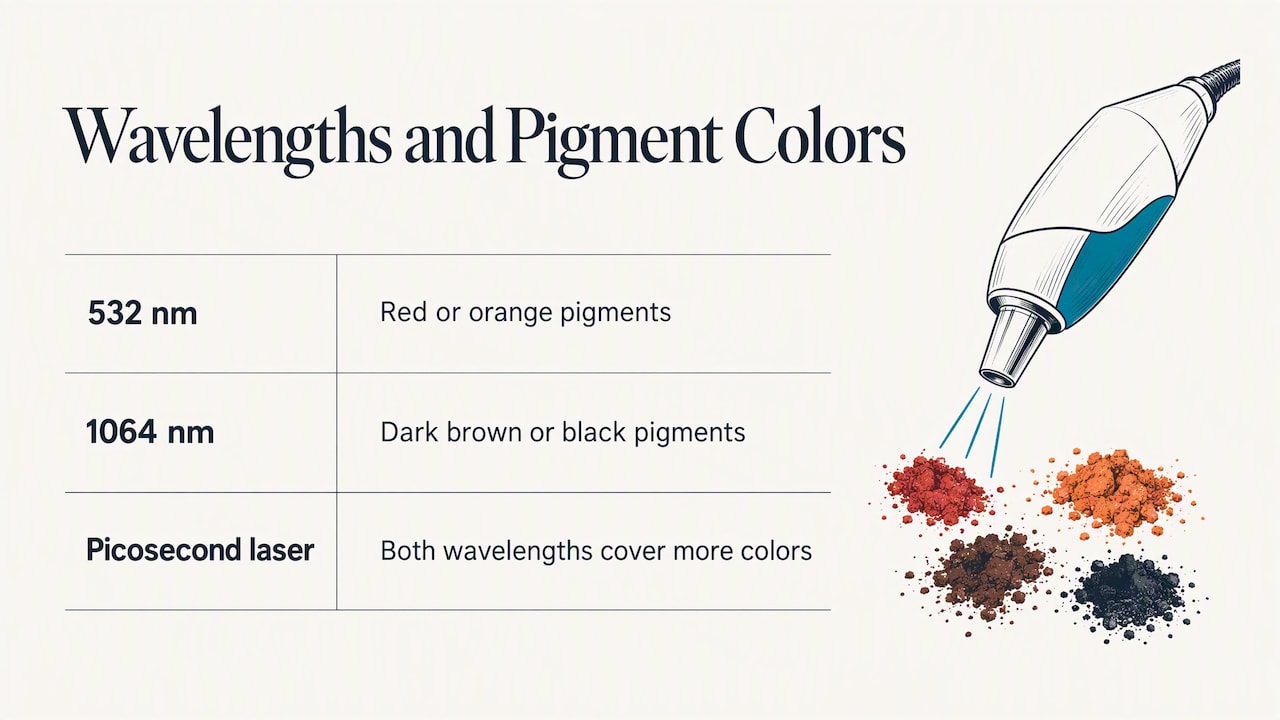
A published review of laser removal of eyeliner and eyebrow tattoos notes that clinicians use wavelengths such as 532 nm for red or orange pigments and 1064 nm for dark brown or black pigment. The same authors say a picosecond laser that offers both wavelengths gives more versatility across colors.
Picosecond versus Q-switched lasers
You will see two laser families mentioned. Q-switched lasers were the long-standing standard. A 2023 review reports that picosecond lasers have challenged Q-switched lasers because of their greater selectivity, lower fluence needs and less thermal damage to surrounding tissue. Shorter pulses break pigment up with more photomechanical effect, as described in a clinical update on laser tattoo removal.
For thin facial skin next to your eyes, less collateral heat is a real advantage. It is not a guarantee, and technique and settings matter as much as the device name.
Why it takes several visits
The laser breaks the ink up, but your body does the clearing. The American Academy of Dermatology points out that the body, not the laser, clears the shattered ink, which is why the gap between treatments is medically necessary for healing and immune response. Cleveland Clinic adds that professional tattoos can take several sessions because ink granules sit below the skin’s surface.
How many sessions and how far apart
Brow tattoos are small and often lighter than body tattoos, so they usually clear faster than a full sleeve. A Swiss study of cosmetic eyebrow tattoos treated with a picosecond laser found an average of 3 sessions achieved patient objectives, with significantly more sessions for visible warm pigments. The same study used intervals of 4 weeks at 755 nm and 8 weeks at 532 nm.
Treat those figures as a starting point, not a promise. What changes your count:
| Factor | Likely effect on sessions |
|---|---|
| Cool, dark brown or black pigment | Usually fewer sessions |
| Warm red, orange or pinkish pigment | More sessions |
| Heavily layered ink from touch-ups | More sessions |
| Light, fading microblading | Often fewer sessions |
| Goal is lightening so a new shape can be tattooed over | Fewer sessions than full clearance |
Two more things help you plan. First, you can often stop short of full clearance. If your goal is to rework the shape, “light enough” may be the target. Second, results are judged after the skin has healed, not the day after, because the immune response keeps working between visits.
Can laser remove it completely?
Sometimes yes, sometimes nearly. A clinical update advises that patients be told clearance is often incomplete, with possible residual outlines or textural skin changes. The FDA is equally direct that complete removal may not be possible in some cases. The brow review above adds that laser removal can be safe and effective, but patients should be counseled about pigment unmasking and each case is unique.
An honest consultation should therefore set an expectation range, not a guarantee. If someone promises 100 percent removal in a fixed number of visits, ask what they base that on.
Risks and side effects to know about
The FDA lists the common risks of laser tattoo removal: scarring, infection, pinpoint bleeding, redness, soreness and skin lighter than the surrounding skin. On brows, three issues deserve extra attention.
Ink that turns darker
The FDA also warns that some eyebrow pigments, especially white or flesh-toned inks, can oxidize and turn black when lasered, and that this can be irreversible. If you remember your artist using a lightening or “corrector” shade, or you are unsure what was used, say so at your consultation. A small test spot before treating the whole brow is a sensible precaution, and it is one reason to avoid walk-in, no-assessment treatment.
Eye safety
Your brows sit close to your eyes. The published brow review states that periocular laser treatment requires eye protection, and that a topical gel can protect eyebrow and eyelash hairs from thermal injury. Ask what eye shielding is used and who places it. Corneal injury and hair damage are the complications those protocols are meant to prevent.
Hair and skin changes
Treating ink around natural brow hair can leave the hair thinner or lighter in the short term, and lighter skin patches are a listed risk. If you have darker skin or a history of pigment changes, tell your provider, since pigment-related side effects need particular care. This is something to raise in person with a physician or an experienced laser professional who can look at your skin.
What the treatment feels like
The FDA describes laser tattoo removal as feeling like a thin rubber band snapping against the skin, and says a small amount of numbing cream can be applied beforehand if it is painful. Brows are a small area, so a pass takes minutes. Most of the appointment is the consultation, skin prep, eye protection and aftercare instructions.
Expect a quick series of snaps, a warm sting, and immediate whitening or redness of the treated skin. Plan the rest of your day without eye makeup on or near the brows.
Healing and aftercare
After treatment the area may be red, swollen or blistered. The AAD advises following your dermatologist’s instructions, which may include washing the area and applying antibiotic ointment, and protecting treated skin from the sun for 3 months with clothing that completely blocks light. On a face, that usually means a hat with a brim plus sunscreen once the skin allows. The AAD recommends broad-spectrum, water-resistant sunscreen with SPF 30 or more for tattooed skin.
A practical routine looks like this:
- Keep the area clean and follow the written instructions you were given, not generic ones.
- Do not pick scabs or blisters. Picking raises the chance of scarring and infection.
- Skip makeup on the brows until your provider says the skin has closed.
- Avoid tanning and strong sun, and cover the area outdoors.
- Call your provider about increasing pain, pus, spreading redness or fever. These are signs of infection.
Expect the brows to look patchy or lighter for a while. Do not judge the result at one week, and do not book the next session sooner than your provider’s interval.
Laser versus other removal methods
You will see other approaches advertised for brows, including saline and acid-based removal and creams. The FDA’s consumer guidance covers tattoo removal options and results and is a good place to read about alternatives before you pay anyone. Our view is plain: for an area this close to the eyes, choose a method whose safety protocols you can see and ask about, and ask to see before-and-after photos of brow clients, not body work.
A few questions that separate careful providers from the rest:
- Who performs the treatment, and who supervises?
- What laser or lasers do you use, and why for my pigment color?
- Will you do a test spot?
- What eye protection do you use?
- What is your plan if my ink darkens or only partly clears?
What eyebrow tattoo removal costs
Prices vary by region, provider and ink. The American Society of Plastic Surgeons reports an average of $697 for laser skin treatments like tattoo removal, and says the final price may include other related expenses and depend on how many treatments you need. It also notes that large, colorful and elaborate tattoos tend to need more sessions and cost more, and that most health insurance does not cover cosmetic procedures or their complications.
Brows are small, so per-session pricing is normally lower than for large tattoos, but several visits add up. Ask whether the quote is per session or per package, what a test spot costs, and whether follow-up visits are included. We do not publish a fixed brow price, because the right plan depends on your ink. We quote after we see it.
Our perspective
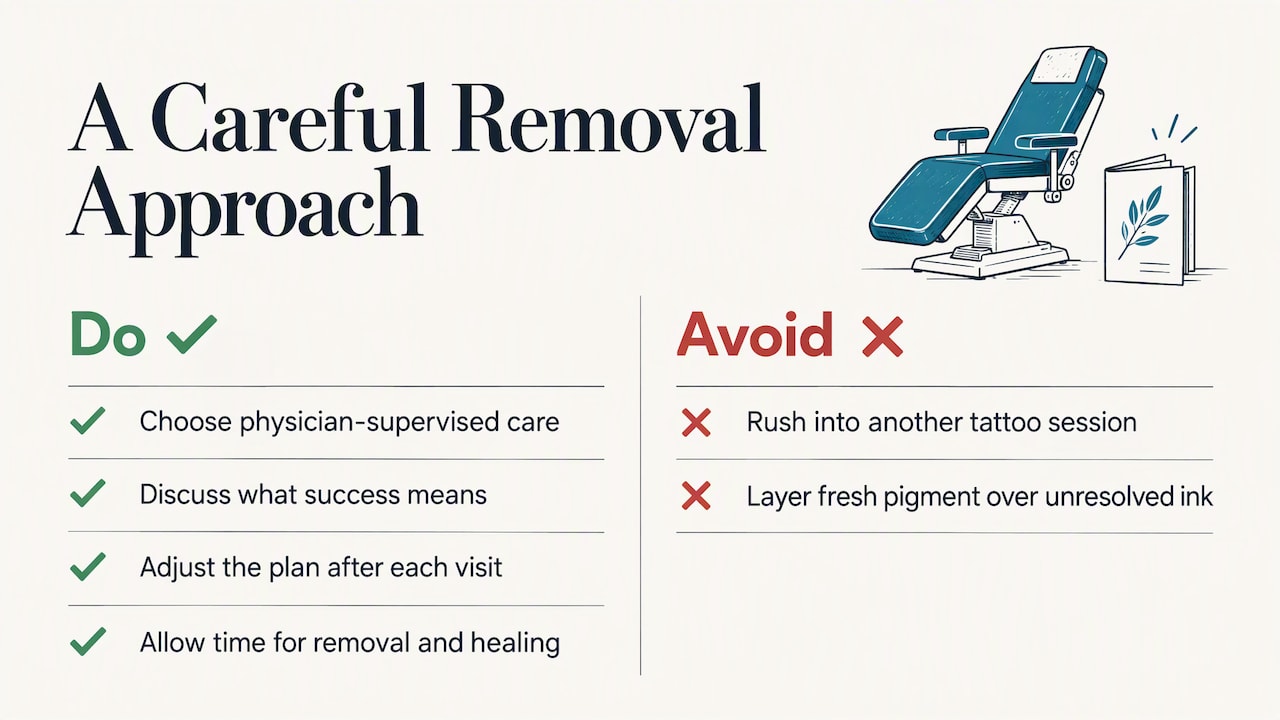
We see brow tattoo removal as a skin-health decision first and a cosmetic one second. The face is unforgiving: thin skin, nearby eyes, and a pigment mix you often cannot identify. That is why we think it belongs in a physician-supervised setting with a real consultation, a conversation about what “success” means for you, and a plan that can be adjusted after each visit.
Here is how we approach it at LA ViE MD. We start by looking at the ink, the skin and your goals. Some clients want the brows gone. Others only want the color neutralized or lightened so a new shape can be placed once the skin has healed. We would rather tell you that a result will likely be partial than sell a promise. Our care is led by Dr. Neetu Nebhwani, a board-certified Internal Medicine physician with over ten years of experience, and every treatment plan is built around the individual client’s skin and goals.
One piece of advice we repeat often: do not rush into another tattoo session to cover a brow you dislike. Layering fresh pigment over unresolved ink often creates a darker, harder-to-treat result. Give removal and healing the time they need.
— Neesh
Planning your brows after removal
Once the skin has fully healed and your provider has cleared you, you have choices: leaving brows natural, using pencil or powder, or a new semi-permanent or permanent design. Because a poor shape is the most common reason people remove brows in the first place, the planning step is worth more than the technique. This guide to choosing eyebrow shapes for your face walks through mapping a shape to your face proportions before you commit to anything lasting.
Two habits keep you from repeating the mistake. Try a shape temporarily with pencil for a few weeks first. And bring photos of your old brows and the results you disliked to your next artist, so they understand the history.
Eyebrow tattoo assessment at LA ViE MD
If you live in Danville, Livermore, Dublin or Los Gatos, or elsewhere in the Bay Area, you can have your brows assessed in person. Our laser procedures include tattoo removal, and our tattoo laser overview explains the basics of how laser erasing works. We can look at your ink, discuss realistic expectations, and put together a plan with spacing that matches your skin’s healing. Pricing for removal is quoted at consultation rather than published, since it depends on the number of sessions.
To get started, request a consultation through our Dublin location page or our main site. Bring photos of how your brows looked when they were first done, and the name of the studio or artist if you remember it.
FAQ
Can eyebrow tattoos fade on their own?
They can lighten and change color over time, especially with sun exposure, but they do not normally disappear. The ink sits in the dermis and is designed to be permanent. If you want it gone or substantially lighter, laser is the usual route.
Can laser remove an eyebrow tattoo 100 percent?
Not always. The FDA says complete removal may not be possible in some cases, and clinical guidance notes that outlines or texture changes can remain. Many people get a large improvement, and that is often enough to reshape or redo the brows.
How long does it take to heal after eyebrow laser removal?
Redness, swelling and sometimes blistering are common at first, and the skin may look uneven for a few weeks. The AAD recommends sun protection of treated skin for 3 months. Your provider will tell you when it is safe to wear makeup or schedule the next session.
Can I get a new eyebrow tattoo after removal?
Generally yes, once the skin has fully healed and your provider agrees. Many people wait until removal is finished, because new pigment over leftover ink can darken or muddy the result. Plan the new shape carefully before you book.
Does insurance cover eyebrow tattoo removal?
Usually not. The ASPS notes that most health insurance does not cover cosmetic procedures or their complications. Ask your provider for a written quote that states the number of sessions and what is included.
Sources
- Tattoo Removal: Options and Results, FDA
- Laser Tattoo Removal: A Clinical Update, PMC
- Laser Removal of Eyeliner and Eyebrow Tattoos, PMC
- Lasers for the treatment of eyebrow microblading, PubMed
- Laser Removal of Cosmetic Eyebrow Tattoos with a Picosecond Laser, MDPI
- Tattoo Removal: How It Works, Cleveland Clinic
- Tattoo removal: Lasers outshine other methods, AAD
- Caring for tattooed skin, AAD
- Tattoo Removal Cost, American Society of Plastic Surgeons