Hollow Cheeks Treatment: What Restores Volume and How
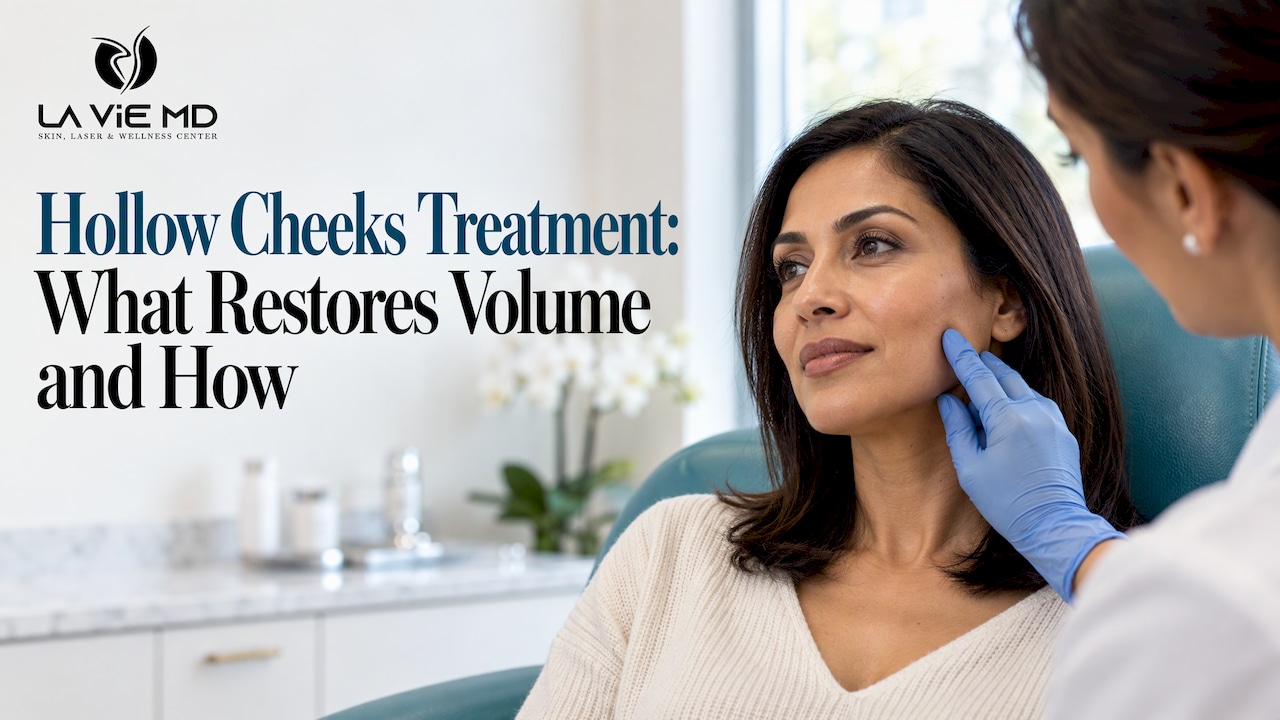
The most direct nonsurgical treatment for hollow cheeks is an injectable filler placed deep in the midface by a trained, physician-supervised injector. It replaces lost volume right away and can be planned around your own anatomy. At LA ViE MD, Dr. Neetu Nebhwani, a board-certified Internal Medicine physician, supervises every treatment and builds a custom plan for each patient, whether you live in Danville, Livermore, Dublin or Los Gatos.
This guide explains why cheeks hollow, which treatments exist, how they differ, what recovery looks like and what to discuss before you book.
TL;DR
- Hollow cheeks usually come from a mix of fat-pad shifts, bone remodeling and weakening support structures, not from one cause.
- Injectable fillers are the nonsurgical option: results are often visible immediately, and the procedure can take from 15 minutes to two hours.
- Sculptra works differently from hyaluronic acid fillers. It builds results gradually, over a few weeks.
- Surgical routes, fat grafting and cheek implants, exist for people who want a permanent change.
- A physician consultation comes first, so the treatment is matched to your face rather than to a trend.
Table of Contents
- Why cheeks become hollow
- Your treatment options at a glance
- Dermal fillers for hollow cheeks
- Sculptra: gradual volume
- Surgical routes: fat grafting and cheek implants
- Do facial exercises fix hollow cheeks?
- Safety: what to know before you book
- How a custom plan is built
- Treating hollow cheeks at LA ViE MD
- Our perspective
- Frequently asked questions
- Sources
Why cheeks become hollow
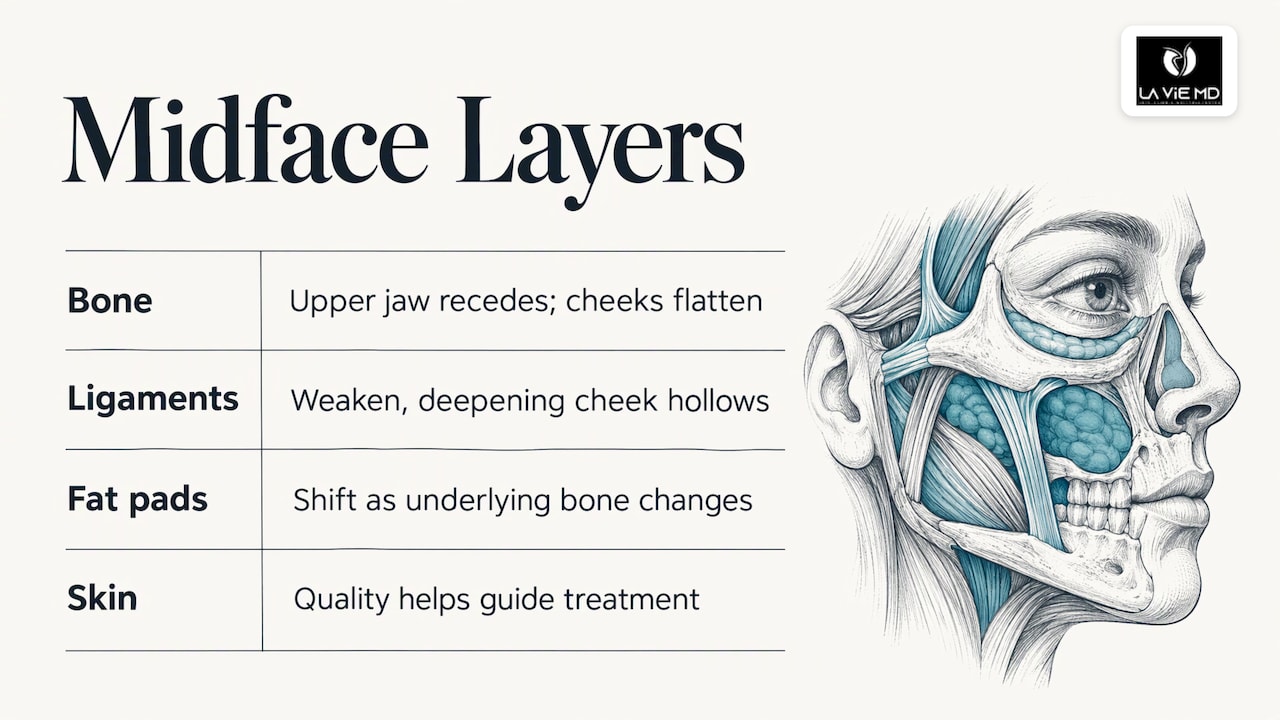
A hollow cheek is rarely just “less fat.” The midface is a layered structure of bone, ligaments, fat pads and skin, and each layer changes over time.
Research on facial aging describes midface bone remodeling as a driver. Between the 30s and 50s, the upper jaw bone recedes slightly and the tooth-bearing bone regresses, which contributes to flattening and hollowing in the cheeks and a deeper groove from nose to mouth. The same review notes that fat pads shift position as the bone beneath them changes and the ligaments that hold them weaken, which deepens the hollows further.
Fat itself matters too. An anatomical study of cadavers found that the cheeks hold roughly half of the total facial and neck fat, so even modest changes in that area alter the whole look of the face.
Other things can contribute: genetics, a naturally narrow or flat midface, significant weight change and some medical situations. That is why a consultation matters. The right treatment depends on whether the problem is volume loss, bone structure, skin quality or a combination.
Your treatment options at a glance
The American Society of Plastic Surgeons describes the goal of cheek augmentation as adding volume or lift. It lists fat grafting or solid cheek implants as the surgical options, and injectable fillers as the nonsurgical option.
| Option | Type | How it works | Typical timeline |
|---|---|---|---|
| Hyaluronic acid filler | Nonsurgical | Gel placed deep in the cheek to restore volume and lift | Immediate result, final look over days to weeks |
| Sculptra (PLLA) | Nonsurgical | Stimulates gradual volume over time | Gradual, building over weeks |
| Fat grafting | Surgical | Your own fat is moved to the cheeks | Surgical recovery |
| Cheek implants | Surgical | Solid implant placed over the cheekbone | Outpatient surgery, weeks of swelling |
For most adults who want a natural refresh without surgery or downtime, fillers and Sculptra are the practical starting point. They are also the options we offer at LA ViE MD.
Dermal fillers for hollow cheeks
Fillers are the most common answer to hollow cheeks because they address the exact problem: missing volume. According to Cleveland Clinic, cheek fillers increase volume and define the cheekbones, the procedure takes from 15 minutes to two hours, and results are often seen immediately.
What the FDA says about cheek filler use
Several hyaluronic acid fillers have FDA approval specifically for the cheeks. The FDA’s summary for one of them states it is indicated for deep injection for cheek augmentation to correct age-related midface volume deficit in adults over 21. The FDA’s summary for another cheek filler likewise lists cheek augmentation and correction of age-related midface contour deficiencies in patients over 21.
The words “deep” and “midface” matter. Cheek filler is placed at a different depth than a filler used for fine lines, and it is placed where it supports the structures that have lost their foundation. Technique and anatomy knowledge are what separate a soft, lifted cheek from a heavy or puffy one.
What a session looks like
Expect a consultation, a review of your medical history, a facial assessment, then the injections. Many people are surprised by how quickly it goes. Most of the visit is planning, not injecting.
Afterward, plan to keep it easy. The FDA documentation advises that patients minimize strenuous exercise and exposure to extensive sun or heat in the first 24 hours. Cleveland Clinic describes recovery as quick, though side effects can occur.
How long cheek filler lasts
Duration varies by product, the area treated and the person, so your provider should give you an estimate for the specific product they recommend. Cleveland Clinic notes that with most cheek fillers some results show immediately, but full results can take several days and sometimes several months. Because the volume is added gradually over a series of visits when needed, many patients treat the cheeks in stages.
For an overview of how filler benefits and longevity are framed, see our guide to dermal fillers for skin rejuvenation and lasting results.
Sculptra: gradual volume
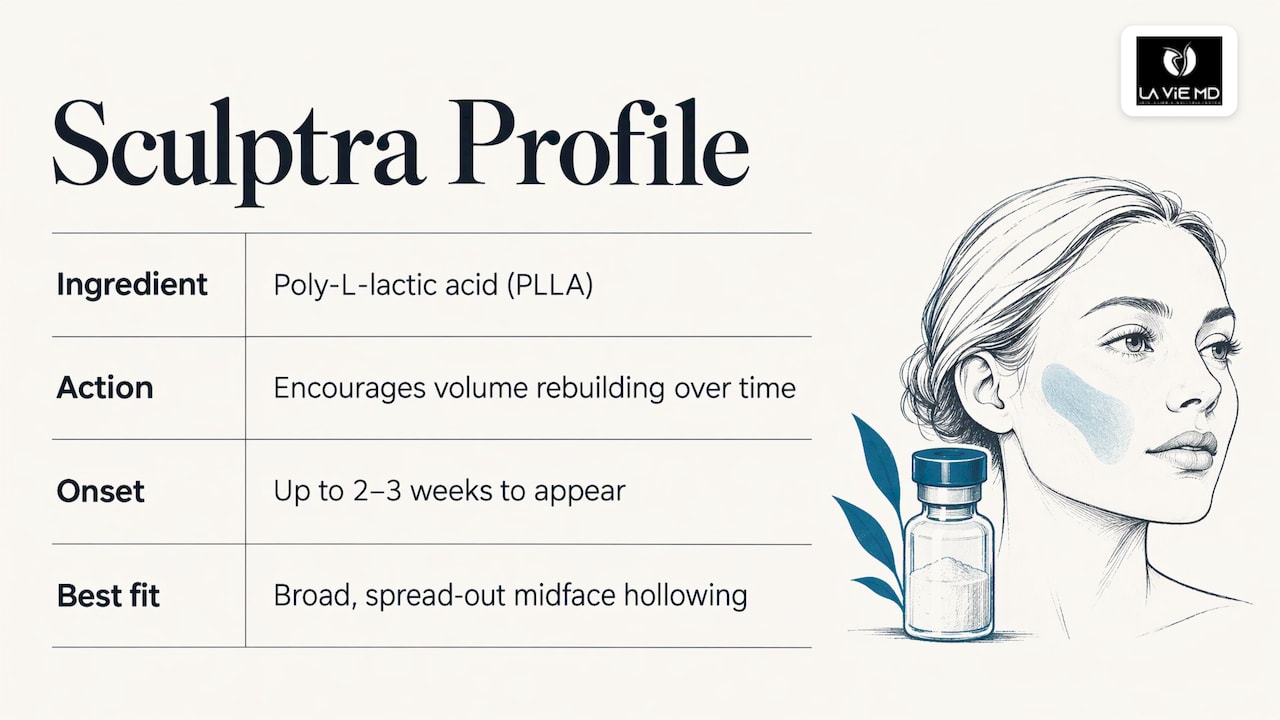
Sculptra contains poly-L-lactic acid (PLLA), a biostimulating ingredient. Instead of simply occupying space, it is used to encourage the skin to rebuild volume over time. Cleveland Clinic says PLLA results can take up to two to three weeks to appear.
This suits patients who prefer a subtle, progressive change over an instant one, and those whose hollowing is broad and spread across the midface rather than concentrated in one spot. We offer Sculptra alongside our other injectables, and during your consultation we help you decide whether it, a hyaluronic acid filler or a combination fits your goals.
Surgical routes: fat grafting and cheek implants
Some people want a permanent change and are ready for surgery. These procedures are performed by a surgeon, not by a medical spa, so they sit outside what we do, but they are part of the honest picture.
- Fat grafting moves your own fat to the cheeks. A systematic review of facial fat grafting found a wide range of reported complication rates, and its authors concluded that the true rate is unknown because reporting is inconsistent.
- Cheek implants are solid and permanent, though removable. Cleveland Clinic says the surgery typically takes up to an hour as an outpatient, and redness and swelling take several weeks to a month to settle.
If you are weighing surgery, a board-certified plastic surgeon is the specialist to see. If your goal is a natural-looking refresh with little downtime, start with a physician consultation about injectables.
Do facial exercises fix hollow cheeks?
They are widely shared online, but the evidence is thin. A 2025 systematic review of 12 studies with 321 women found reported improvements in areas like the cheeks and jawline, yet concluded that the current evidence is not enough to establish efficacy with confidence. Exercise cannot rebuild bone or move displaced fat pads, which is why volume restoration is treated by adding volume where it was lost.
Safety: what to know before you book
Good outcomes start with safe habits. Before any cheek filler treatment, tell your provider:
- if you are pregnant or breastfeeding;
- if you have a history of excessive scarring or pigmentation disorders;
- if you take immunosuppressive therapy;
- if you use aspirin, ibuprofen or other blood thinners, which can prolong bleeding.
These are the items listed in FDA documentation for a cheek filler. Common effects after treatment include bruising, swelling, redness, tenderness and small bumps, which Cleveland Clinic says usually resolve within a week or two. Rare complications include allergic reaction, infection and, very rarely, injection into a blood vessel. Because of this, injecting under physician supervision, with knowledge of facial vascular anatomy, is essential.
Call your provider promptly if you notice severe swelling, skin color changes, worsening pain or any change in vision after treatment, and seek emergency care for vision changes.
If you have heard about lumps shifting over time, our guide on filler migration and how to prevent it explains how placement and technique affect that.
How a custom plan is built
A hollow cheek rarely stands alone. A good plan looks at:
- Where the volume is missing. The front of the cheek, the area beside the nose, and under the eyes can each need different treatment.
- Your bone structure. A naturally flat midface calls for a different approach than age-related volume loss.
- Skin quality. Thin or crepey skin over a hollow may also benefit from skin-rejuvenation treatments alongside volume.
- Your goals. Some people want a subtle lift, others a more defined cheekbone. The plan should match what you want to see in the mirror.
If your hollowness extends toward the lower eyelid, the undereye filler page explains how that area is treated. If your profile feels unbalanced, our article on a recessed chin shows how volume elsewhere in the face can work together with the cheeks.
Treating hollow cheeks at LA ViE MD
Our injectables include dermal fillers and Sculptra, delivered under the supervision of a board-certified physician. Every plan is customized to your skin concerns and aesthetic goals, using advanced technology across our procedures. You can see the options on our dermal fillers page or the Voluma XC page, and we serve patients through our locations, including Dermal Fillers in Dublin, CA and Los Gatos.

We do not publish prices, because cost depends on the product, the amount and your plan. A consultation gives you a clear picture. Start at laviemd.us to book.
Our perspective
Patients often come in asking for “cheek filler” when what they are really describing is a tired or hollow midface. The best results begin with a conversation, not a syringe.
As a physician, I look at the whole face: how the cheek supports the eye area, how it relates to the jawline and where light falls on your features. A natural result usually means restoring balance, not adding the most product.
That is why we build every plan around the individual, offering fillers and Sculptra as tools that can be used alone or together. Medical supervision is the foundation of how we practice, and it is what lets us tailor treatment safely to each patient.
Dr N
Frequently asked questions
Why are my cheeks hollow?
Usually it is a combination of changes: bone remodeling in the midface, shifting fat pads and weakening ligaments. Genetics, a naturally flat midface and weight change can play a part. A physician can tell you which applies to you.
How long do fillers in cheeks last?
It depends on the product and the person. Results often show immediately, and full results can take days to months. Your provider can give a realistic timeframe for the product they recommend.
Is cheek filler painful or does it need downtime?
Cleveland Clinic describes recovery as quick, and the procedure can take from 15 minutes to two hours. Bruising and swelling are common and usually settle within a week or two. Avoid strenuous exercise, sun and heat for the first 24 hours.
Can I fix hollow cheeks without surgery?
Yes. Injectable fillers are the nonsurgical option the American Society of Plastic Surgeons lists, and Sculptra offers gradual volume. A consultation will show which suits your face.
Sources
- The Facial Aging Process From the “Inside Out” (Swift et al., 2020)
- Why do we age in our cheeks? (Raskin & Latrenta, 2009)
- Cheek Augmentation, American Society of Plastic Surgeons
- Cheek Filler: Benefits, Risks & What To Expect, Cleveland Clinic
- Cheek Implants: Types, Surgery & Recovery, Cleveland Clinic
- FDA summary for JUVÉDERM VOLUMA XC
- FDA summary of safety and effectiveness for Restylane Lyft
- Facial Fat Grafting: Worth the Risk? (Schiraldi et al., 2022)
- Efficacy of Conservative Techniques for Mechanical Facial Rejuvenation (2025)