Jowls Treatment: What Works, by Severity
The right jowls treatment depends on what is actually causing yours: loose skin, lost volume, fat under the chin, or overactive neck and jaw muscles. Most people have a mix, which is why one product rarely fixes everything. At LA ViE MD, Dr. Neetu Nebhwani, a board-certified Internal Medicine physician, builds a custom plan after examining your face, using injectables, skin tightening and laser options matched to your concern and goals.
Below, you will find each non-surgical option, what it does for jowls, how long it lasts and what recovery looks like, so you can walk into a consultation knowing what to ask.
TL;DR
- Jowls come from several changes at once: skin laxity, fat shifting, lost support and muscle pull. Treatment works best when it targets the layer that is causing yours.
- Mild to moderate jowls respond to a combination of volume (fillers, Sculptra), muscle balancing (neuromodulators like Botox), fat reduction (Kybella) and tightening (radiofrequency or ultrasound).
- Non-surgical results build gradually over weeks to months and last from a few months to a few years, depending on the treatment.
- Severe sagging is the territory of surgery. Non-surgical care can still help you look your best and may delay when surgery becomes appropriate.
- A physician-led consultation is the fastest way to find out which of these fits your face.
Table of Contents
- What causes jowls
- Matching treatment to your degree of sagging
- Botox and other neuromodulators for jowls
- Fillers and Sculptra: restoring the support under the jowl
- Kybella for fullness under the chin and along the jaw
- Skin tightening: radiofrequency, ultrasound and laser
- What about facial exercises?
- When surgery comes into the picture
- Our perspective
- Start with a consultation at LA ViE MD
- FAQ
- Sources
What causes jowls
Jowls are the soft sag that gathers along the jawline and blurs the line between face and neck. A 2024 guideline in the Journal of Cosmetic Dermatology describes jowl formation as a combination of skin laxity, fat redistribution, loss of support with drooping, and changes in muscle dynamics in the lower face and upper neck.
That list matters because each cause has a different fix:
- Lost volume or support in the cheeks, chin and jawline: restored with fillers or a collagen-stimulating injectable.
- Loose skin: tightened with energy-based devices.
- Fat under the chin or along the jaw: reduced with an injectable that breaks down fat.
- Muscle pull from the neck and lower face: softened with a neuromodulator.
The same guideline says the choice between surgical and non-surgical approaches depends mainly on how much sagging you have, your expectations, your budget, any medical contraindications and how much downtime you can take. A 2023 expert consensus on the lower face and neck recommends working from deep to superficial: first support from the midface and bone structure, then chin and neck fat and volume, and finally skin laxity. In plain terms, a good plan starts with the foundation, not with the surface.
Matching treatment to your degree of sagging
Here is a quick map. It summarizes the sources cited in the sections below; your own face may need a different mix.
| Your situation | Treatments that fit | Typical timeline |
|---|---|---|
| Early jowling, strong skin | Neuromodulator for jaw and neck muscles, filler along the jawline and chin | Neuromodulator effects in 1 to 2 weeks, lasting 3 to 4 months |
| Moderate jowls with volume loss | Filler or Sculptra, plus tightening | Filler results last from months to over a year, depending on product |
| Fullness under the chin or jaw | Kybella, sometimes with tightening | Gradual, with a series of treatments |
| Loose, crepey skin along the jaw | Radiofrequency, ultrasound, or laser resurfacing | Gradual over 2 to 6 months or longer |
| Pronounced, heavy jowls | Surgery is the most complete correction; non-surgical care supports or delays it | Surgical recovery runs weeks to months |
Botox and other neuromodulators for jowls
Neuromodulators (Botox, Dysport, Daxxify) relax muscles. In the lower face, some muscles pull the corners of the mouth and the jawline downward, and the platysma, the thin muscle sheet in the neck, creates bands and tugs on the jaw.
According to a dermatologist’s guide published in the Journal of Cosmetic Dermatology, platysma injections can improve neck contour in up to 91% of patients, with results in one to two weeks that last three to four months. The same guide notes that neuromodulators do not address fullness under the chin or loose skin, so they are one piece of the plan, not the whole plan.
One technique you may hear about is the “Nefertiti lift.” A Dermatologic Surgery review describes it as small injections of 2 to 3 units per site in a horizontal row along the jaw and into the neck band, 15 to 20 units per side in total, relaxing the upper platysma for a more lifted, defined jawline. The review also notes there is currently no FDA indication for “lifting” with botulinum toxin, which is why placement and dosing belong in the hands of a trained physician who knows your anatomy.
Who does this suit best? Patients in their 30s to 50s with early jowling, visible neck bands or a strong lower-face muscle pull, and enough skin quality that the jawline only needs a little help. Because the effect wears off in a few months, it is usually repeated on a regular schedule. You can see what we offer on our injectables page, and our team treats patients at our Dublin, Livermore and Los Gatos locations.
If you have heard that Botox in the jaw muscles can change the lower face, our article on masseter Botox, jowls and prevention explains how dosing and placement affect the result.
Fillers and Sculptra: restoring the support under the jowl
A jowl often looks worse because the chin, jawline and cheeks have lost volume, so the soft tissue has nothing to rest on. Replacing that support can soften the jowl without touching it directly.
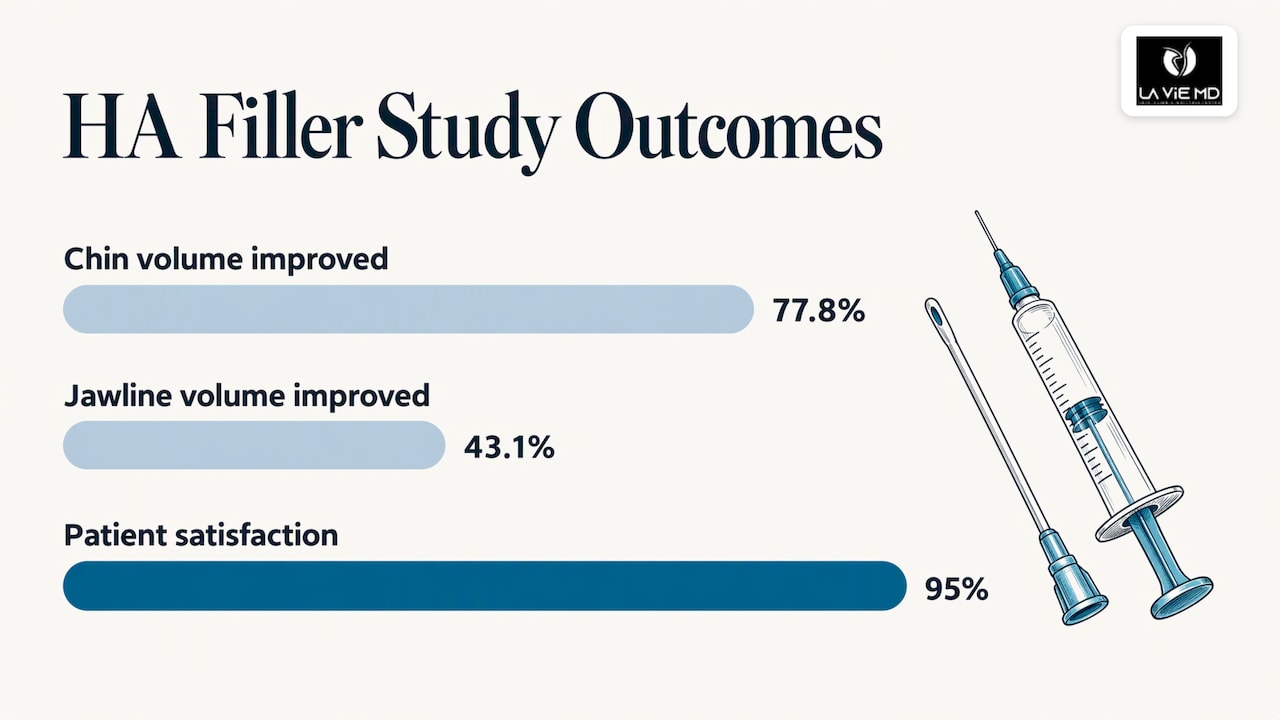
The dermatologist’s guide cited above reports that hyaluronic acid (HA) filler improved chin volume loss by at least one grade in 77.8% of patients and jawline volume loss in 43.1% in an 18-month study, with 95% patient satisfaction. It also notes that HA filler does not solve severe skin laxity or significant fullness under the chin, and that serious vascular complications are rare, particularly when a microcannula (a thin, blunt-tipped tube) is used.
Calcium hydroxylapatite (CaHA) fillers give more structural support and lift than HA. In one study the guide cites, jawline sagging improved for up to one year. In thin skin, such as the neck, diluted formulations lower the risk of nodules.
A 2024 article on the JOLT technique lists the many modalities used for jowls, from lasers and ultrasound to deoxycholic acid and facelift, and observes that the sheer number confirms none is ideal on its own. That is the reason for combining treatments, and for placing filler where it shifts tissue and camouflages the jowl edge rather than simply adding bulk.
We offer dermal fillers and Sculptra, along with Botox and Kybella, on our injectables page. For a closer look at how filler works across the face, read our guide to dermal filler benefits and lasting results. If your concern also includes hollowing in the midface, our page on hollow cheeks treatment explains how volume there supports the lower face.
Filler or Sculptra for jowls?
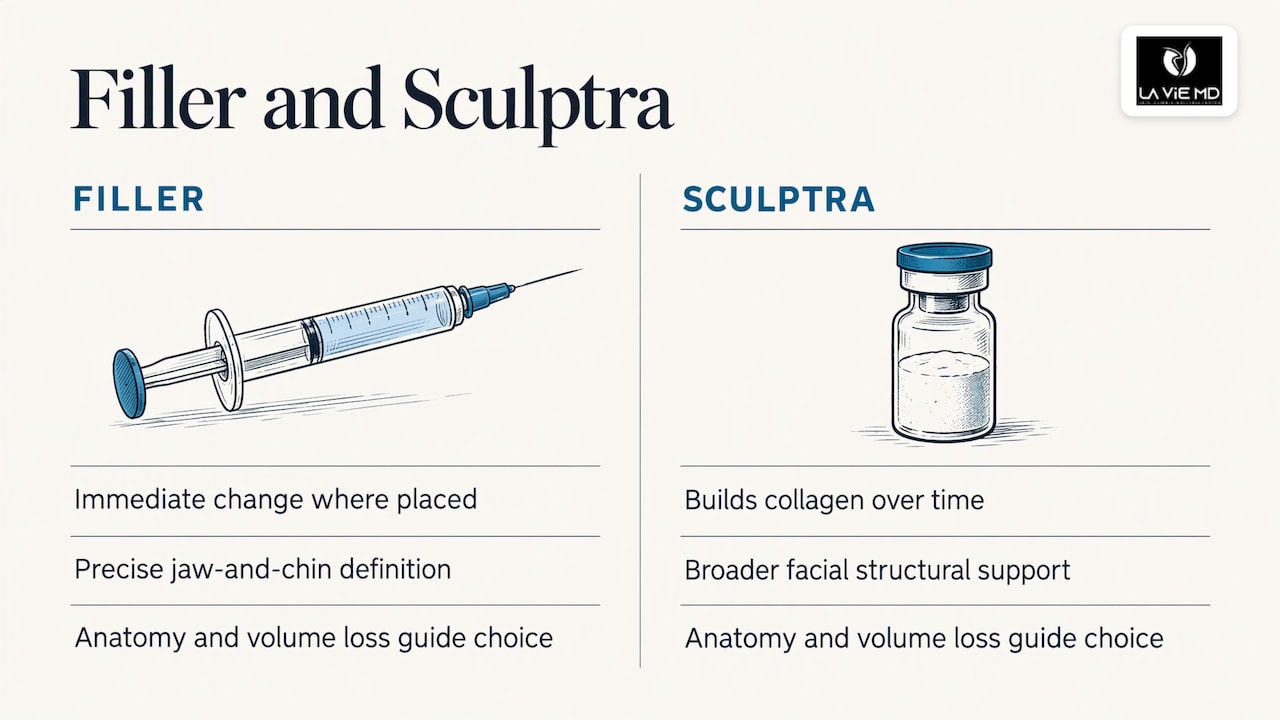
This is one of the most common questions. Both can support the jawline, but they work differently. Filler gives a defined, immediate change in the area where it is placed. Sculptra is a collagen-stimulating injectable, so its effect builds over time and is more about overall structure. Which is better depends on whether you need precise definition at the jaw and chin, or broader support across the face. In many plans the two complement each other. A physician examination settles it, because your bone structure, skin thickness and the location of the volume loss decide the answer.
Kybella for fullness under the chin and along the jaw
Sometimes what reads as a jowl is partly fat. Kybella is an injectable that breaks down fat under the chin. In the guide cited above, deoxycholic acid reduced submental (under-chin) fullness in 91.7% of patients after two treatments, with results sustained for two years. Expected side effects include swelling, redness, pain and numbness. Injury to the nerve that moves the lower lip is infrequent, and hair loss was reported in up to 15% of patients.
The American Society of Plastic Surgeons lists Kybella alongside botulinum toxin for neck bands and fillers for volume as non-surgical tools in the lower face and neck. Our Kybella double chin page walks through what to expect, and our non-surgical neck lift page shows how it can be combined with other treatments for the jaw and neck together.
Skin tightening: radiofrequency, ultrasound and laser
When the dominant issue is loose skin, the answer is energy. Devices heat the deeper layers of skin to prompt the body to produce new collagen, tightening gradually.
The American Academy of Dermatology outlines what to expect:
- Ultrasound: one treatment typically gives modest lifting within two to six months.
- Radiofrequency: results can last two to three years with proper skin care. Minimally invasive versions that use tiny needles show results in about a month, with gradual tightening for close to a year in some studies, and may need a driver home and a compression garment for four to five days.
- Laser resurfacing: the most effective of these for tightening loose skin, with five to seven days of downtime and a higher chance of side effects.
A 2020 review of non-surgical facial rejuvenation found radiofrequency treatments beneficial for jowls, jawline contouring and neck laxity. It also states that radiofrequency is contraindicated in patients with implantable medical devices or healing disorders, so tell your provider about any implant or medical condition. For high-intensity focused ultrasound, the same review expects full results within six months to a year, with swelling, numbness and bruising that generally resolve within one to two months.
A 2021 review of non-surgical skin tightening adds two useful points. Maximal results appear gradually over three to six months, and younger patients with mild to moderate laxity tend to do better than older patients with severe laxity. It suggests repeating tightening every one to two years. That is the practical argument for starting early: the tighter your starting point, the more these devices have to work with.
At LA ViE MD, our skin rejuvenation treatments include Morpheus8 and Forma, and we also offer microneedling, HydraFacial and laser procedures. Our pages on skin tightening treatments and loose skin tightening explain how each fits different skin types and goals.
Skin care between visits matters as well. Daily hydration and sun protection support the skin you are treating, and the same logic applies to fine lines around the mouth, which are a separate concern from jowls. If you are weighing home care against injectables there, this guide to smile lines before injectables is a helpful companion.
What about facial exercises?
Face yoga gets a lot of attention online. UCLA Health reports that a small 2018 study found improved cheek fullness in middle-aged women after 20 weeks of daily or every-other-day sessions of about 30 minutes, and that a 2025 study of 12 participants found better facial muscle tone and elasticity after eight weeks. The same report notes that solid research on face yoga’s anti-aging effect is still limited. Exercises can be a pleasant supplement to professional treatment, but loose skin and lost volume are structural, which is why most people with visible jowls look to treatments that act on those layers.
When surgery comes into the picture
For pronounced jowls, a lower facelift is the most complete correction. The American Society of Plastic Surgeons describes the lower facelift as targeting jowls and marionette lines and sharpening the jawline, most often combined with a neck lift. The AAD says minimally invasive procedures cannot match a facelift, and the 2021 skin tightening review calls surgery the gold standard for skin laxity.
Surgery brings real commitments. The ASPS facelift guide outlines a recovery in which the first week involves significantly limited activity, weeks two and three allow a return to work depending on the job, and swelling and incision lines can take several months to fully settle. It also notes that a facelift is not guaranteed to last a lifetime. UT Southwestern adds that candidacy depends on overall health, stable weight (especially for people using GLP-1 medications), non-smoking status and having help at home. If you are a candidate and want surgery, a board-certified plastic surgeon is the professional to consult for it.
The ASPS also notes that non-surgical options can delay when surgery becomes appropriate and complement surgical results. For many of our patients in Danville, Livermore, Dublin and Los Gatos, that is the goal: a refined, natural jawline with little or no downtime.
Our perspective
Patients usually come to us pointing at one spot and asking for one fix. The jawline rarely works that way. The face is layered, so we look at support, fat, muscle and skin together, and then build a plan around what we find.
That is why a physician should lead this kind of care. Injectables and energy devices act on real anatomy, and the right dose, depth and sequence differ from person to person. Our approach is individualized: custom treatment plans based on your skin concerns and goals, under the direct supervision of a board-certified physician.
For most jowls we are aiming for a lift that looks like you on a good day, not a different face. Combining volume, muscle balance, fat reduction and tightening, spaced over time, is how we get there.
Dr N
Start with a consultation at LA ViE MD
If you are ready to find out which combination fits your jawline, our injectables, skin tightening and laser options are all offered under physician supervision. Dr. Nebhwani brings over ten years of experience as a board-certified Internal Medicine physician and designs each plan around your skin and goals.
Browse our injectables and skin rejuvenation treatments, then book a consultation through laviemd.us at the location nearest you: Danville, Livermore, Dublin or Los Gatos.
FAQ
Can Botox help jowls?
Botox can help when muscle pull from the lower face and neck contributes to the sagging look. It relaxes those muscles for a more lifted jawline, with results in one to two weeks that typically last three to four months. It does not replace volume or tighten skin, so it is often paired with filler or a tightening treatment.
How can I reduce sagging jowls without surgery?
The most effective non-surgical approach is a combination matched to your anatomy: filler or Sculptra for support, a neuromodulator for muscle balance, Kybella for fat, and radiofrequency or ultrasound for skin. Results from tightening build over three to six months. A physician exam determines which of these you need.
Is filler or Sculptra better for jowls?
Neither is better for everyone. Filler gives immediate, defined support along the jaw and chin, while Sculptra stimulates collagen for a gradual, broader change. Many plans use both. Your bone structure, skin thickness and where you have lost volume decide the choice.
How long do non-surgical jowl treatments last?
It varies by treatment. Neuromodulators last about three to four months, CaHA filler in the jawline up to a year in one study, Kybella results were sustained for two years in the cited research, and radiofrequency tightening can last two to three years with good skin care, according to the AAD. Maintenance keeps results going.
Do jowl treatments hurt, and is there downtime?
Most injectable treatments involve brief discomfort and some swelling or bruising. Minimally invasive radiofrequency may require a driver home and a compression garment for a few days, and laser resurfacing means five to seven days of downtime, per the AAD. Your provider will explain what to expect for your specific plan.
Sources
- Revitalizing the lower face: Therapeutic insights, Journal of Cosmetic Dermatology, 2024
- Assessment and Treatment Strategies for the Aesthetic Lower Face and Neck, PMC, 2023
- A Dermatologist’s Guide to Nonsurgical Rejuvenation of the Neck and Jawline
- Lifting With Neuromodulators, Dermatologic Surgery
- JOLT: A Noninvasive Solution for the Correction of the Jowl, PMC, 2024
- Neck Lift, American Society of Plastic Surgeons
- Many ways to firm sagging skin, American Academy of Dermatology
- A review of nonsurgical facial rejuvenation, 2020
- Non-surgical skin tightening, 2021
- Can face yoga make you look younger? UCLA Health
- Facelift options, American Society of Plastic Surgeons
- Facelift patient guide, ASPS
- Facial rejuvenation: Options to restore a youthful look, UT Southwestern
- Smile lines before injectables