
Skin Barrier Repair Products: What to Look For and How to Use Them
The best skin barrier repair products are simple: a fragrance-free cream or ointment with ceramides, fatty acids and a humectant such as glycerin or hyaluronic acid, a gentle cleanser, and daily sunscreen. What matters more than the label is the routine around them: fewer actives, lukewarm water, and patience. If your skin stays stinging, red or flaky after you simplify, or the damage followed a peel or laser session, a physician-guided plan gets you healed faster than trial and error. That is how we work with patients at LA ViE MD, where medical-grade skincare is part of every treatment plan.
TL;DR
- A healthy barrier keeps water in and irritants out. Stinging, tightness, flaking and sudden sensitivity are the usual signs it is compromised.
- Choose fragrance-free creams or ointments built on ceramides, fatty acids, glycerin, hyaluronic acid and petrolatum, and use them on damp skin.
- Pause exfoliating acids, retinoids, scrubs and fragranced products until your skin calms. Most people need three to four months for full recovery.
- Persistent, painful, oozing or infected-looking skin needs a clinician, not another product.
- If your barrier was stressed by a peel, laser or microneedling, ask your provider for a recovery plan matched to the treatment.
Table of Contents
- What the skin barrier is, and how to tell it is damaged
- What a good barrier repair product actually contains
- What to avoid while the barrier heals
- A simple barrier repair routine
- Barrier repair after a peel, laser or microneedling
- When to see a clinician
- Why a physician-guided plan beats a shopping list
- Get a plan built around your skin
- FAQ
- Sources
What the skin barrier is, and how to tell it is damaged
Your skin barrier is the outermost layer of the skin, called the stratum corneum. Cleveland Clinic describes it as a brick wall: flat dead skin cells are the bricks, and ceramides, cholesterol and fatty acids are the mortar. The wall keeps water inside and keeps chemicals and bacteria out.
When the mortar is stripped, the same source lists the signs: dry, scaly or flaky skin, rough patches, itchiness, inflammation, tenderness, breakouts, and stinging when you apply skincare you used to tolerate. That last one is the most telling. If your usual serum suddenly burns, the barrier is likely the problem, not the serum.
A Northwell Health dermatology feature compares a healthy barrier to a waxed car: water beads off when it is intact, and a stripped surface holds moisture poorly and irritates easily. The same article makes a point worth remembering. A shiny or congested face tempts people to over-cleanse, and the problem is stripping, not cleansing.
Common ways people damage it
- Hot water. Cleveland Clinic’s Dr. Piliang uses a butter-on-a-knife image: heat melts the fatty layer away.
- Over-cleansing. The viral 60-second face-massage rule offers no benefit and can break down that fatty layer.
- Stacking exfoliating acids, retinoids and scrubs.
- Harsh or fragranced cleansers and soaps.
- Treatments that deliberately create controlled injury, such as peels, lasers and microneedling, when aftercare is skipped.
What a good barrier repair product actually contains
Product pages ranking for this search often list a dozen ingredients. You need to understand three jobs. Cleveland Clinic’s Dr. Anthony explains the logic in three parts: emollients restore the natural fats, humectants pull water into the skin, and occlusives seal it in. A good repair cream does all three or you layer products that do.
| Job | Ingredients | What it does |
|---|---|---|
| Emollient (replaces lipids) | Ceramides, fatty acids, shea butter, cholesterol | Fills the gaps in the “mortar” |
| Humectant (draws in water) | Glycerin, hyaluronic acid, urea | Pulls moisture into the upper skin |
| Occlusive (seals) | Petrolatum, dimethicone, mineral oil | Slows water loss from the surface |
Cleveland Clinic notes that humectants can sting or burn when applied alone, which is why they work best under a sealing layer. The American Academy of Dermatology recommends fragrance-free creams or ointments rather than thin lotions, and lists jojoba oil, dimethicone, glycerin, hyaluronic acid, lactic acid, lanolin, mineral oil, petrolatum and shea butter among the ingredients to look for. It also warns that “unscented” products can still contain odor-masking chemicals that irritate sensitive skin, so look for “fragrance-free” on the label.
Ceramides
Ceramides are lipids your skin makes naturally. MedlinePlus, the U.S. National Library of Medicine’s health site, tells people with dry skin to look for moisturizers containing them. Cleveland Clinic reports that ceramide-rich products work well for many people with eczema because of their anti-inflammatory effect.
Niacinamide
Niacinamide is a form of vitamin B3, and it is a reasonable add-on to a barrier routine. A peer-reviewed review reports that it improves the integrity of the stratum corneum and skin hydration. In a split-face trial of 50 women, 5% niacinamide applied twice daily for 12 weeks reduced fine lines, dark spots, blotchiness and sallowness. Laboratory work also shows that topical nicotinamide raised ceramide and fatty acid levels in the stratum corneum and lowered water loss through dry skin.
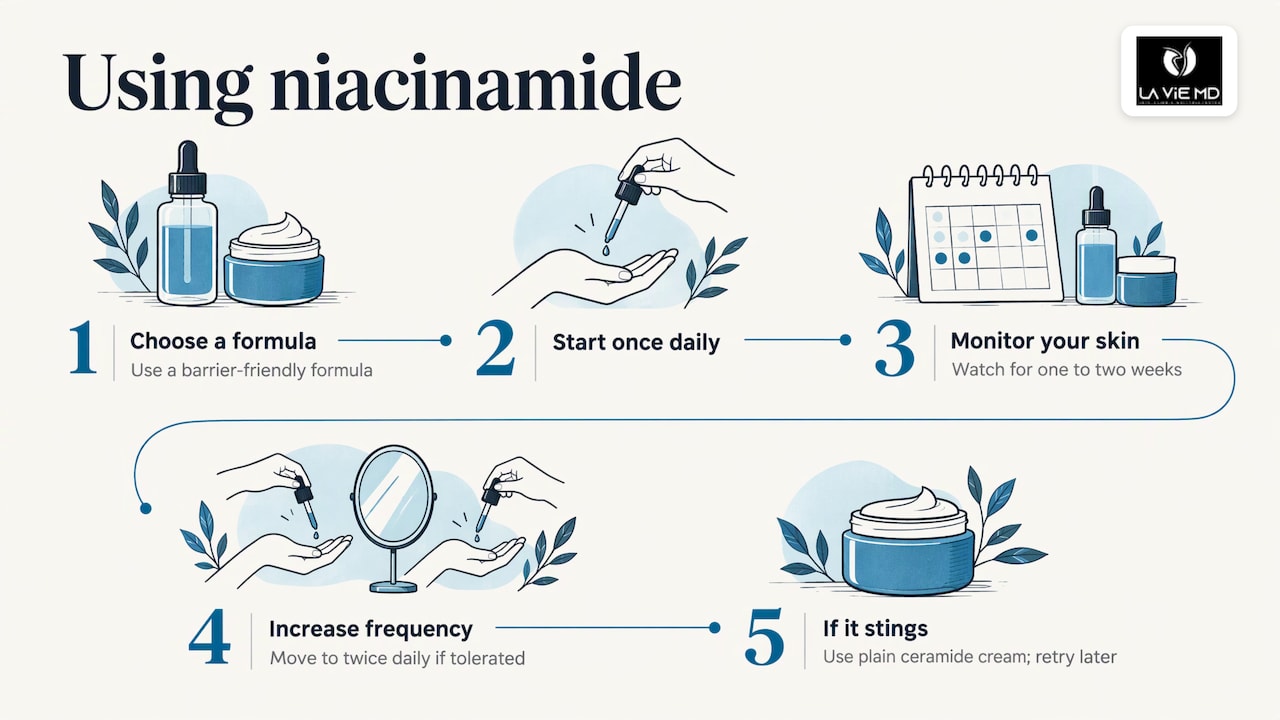
How to use it: introduce it into a barrier-friendly formula, apply it once a day at first, and watch how your skin responds over a week or two before moving to twice daily. If a niacinamide product stings, your barrier may be too compromised for it right now. Go back to a plain ceramide cream and retry later.
Hyaluronic acid and glycerin
These hold water at the surface. A panel of nine dermatologists writing in the Journal of Drugs in Dermatology considered ceramides, hyaluronic acid and niacinamide beneficial for barrier-compromised skin such as rosacea, along with avoiding potentially irritating ingredients. They recommended over-the-counter products as part of a maintenance regimen, not only as a short fix.
What to avoid while the barrier heals
Repair is as much about subtraction as addition. Pause these until your skin is calm:
- Alcohol-containing products, fragrance and fragranced soaps. The AAD advises avoiding alcohol, alpha-hydroxy acids and fragrance to help skin hold its natural moisture.
- Retinoids on dry, irritated skin. The AAD lists them among products to stop using on dry skin.
- Olive oil, essential oils, lanolin, botanicals and sodium lauryl sulfate. Cleveland Clinic’s dermatologist flags these for stinging, itch, redness or allergy risk. Olive oil’s fatty-acid balance can damage the barrier.
- Scrubs and microbeads. Cleveland Clinic suggests that when you do exfoliate, use a mild AHA exfoliant rather than physical grains, and only once the skin is tolerating it.
- Hot showers and long cleansing. Use warm water, and keep the wash short.
Northwell’s guidance sums up the principle: cut back on anything that burns, stings or leaves skin tight, and give skin fewer things to react to.
A simple barrier repair routine
- Cleanse once or twice a day with a mild, soap-free, fragrance-free cleanser. MedlinePlus advises avoiding scrubbing, and Cleveland Clinic’s advice is to skip the extended massage.
- Moisturize on damp skin. Cleveland Clinic recommends applying emollients within about three minutes of showering, warming the product between your hands and rubbing it in gently. MedlinePlus suggests moisturizing two to three times a day.
- Seal if needed. On very dry areas, a petrolatum-based ointment on top is the occlusive step. During an eczema flare, Cleveland Clinic suggests reapplying every three to four hours.
- Wear sunscreen every morning. Cleveland Clinic lists daily sunscreen as part of barrier care.
- Back off active treatments. Pause acne products on broken skin, and keep exfoliants and retinoids out until the stinging stops.
- Give it time. Cleveland Clinic says visible repair typically takes three to four months, so judge the routine over weeks, not days.
If your concern is mostly dryness, our guide to dry skin treatment, step by step goes deeper on moisturizers and in-office options.
Barrier repair after a peel, laser or microneedling
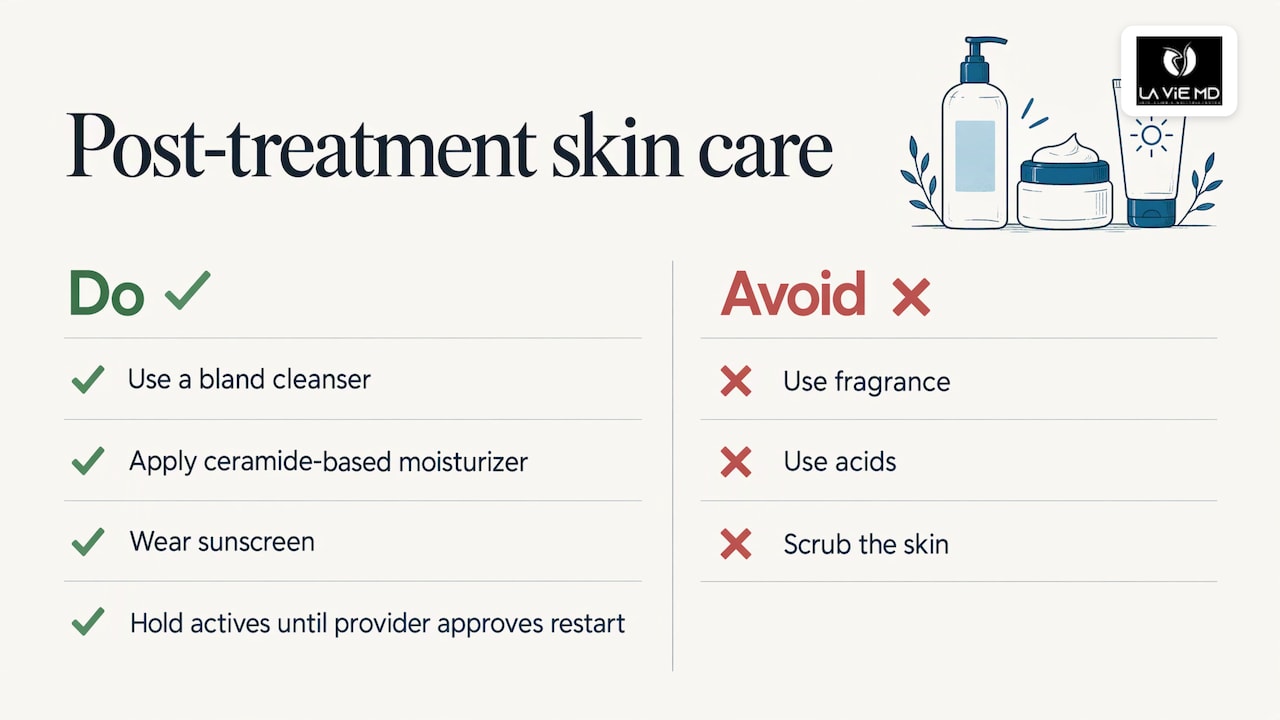
This is the situation most people searching this phrase are really in: a treatment left skin pink, tight and reactive, and now every product stings. Mild redness and tightness after a superficial peel or microneedling can be a normal part of healing, but it is the time when a gentle, minimal routine matters most. Use only a bland cleanser, a ceramide-based moisturizer, and sunscreen, and hold your actives until your provider says to restart.
If you were treated with us, follow the aftercare you were given. For microneedling specifically, we outline what to do and when in our microneedling aftercare guide. Because it is the same barrier whatever the procedure, the same principles apply: no fragrance, no acids, no scrubbing, and lots of patience.
When to see a clinician
Barrier damage that does not improve is not always a product problem. Northwell says to see a dermatologist if skin is very inflamed, painful, swollen, blistered, crusted or oozing, or is not improving after you simplify your routine. Persistent symptoms can point to eczema, contact dermatitis, infection, a medication reaction or another skin condition that needs treatment.
MedlinePlus adds that you should call your provider if itching occurs with no visible rash, dryness keeps you from sleeping, or you have open cuts or sores. Cleveland Clinic advises emergency care for a rash with fever, blistering, oozing yellow or green fluid, sudden rapid spread or pain. Those signs are not something to treat with a cream.
Why a physician-guided plan beats a shopping list
The internet answer to a damaged barrier is a list of ten viral creams. The trouble is that the right product depends on why the barrier is damaged: over-exfoliation, a flare of rosacea or eczema, a seasonal change, or a treatment that was meant to resurface the skin. Each calls for a different level of richness, a different restart date for your actives, and sometimes a different treatment altogether.
The cause also decides what comes next. Once the barrier is stable, concerns such as texture, pigmentation or fine lines are easier and safer to treat, because calm, hydrated skin tolerates treatment better. If you are weighing your options, our pages on uneven skin texture and dermaplaning versus HydraFacial explain how treatments fit in.
What we tell patients about barrier repair
Most barrier problems we see are not caused by too little skincare. They come from too much of it, or from the wrong kind at the wrong time. Our approach is to simplify first, then build a plan around the patient’s skin and goals.
Medical supervision matters here because the same redness can be a reaction to a product, a skin condition, or a normal part of healing after a procedure. A physician can tell the difference and choose a regimen to match, rather than leaving you to guess from a label.
We believe treatments and skincare work best together. Medical-grade skincare protects the results of the procedures we perform, and a healthy, well-hydrated barrier is the foundation for them. That is why every plan we create is individualized to your skin concerns and aesthetic goals.
Dr N
Get a plan built around your skin
LA ViE MD is a boutique medical spa in the Bay Area led by Dr. Neetu Nebhwani, a board-certified Internal Medicine physician with over ten years of experience. We create custom treatment plans, offer medical skincare products, and provide medical-grade facials such as HydraFacial, microneedling and more. If your skin has been reactive, tight or irritated and you want a physician’s guidance on what to use and when to restart treatments, book a consultation at our skin rejuvenation treatments page, or start at laviemd.us. We serve patients in Danville, Livermore, Dublin and Los Gatos.
FAQ
What is the best skin barrier repair cream?
The best one is fragrance-free and combines ceramides, fatty acids and a humectant such as glycerin or hyaluronic acid, ideally in a cream or ointment rather than a thin lotion. That follows AAD guidance on what to look for. Beyond that, the best product is the one your skin tolerates without stinging, so a physician’s recommendation can save you months of trial and error.
Can niacinamide repair the skin barrier?
It can help. Published research reports that niacinamide improves stratum corneum integrity and skin hydration, and laboratory data show it raises ceramide levels. Start with one application a day in a gentle formula, and pause it if your skin stings, then reintroduce it once the barrier is calmer.
How long does it take to repair a damaged skin barrier?
Cleveland Clinic says barrier repair typically takes three to four months to show benefits. You may feel less stinging and tightness sooner once you strip your routine back. If nothing improves after you simplify, see a clinician to rule out eczema, contact dermatitis or infection.
Should I use a barrier cream after a chemical peel?
Only use what your provider advises. In general, after a superficial peel the safest routine is a mild cleanser, a fragrance-free ceramide moisturizer and sunscreen, with exfoliating acids and retinoids on hold. Call your provider if you have blistering, oozing, severe pain or swelling.
Sources
- Cleveland Clinic: Signs your skin barrier is damaged
- Northwell Health: Damaged skin barrier, signs, causes and what helps
- Cleveland Clinic: Best creams and lotions for eczema
- Cleveland Clinic: Emollients
- AAD: Dermatologists’ top tips for relieving dry skin
- AAD: How to pick the right moisturizer
- MedlinePlus: Dry skin, self-care
- PMC: Niacinamide review (Ceilley, 2017)
- Journal of Drugs in Dermatology: Barrier deficiency in rosacea
- Niacinamide increases biosynthesis of ceramides


