
Recessed Chin: Causes, Fixes and When Filler Helps
A recessed chin means your chin sits further back than the rest of your face, so your profile looks softer or less balanced from the side. It is usually an inherited trait, not a medical problem. If the cause is mild to moderate, dermal filler can add projection in a short visit with no surgery. If the jaw itself sits far back, surgery does what filler cannot. Below, we explain how to tell which situation you are in and what each option really delivers.
TL;DR
- A recessed chin (retrognathia or microgenia) is usually a normal inherited trait, but jaw pain, chewing trouble, snoring or chronic mouth breathing deserve a medical check.
- Chin filler suits mild to moderate cases. Manufacturer data points to results lasting up to about a year, and fillers cannot fix a structurally misaligned jaw.
- Surgery (implant, sliding genioplasty) is permanent and more invasive. Fat grafting is a middle path with its own trade-offs.
- Provider skill matters most. Chin filler has real vascular risks that an anatomy-savvy, physician-supervised injector is trained to avoid.
- A consultation tells you whether filler, a combination plan or a surgical referral fits your goals.
Table of Contents
- What a recessed chin actually is
- Why it happens
- Can you fix a recessed chin naturally?
- Your options compared
- How chin filler works
- Safety: why the injector matters
- Our perspective
- Choosing between filler and surgery
- What to expect at a chin filler consultation
- See what filler could do for your profile
- FAQ
- Sources
What a recessed chin actually is
Doctors call a lower jaw that sits behind where it should be retrognathia. It is judged from the side, which is why many people only notice it in photos or when they catch their profile in a mirror. “Recessed,” “receding” and “weak” chin all describe the same look in everyday language.
Two things are often mixed up:
- The jawbone sits back. The whole lower jaw is positioned behind the upper jaw. This is a skeletal issue.
- The chin point is small. The jaw is fine, but the bony tip of the chin projects less. This is sometimes called microgenia.
The distinction matters because it decides what can work. A small chin point responds well to added volume. A jaw that is truly set back may need a bite or bone solution.
Why it happens
Per the Cleveland Clinic, a recessed chin is often simply an inherited feature. It can also relate to jaw alignment (malocclusion) or, less often, to functional issues such as sleep-disordered breathing.
Common contributors include:
- Family genetics, the most frequent explanation.
- Bite and jaw alignment differences.
- Natural aging, as bone and soft tissue change over time and the lower face loses definition.
- Less commonly, conditions present from birth that your doctor would identify.
When to get a medical opinion first
If your chin comes with jaw pain, difficulty chewing, chronic mouth breathing or snoring, see your primary care doctor, dentist or an orthodontist before any cosmetic treatment. Those symptoms can point to a bite or airway issue that should be evaluated on its own terms. A cosmetic fix is not a substitute.
Can you fix a recessed chin naturally?
No exercise, posture habit or supplement moves bone. What you can do without needles or surgery is change how balanced your lower face looks:
- Reduce submental fullness. Fat under the chin can hide the chin line and make recession look worse. Our page on Kybella for a double chin explains one way to address it.
- Look at your neck and jawline. Loose skin below the chin blurs the profile. A non-surgical neck lift targets that area.
- Check your nose. Plastic surgeons note that a small chin can make a nose look larger, which is why MedlinePlus mentions combining chin work with rhinoplasty for some patients. A non-surgical option for the nose exists on our injectables page.
Those are balancing moves. They do not change the underlying bone.
Your options compared
| Option | Invasiveness | Duration | Best for |
|---|---|---|---|
| Dermal filler | Injections, minimal downtime | Temporary, up to about 1 year per manufacturer data | Mild to moderate recession, trying a new profile |
| Fat grafting | Minor surgery | Long lasting, with a study reporting 82% survival at six months | Patients wanting stable volume using their own tissue |
| Chin implant | Surgery | Generally permanent | Moderate to significant projection |
| Sliding genioplasty | Surgery on the bone | Permanent | Larger skeletal differences |
The Cleveland Clinic describes surgical options as generally permanent but invasive, and filler as suitable for mild to moderate contouring but not a cure for structural jaw misalignment. ASPS calls surgical augmentation one of the most effective ways to increase chin projection, width or length.
How chin filler works
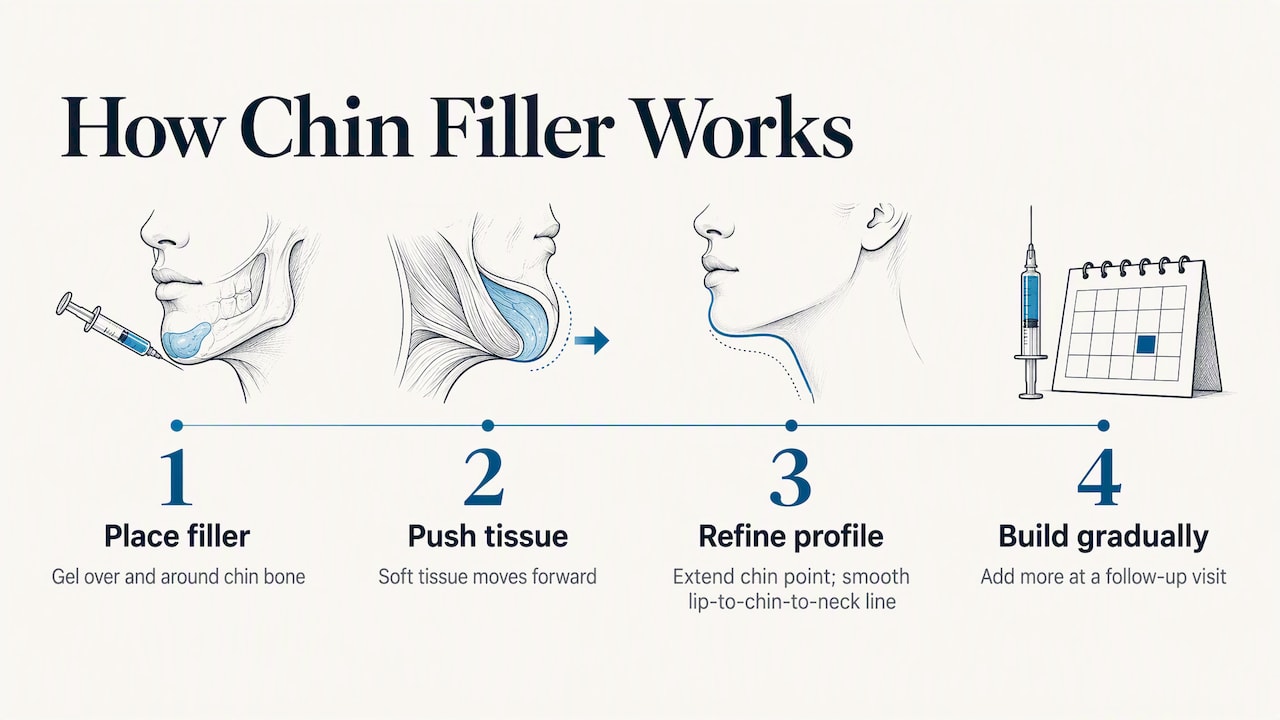
Filler is a gel placed over and around the chin bone to push the soft tissue forward. The aim is to extend the chin point and smooth the line from lip to chin to neck. Because it is built up in small amounts, your provider can add more at a follow-up visit instead of committing to everything at once.
The FDA regulates dermal fillers as medical device implants, and some products carry labeling for augmenting the chin region to improve the chin profile. Ask any provider which product they plan to use and why.
What results look like
Manufacturer data cited on the Juvederm chin page reports over 90% patient satisfaction in studies, results lasting up to about a year with optimal treatment, and mild swelling, bruising and tenderness that generally settle within two to four weeks. A systematic review of chin filler studies is also available if you want the clinical detail. Treat any satisfaction figure from a manufacturer as marketing-adjacent, and rely on your own consultation and before-and-after photos.
What filler cannot do
Experts caution that fillers cannot replace the skeletal change surgery achieves. If you have loose skin or need significant bone advancement, a good provider will tell you filler will likely disappoint. ASPS guidance stresses managing expectations: filler offers minimal-to-moderate change, not a transformation. Treatment is also generally delayed until skeletal maturity, usually between 14 and 18, per the Cleveland Clinic.
Safety: why the injector matters
The most serious filler risk is injection into a blood vessel, which can cause tissue death and, in rare cases elsewhere on the face, vision loss or stroke, according to the FDA. Careful providers use techniques such as aspiration, pulling back on the plunger before injecting, to check the needle is not in a vessel. The ASPS says facial filler is safe when done by a board-certified or experienced practitioner, and that complications are uncommon and generally mild, though rare serious ones occur.
Practical checks before you book:
- Confirm a licensed physician supervises the practice and who will inject you.
- Ask how they handle a vascular complication, and what they keep on hand.
- Ask what they would not treat. A provider who says yes to everything is a warning sign.
- Review before-and-after photos of chin patients, not only lips.
If swelling is severe, or you notice intense pain, skin that turns pale or dusky, or any vision change after filler, contact your provider immediately or go to emergency care.
Settling for a cheaper injector is a poor trade here. Misplaced filler can also shift or look lumpy over time, which is why we wrote a guide to filler migration and how to prevent it.
Our perspective
Most people who come to us about a recessed chin ask for “chin filler” because that is the name they have seen online. We start one step earlier: what bothers you, and from which angle? Often it is the profile, sometimes the nose, sometimes a soft neckline that makes the chin look smaller than it is.
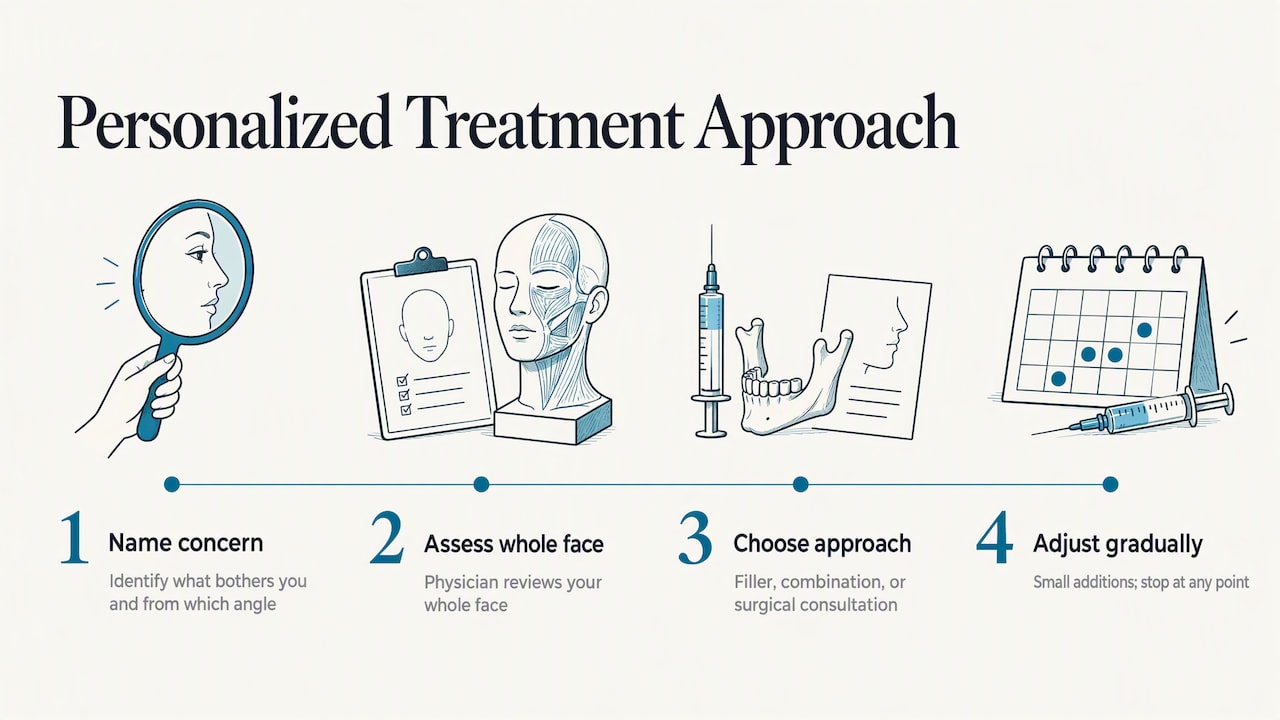
Our approach is built around a physician who looks at your whole face. Dr. Neetu Nebhwani is a board-certified Internal Medicine physician with more than ten years of experience, and every plan is medically supervised and custom. That means we will say so when filler is a good fit, when a combination such as chin plus jawline or neck work balances you better, and when your goals are beyond what an injectable can reach and a surgical consultation is the honest answer.
We also like gradual work. Small, deliberate additions keep your face looking like yours, and you can stop at any point. If you are unsure you will like a stronger profile, a temporary option lets you live with it first.
— Neesh
Choosing between filler and surgery
Filler tends to fit if:
- Your bite is normal and the chin is mildly to moderately short on projection.
- You want to preview a new profile before committing.
- You prefer minimal downtime and accept maintenance.
Surgery or a surgical consult fits better if:
- You want a permanent change.
- The jaw is clearly set back, or you also have a bite problem or sleep symptoms.
- You would need a large volume of filler to see the effect you want.
Fat grafting sits between the two. The ASPS describes it as reliable and lasting, using your own fat, without a synthetic implant. It is a surgical procedure, so it belongs with a plastic surgeon, not a med spa.
What to expect at a chin filler consultation
- Profile assessment. We look at your face from the front and the side, and discuss which features you want to change.
- Medical history. Allergies, medications, prior filler and any bite or airway symptoms.
- A plan. Which areas, how gradual, and whether other treatments belong in it.
- Treatment. Filler is placed in small amounts, with attention to anatomy.
- Aftercare and follow-up. Expect some swelling and bruising, with a check-in to adjust if needed.
If you are comparing treatments more broadly, our guides to dermal filler benefits, Sculptra and fillers and Botox versus fillers explain how each one works. If a clenched jaw or bulky masseters make the lower face look heavy, our article on masseter Botox covers that question.
See what filler could do for your profile
LA ViE MD is a boutique, physician-supervised medical spa in the Bay Area serving patients from Danville, Livermore, Dublin and Los Gatos. Our injectables include dermal fillers and non-surgical rhinoplasty, and we build each plan around your face. We do not publish prices for these treatments, so reach out through our site to book a consultation and get a plan for your goals.
FAQ
What causes a recessed chin?
Most often it is inherited. It can also come from jaw alignment differences, aging changes or, less commonly, functional issues such as sleep-disordered breathing. If you also have jaw pain, chewing problems, snoring or chronic mouth breathing, see a doctor or dentist first.
Can a recessed chin go away on its own?
No. The bone structure does not change in adulthood without treatment. Weight changes and aging can alter how noticeable it looks, but the underlying position stays.
Does chin filler work for a recessed chin?
It can, for mild to moderate cases. Filler adds forward projection and smooths the profile, but it is temporary and cannot correct a structurally misaligned jaw. A consultation shows whether your anatomy suits it.
How long does chin filler last?
Manufacturer data for one chin filler reports results that can last up to about one year with optimal treatment. Duration varies by product, amount and your own body, so ask your provider what to expect for the product they recommend.
Can you look good with a recessed chin?
Yes. Facial balance is subjective, and many people with a softer chin never treat it. If it bothers you, options exist, from filler to surgery, and a thoughtful provider will help you decide whether you want any of them.
Sources
- Retrognathia, StatPearls (NCBI Bookshelf)
- Genioplasty (Chin Augmentation), Cleveland Clinic
- Retrognathia, Cleveland Clinic
- Chin surgery overview, MedlinePlus
- Juvederm for Chin
- Dermal Fillers (Soft Tissue Fillers), FDA
- FDA labeling document for chin augmentation
- Chin augmentation with injectable fillers: systematic review and meta-analysis
- Expert review of facial filler safety (PMC)
- Danger zones and filler safety, ASPS
- Sculpting the male jawline: chin and neck contouring 101, ASPS
- Fat grafting for chin augmentation, ASPS