

Double Chin Treatment: Options, Results and Safety
The most studied way to reduce a double chin without surgery is a deoxycholic acid injection, sold as Kybella. It dissolves the fat under the chin, and it is the only injectable the FDA has approved for that purpose. Whether it is the right choice for you depends on what is under your chin: fat, loose skin, muscle bands or a mix. That is why a physician exam should come before any treatment. At LA ViE MD, Kybella for double chin is offered under the supervision of Dr. Neetu Nebhwani, a board-certified Internal Medicine physician, to patients in Danville, Livermore, Dublin and Los Gatos.
TL;DR
- Kybella (deoxycholic acid) is the most studied nonsurgical option for submental fat, the medical term for fat under the chin, according to a 2026 systematic review of 30 studies.
- The FDA label allows up to 6 treatments, at least 1 month apart. Swelling, bruising and numbness are expected, so plan for social downtime.
- Fat is only one cause of a soft jawline. Loose skin and muscle bands call for a different plan, and a physician should assess them before you choose.
- Kybella is approved for the area under the chin only. Injecting elsewhere is not an approved use and carries serious warnings.
Table of Contents
- What actually causes a double chin
- Your options, from least to most invasive
- How Kybella works and what to expect
- Safety: who should be careful and why technique matters
- Is it fat, skin, or both?
- Why a physician-led medical spa suits this treatment
- Planning your treatment
- Treatment close to home
- FAQ
- Sources
What actually causes a double chin
A double chin is a pocket of fat under the chin and above the neck. It is commonly linked to aging, weight gain or a genetic predisposition. That last factor explains why some slim people have one: the fat pad can be inherited, so diet and exercise do not always remove it.
Three things combine to shape the area.
- Fat. A pocket that sits between the skin and the muscle underneath.
- Skin quality. Skin loses elasticity over time. Where it is loose, it hangs even when the fat beneath is modest.
- Structure. The bone of the chin and jaw, and the muscle bands in the neck, change how the area looks. A small or recessed chin can make the neck look fuller.
Losing weight can shrink the fat, but it rarely removes a stubborn pocket completely. It can also leave looser skin behind. Most people who search for treatment are in this situation: healthy habits, and a jawline that still does not match how they feel.
Your options, from least to most invasive
Treatments sort into three groups. Which one fits depends on what the exam finds.
| Approach | What it targets | Typical downtime |
|---|---|---|
| Injectable fat dissolving (Kybella) | Fat under the chin | Swelling and bruising for days to weeks |
| Energy-based devices (radiofrequency, microneedling with radiofrequency, fat freezing) | Mild fat, skin tightening | Minimal |
| Surgery (liposuction, neck lift) | Fat, skin and muscle | About two weeks of swelling and bruising |
The 2026 review found injectable deoxycholic acid to be the most studied and effective nonsurgical option, with at least a one-grade improvement in most patients and satisfaction rates of 67% to 86%. Energy-based devices showed promising results with minimal downtime. Most side effects across the studies were mild, temporary and local.
Surgery sits at the other end of the range. Recovery after a surgical procedure is about two weeks of swelling and bruising, with a return to work within a week or two, and its risks include asymmetry, bleeding, nerve damage and scarring. Those are the reasons many people begin with a nonsurgical plan.
How Kybella works and what to expect
Kybella contains deoxycholic acid, a molecule the body naturally uses to break down dietary fat. Injected into the fat under the chin, it destroys the fat cells in that spot. The FDA label says it is indicated for moderate to severe fullness associated with submental fat in adults. The dose is 2 mg/cm², with up to 50 injections (10 mL) per session. Treatments are spaced at least one month apart, up to six in total.
How many sessions
The label’s trials give the clearest numbers. Twelve weeks after the last treatment, 70.0% of patients in Trial 1 and 66.5% in Trial 2 showed at least a one-grade improvement on a combined clinician and patient rating, against 18.6% and 22.2% with placebo. A two-grade improvement was seen in 13.4% and 18.6%. In the trials, 59% of subjects received all six treatments.
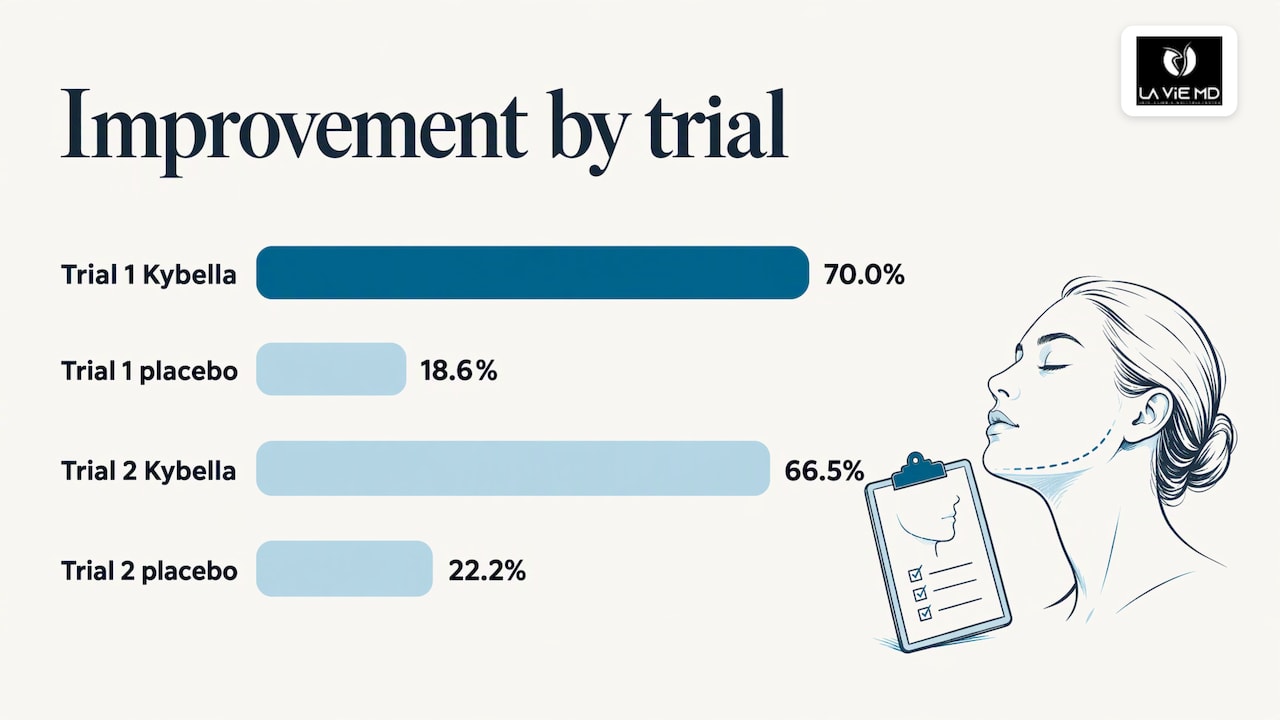
So the usual plan is a series, not a single visit. Some people need fewer sessions than the maximum, and a physician sets the number after seeing how your fat responds. Results appear gradually as the body clears the treated fat, which is why the trials measured at 12 weeks.
What the first days look like
The FDA label lists what trial participants experienced:
- Swelling: 87%
- Bruising: 72%
- Pain: 70%
- Numbness: 66%
- Redness: 27%
- Firmness (induration): 23%
- Nodules: 13%
Some effects last longer than 30 days in more than 10% of people: numbness (42%), swelling (20%), pain (16%) and firmness (13%). The systematic review adds that side effects typically resolve within 28 days. If you have an event, a photo shoot or a video-heavy week coming, schedule the session well ahead of it.
Safety: who should be careful and why technique matters
The FDA updated the Kybella label in September 2026. According to the agency’s labeling change record, the update added a contraindication for infection in the injection area, new warnings on marginal mandibular nerve injury (the nerve that moves the corner of the lower lip), difficulty swallowing and injection site reactions, and guidance on avoiding injection within 1 to 1.5 cm of salivary glands, lymph nodes and muscles. The American Med Spa Association reported that the update also warns of serious events after use outside the submental region, including blurred vision, muscle and nerve damage, weakness and numbness.
What that means for you:
- Placement matters. Very superficial injections into the skin can cause ulceration and necrosis. The label reports nerve injury in 4% of trial subjects, with a median resolution of 44 days, and trouble swallowing with a median of 3 days. Injection into the right layer and area is the point of having a trained physician do it.
- Stay within the approved area. Kybella is approved for fat under the chin in adults. It is not for other parts of the face or body.
- Tell your physician about your history. The label directs clinicians to screen for other causes of fullness under the chin, such as an enlarged thyroid or swollen lymph nodes, and to avoid use in anyone with current or prior difficulty swallowing. It also calls for careful consideration in patients with very loose skin or prominent neck bands.
- Bleeding risk. The review advises delaying treatment in patients with bleeding disorders or on anticoagulant or antiplatelet therapy until clotting values normalize. Tell your physician about blood thinners.
- Age. Safety and effectiveness have not been established in patients under 18, and trials did not include enough people 65 and over to know whether they respond differently.
- Stop signs. Treatment is discontinued if ulceration, necrosis, a nodule, a mass or infection develops. Call your physician promptly if you see any of these.
These are the reasons a medical consultation comes first. A peer-reviewed 2023 review of lower face and neck treatment advises clinicians to first consider whether a patient is better suited to surgery and is willing to have it, and only then to choose nonsurgical options. The same review has them assess bone structure, submental fat, muscle prominence and skin laxity.
Is it fat, skin, or both?
This is the question that decides your result. Use these rough guides as a starting point, then have a physician confirm.
- A soft, pinchable pocket under the chin and fairly firm skin. This is the profile Kybella is approved for.
- Mild fullness with some looseness. Skin tightening can help the tissue look firmer. At LA ViE MD, radiofrequency microneedling with Morpheus8 and Forma are among the skin rejuvenation treatments offered.
- Both fat and laxity. A combined plan is usual. Fat reduction comes first, and skin tightening follows once the shape has settled. The non-surgical neck lift page explains how the clinic approaches the neck.
- Visible neck bands or a lot of loose skin. The label itself calls for careful consideration here, and the review points toward surgical evaluation as a first step.
A mirror test is not enough. Turning your head, tightening your neck and pinching the area tells you a little, but a clinician feels the tissue layers and checks the neck, thyroid and lymph nodes.
Why a physician-led medical spa suits this treatment
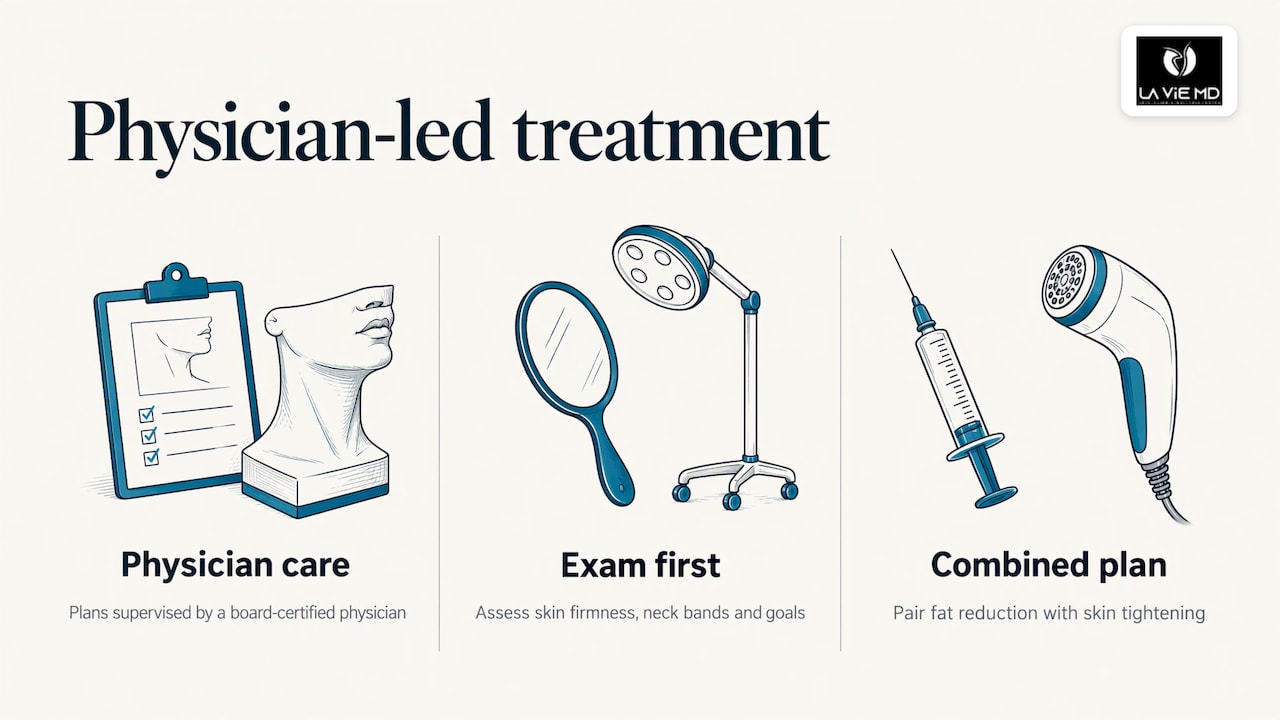
A double chin treatment is an injection near nerves, glands and swallowing muscles. The label’s warnings are about exactly that anatomy. A treatment plan built around your face, with a physician who is a medical doctor and not only a technician, is the sensible way to approach it.
That is how LA ViE MD describes its care: individualized plans, built around each patient’s skin concerns and goals, under the direct supervision of a board-certified physician. Dr. Nebhwani has over ten years of experience. Because the practice also offers skin tightening, injectables and laser treatments, the plan does not have to be built around a single device. If your neck needs tightening as well as fat reduction, it can be planned in one place.
What we tell patients about the chin
A double chin rarely has one cause, so we do not start with a product. We start with a conversation and an exam: how the area looks at rest and when you move, how firm the skin is, whether neck bands show, and what you want your profile to look like.
When the picture is mostly fat, Kybella is a well-studied option, and we plan a series of sessions around how your tissue responds. When skin laxity is part of it, we pair fat reduction with skin tightening, so the result looks balanced and not just smaller. We think the injection decision belongs with a physician because the anatomy under the chin deserves that care.
The best result is a natural one. Friends should notice that you look rested, not that you had something done.
Dr N
Planning your treatment
- Book a consultation. Bring photos from different angles and any medical history that might matter, including blood thinners and any past trouble swallowing.
- Get the diagnosis first. Your physician checks the fat, skin, muscle and neck structure and screens for other causes of fullness.
- Agree the series. Expect sessions at least a month apart, up to six in total, with the number set by how you respond.
- Plan the downtime. Swelling and bruising are the norm. Avoid scheduling a session right before an important event.
- Follow up. Report any firm lumps, skin breakdown, worsening numbness or swallowing trouble promptly.
Treatment close to home
LA ViE MD serves the Tri-Valley, the Peninsula side of the South Bay and the Diablo Valley. You can see location pages for Kybella in Danville, Livermore, Dublin and Los Gatos. If you are comparing it with fat freezing, the clinic’s page on Kybella and cryolipolysis sets the two side by side. Prices are not published online, so the consultation is where you get a plan and a quote.
If the jawline is only one of several concerns, the injectables page lists dermal fillers, Botox, Sculptra and non-surgical rhinoplasty, which are sometimes used together to balance the lower face. Ready to start? Book a consultation with LA ViE MD at laviemd.us.

FAQ
What is the best treatment for a double chin?
It depends on the cause. For fat under the chin, injectable deoxycholic acid (Kybella) is the most studied nonsurgical option. Where loose skin is a factor, skin tightening is added to the plan. A physician exam sorts out which applies to you.
Will losing weight get rid of a double chin?
It can shrink the fat, but it often does not remove it entirely, especially when the fat pad is inherited or the skin has lost elasticity. Many people reach a healthy weight and still want a more defined jawline. A consultation shows what remains and what can be done about it.
How long does it take to see results from Kybella?
Results build gradually over weeks as treated fat is cleared. In the FDA label trials, improvement was measured 12 weeks after the final treatment. The label allows up to six sessions, at least a month apart.
Can I be slim and still have a double chin?
Yes. Genetics and aging both play a part, so a slim person can have a submental fat pad or loose skin under the chin. The right treatment depends on whether it is fat, skin or both.
What are the side effects of Kybella?
The most common are swelling, bruising, pain and numbness around the injection area. In the trials, numbness, swelling, pain and firmness lasted more than 30 days in some patients. Rarer events include nerve injury and skin ulceration, which is why placement by a trained physician matters.
Sources
- Nonsurgical Management of Submental Fullness for Double Chin, Journal of Cosmetic Dermatology (2026)
- Assessment and Treatment Strategies for the Aesthetic Lower Face and Neck (2023)
- FDA Kybella approval label (2026), NDA 206333
- FDA Kybella approval label, supplement 7 (2026)
- FDA Drug Safety-related Labeling Changes: Kybella
- American Med Spa Association: FDA approves additional warning for Kybella labeling
- ClinicalTrials.gov: Evaluation and Management of Double Chin Submental Fat


