
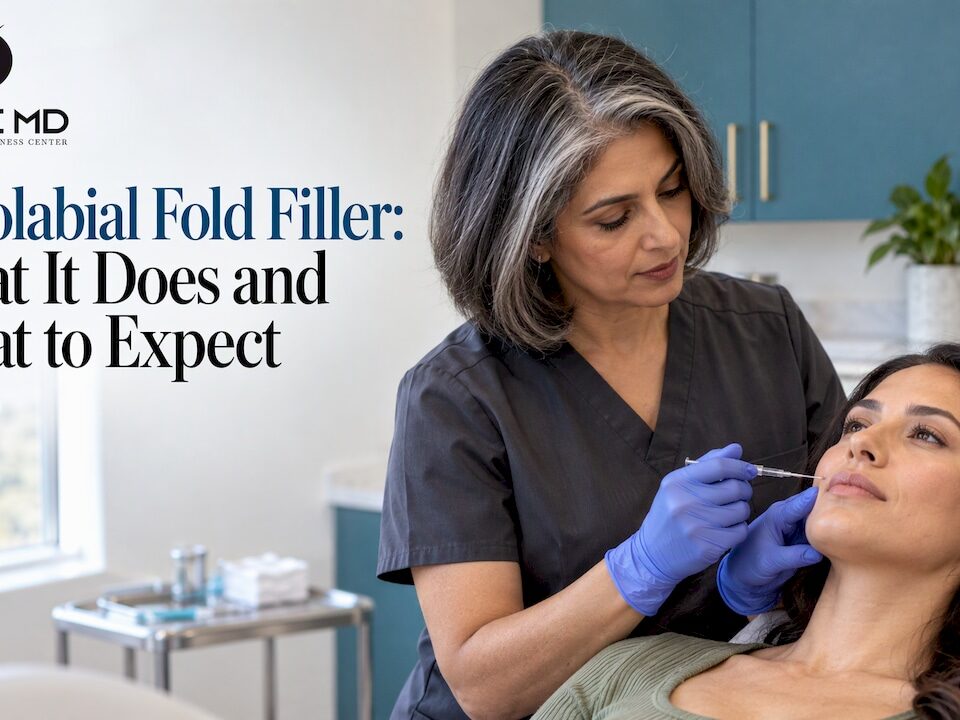
Nasolabial Fold Filler: What It Does and What to Expect
Filler can soften nasolabial folds, the creases that run from the sides of your nose to the corners of your mouth. How well it works depends on why your folds are there. Some folds come from lost volume, some from sagging tissue, some from the way muscle attaches to skin. A physician who assesses the whole midface first can choose the right approach for each. At LA ViE MD, Dr. Neetu Nebhwani, a board-certified Internal Medicine physician, builds a custom treatment plan around your concerns and goals, and that assessment is what separates a natural result from an overfilled one.
This guide is for adults in Danville, Livermore, Dublin and Los Gatos who are weighing smile line filler. It covers what the evidence shows, how treatment is planned, what recovery looks like, how long results last and who should be cautious.
TL;DR
- Hyaluronic acid (HA) filler is the most common choice for nasolabial folds, and a 2021 meta-analysis found clear, sustained improvement on a standard wrinkle scale.
- The cause of your fold decides the plan: volume loss, sagging and muscle attachment each call for a different technique.
- Swelling, tenderness, redness and bruising are common and usually settle within days to a couple of weeks.
- Injection into a blood vessel is the rare serious risk, which is why injector training and anatomy knowledge matter.
- Final cost depends on how many syringes your face needs, so a physician consultation gives the real number.
Table of Contents
- What nasolabial folds are, and why they deepen
- Do fillers work for smile lines?
- How an injector decides where to place filler
- What the appointment is like
- Recovery: swelling, bruising and lumps
- How long smile line filler lasts
- Safety: what to know before you book
- Who is a good candidate
- What affects the cost
- Smile line filler at LA ViE MD
- Our perspective
- FAQ
- Sources
What nasolabial folds are, and why they deepen
The nasolabial folds are the lines that curve from the edge of each nostril down toward the corners of the mouth. Many people call them smile lines because they show most when you smile. Every face has them. They become a concern when they look deep, cast a shadow or make you look tired or older than you feel.
A 2025 anatomical review describes three main contributors: volume deficiency, tissue laxity and muscular attachments. Each type needs its own approach, and many people have a combination of two.
That is why two people with the same fold on a photograph can need very different treatment. One needs a little product in the fold itself. Another needs support higher in the cheek, because the cheek tissue has descended and is pushing into the fold.
Do fillers work for smile lines?
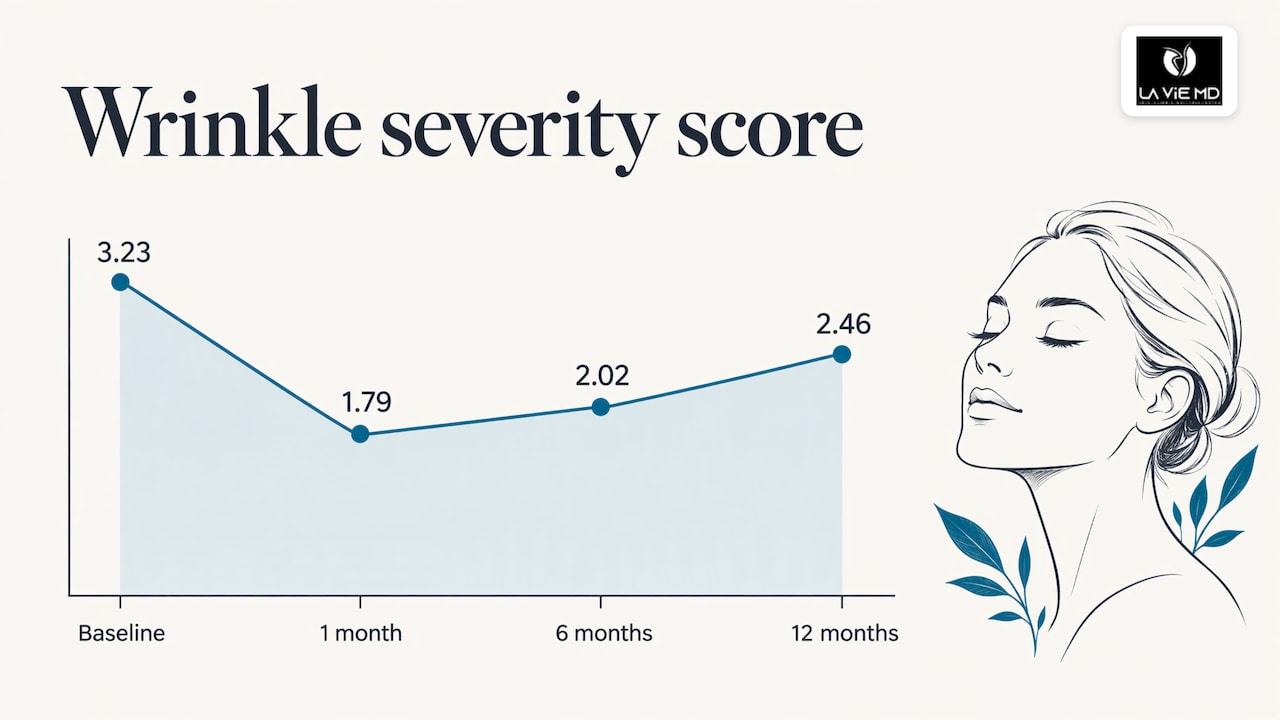
Yes, and the evidence is solid. A 2021 systematic review and meta-analysis pooled randomized trials and tracked the Wrinkle Severity Rating Scale, where a higher score means a deeper fold. The pooled score moved from 3.23 at baseline to 1.79 at one month and 2.02 at six months. By 12 months it was 2.46, still better than where patients started. The authors concluded that fillers give a satisfying and sustainable improvement.
In practical terms, expect the fold to look softer, not erased. A natural face still has a nasolabial fold. The goal is a shallower line and less shadow.
Head-to-head trials show that well-made HA fillers perform similarly. In a 2025 split-face trial, where each side of the face got a different product, two fillers had nearly identical response rates at Week 24 (82.2% and 81.9%). A 64-week split-face study of 140 people found that one resilient HA filler kept its improvement through Week 64. Product matters, but the plan and the hands behind the needle matter at least as much.
How an injector decides where to place filler
The most useful question to ask before treatment is not “which filler?” but “why do I have this fold?”
A 2025 treatment-protocol study makes the point directly: the cause of the fold determines the protocol, and severity determines the dose. The authors outline four escalating approaches:
- Skin-type folds: a cohesive HA filler placed directly in the mid-to-deep dermis or just beneath it.
- Bony retrusion: product placed in layers near the bone beside the nose, to restore support.
- Drooping cheek tissue: deeper injections in the medial cheek and near the ear to lift tissue, combined with direct fold treatment.
- Advanced aging: temple and jawline work combined with midface and fold treatment.
Treating the fold versus treating the cheek
People often assume cheek filler alone will fix smile lines. One whole-face review reports that cheek volumizing alone did not improve the fold, and that satisfactory improvement needed direct injection into it. At the same time, cheek support can give a lift that makes the fold look less deep, and it can reduce how much product the fold itself needs.
The anatomy also explains why placement is a skill. A technique paper notes that the fold sits over dense fascia with a thin fat layer, so a single deposit of gel tends to spread and lose its shape. That is the reason for layered, controlled placement. Technique can even change early results: in the 2025 split-face trial, a retrograde technique (injecting while withdrawing the needle) reached a 95.4% responder rate at 12 weeks versus 87.3% for fanning with the same product, with no meaningful difference later.
If your concern is a broader lower-face change, a plan may also address the jawline. Our guide to jowls treatment by severity explains how that fits in. Tired-looking lower lids and hollows are covered in our page on undereye filler.
What the appointment is like
A typical visit begins with a consultation: your history, the face assessed at rest and in motion, and a conversation about what you want to look like. If you go ahead, the area is cleaned, and many HA fillers contain lidocaine, a numbing agent, in the gel itself. Filler goes in with a fine needle or a blunt-tipped cannula, in small amounts along planned lines.
The FDA-approved instructions for one HA filler, RHA 2, describe injection into the mid-to-deep dermis, with a touch-up after two weeks if needed. Many patients are planned in stages for that reason: treat, let the swelling settle, then refine.
A physician-led plan matters here because the right amount is rarely the most you can fit in. Smile lines look best when the face still moves normally and the cheeks and mouth stay in proportion.
Recovery: swelling, bruising and lumps
Common reactions are firmness, redness, tenderness, swelling, lumps and bruising at the injection sites. In the FDA data for RHA 2, more than 70% of these reactions had resolved by Day 7 and more than 85% by Day 14.
The pooled data from the meta-analysis is similar in spirit. Among reported complications, the most common were lumpiness (43%), tenderness (41%), swelling (34%) and bruising (29%). These are local, usually temporary effects, not signs that something went wrong.
Some products run a little longer. The FDA summary for saypha MagIQ, approved on September 8, 2025, reports that 95.3% of 255 subjects had an injection-site reaction after initial treatment. Most were mild or moderate, 35.3% lasted 8 to 14 days and 23.1% lasted longer than 14 days. Plan your first treatment well ahead of a wedding, photo shoot or big event.
Practical aftercare
- Expect some swelling for several days and schedule treatment accordingly.
- Follow the aftercare instructions your physician gives you for exercise, heat and makeup.
- Call us promptly if a lump is painful, a spot looks unusually pale, or the area feels much firmer than you were told to expect.
How long smile line filler lasts
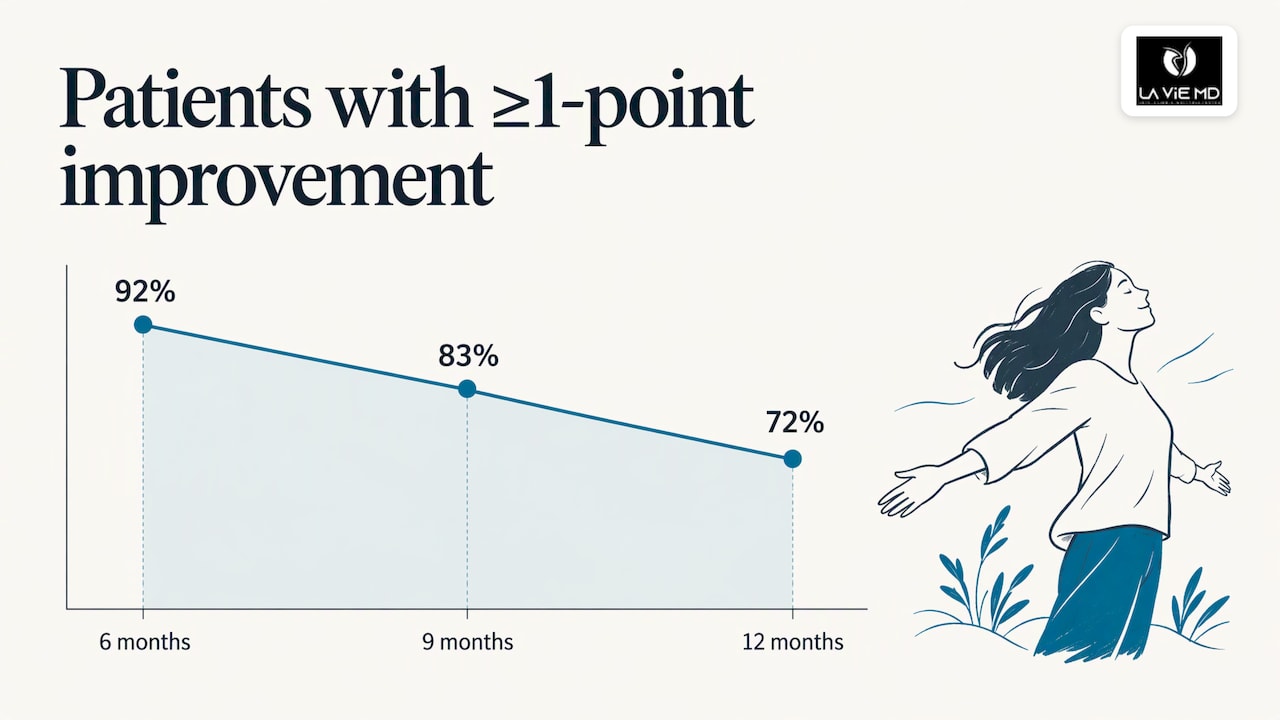
Duration depends on the filler material and the area injected, and repeat treatment may be needed, according to the FDA. Trial figures give a useful picture. In a 70-person study summarized in the FDA patient information for EVOLYSSE FORM, 92% had at least a 1-point improvement in fold severity at 6 months, 83% kept it through 9 months, and 72% through 12 months. At one year, 80% rated their folds as improved and 88% said they would be treated again.
That is a good guide, not a promise. Your metabolism, your facial movement, the product and the amount all play a part. Biostimulating products such as Sculptra work differently: they build gradually over several sessions. A midface review notes that consensus guidelines for poly-L-lactic acid suggest 3 to 5 initial sessions at least four weeks apart, with gradual effects lasting two years or more. We offer Sculptra and other injectables, and your physician can tell you whether a gradual approach suits your face.
If you ever notice product that seems to have shifted, read our guide on filler migration and how to prevent it.
Safety: what to know before you book
Filler is a medical device and the FDA treats it as one. Its consumer page on dermal fillers lists swelling, bruising, redness, pain and tenderness as common effects that often resolve in a few days to weeks.
The most serious risk is unintentional injection into a blood vessel. The FDA says this can lead to tissue death, blindness or stroke, sometimes permanently. Seek immediate medical attention for unusual pain, vision changes, skin that turns white, gray or blue, or any signs of stroke.
The nasolabial fold is a place where anatomy matters. A 2023 review of facial anatomy notes that the facial artery runs close to the fold, and that linear threading or fanning techniques, and consideration of a cannula, help lessen vascular injury risk. It also says aspiration before injection and layered placement are recommended. These are questions for your injector, and they are the reason to choose a physician-led practice with deep anatomical training.
Who is a good candidate
The FDA says dermal fillers are approved for adults 22 and older for moderate to severe facial wrinkles and folds. It also says safety is unknown during pregnancy and breastfeeding, in people under 22, and in people prone to keloid or hypertrophic scarring. Treatment should wait if the skin is inflamed or infected.
Tell your physician before treatment if you:
- have a bleeding disorder;
- have had severe allergies or anaphylaxis;
- are allergic to lidocaine, collagen, eggs, animal products or bacteria;
- are pregnant or breastfeeding.
The FDA also notes that the safety of combining fillers with neuromodulators, and of long-term repeated use, has not been tested in controlled studies. Share every treatment you have had, so your plan accounts for it. If you are weighing filler against other options for lines, our wrinkle treatment guide compares them, and Botox can complement filler for expression lines elsewhere on the face.
What affects the cost
Nasolabial fold filler is priced by the syringe, and the number you need is the biggest driver. A shallow fold may take less than a syringe per side. A fold with volume loss, sagging and a muscle component may need cheek support too, which adds product.
Other factors are the product chosen, the area treated, whether a touch-up is planned, and the experience of the person injecting. Be wary of comparing quotes per syringe without comparing the plan behind them. A low per-syringe figure attached to a plan that treats only the fold line can cost more over time than a plan that addresses the cause.
We do not publish fixed prices for filler, because the right plan depends on your face. A consultation gives you a plan and a number for your own treatment.
Smile line filler at LA ViE MD
LA ViE MD is a boutique medical spa serving the Bay Area, with patients from Danville, Livermore, Dublin and Los Gatos. Treatments are medically supervised, and Dr. Nebhwani, a board-certified Internal Medicine physician with over ten years of experience, leads the practice. Each plan is built around your specific skin concerns and aesthetic goals, not a standard number of syringes.
You can read more about our dermal fillers, the benefits and lasting results of fillers, or our Dublin dermal filler page. When you are ready, book a consultation through our injectables page.
Our perspective
Smile lines are rarely a problem of one line. When a patient points at the fold and asks for filler there, the first thing we look at is what is happening around it: the cheek, the jawline, the way the face moves.
Our approach is to treat the cause and not just the crease. That means a physician-led assessment, a plan written for your face and a conversation about what natural looks like on you. Smile lines are part of expression, and the aim is a softer shadow, not a frozen or overfilled look.
We would rather build a result in stages than do everything in one visit. It gives you time to see how your face responds, and it keeps the final look balanced. Medical supervision and advanced technology across our treatments are the reasons we can offer that level of care.
Dr N
FAQ
Where is filler placed for smile lines?
Often directly in the fold, in the mid-to-deep dermis or just under it. Depending on your anatomy, your physician may also place product in the cheek to lift tissue that is pressing into the fold. The cause of your fold decides the mix.
Will filler make me look overdone?
Not when the plan is built to restore support and soften shadow, not to erase the fold. Smaller amounts, placed in stages, let you see the change before adding more. Tell your physician at the consultation exactly how much change you want.
How soon will I see results?
You will see an improvement right away, though swelling can hide the final look. In the FDA data for one filler, more than 85% of common reactions had resolved by Day 14, so many people judge their result at around two weeks. A touch-up can be done then if needed.
Is filler for smile lines safe?
FDA-approved fillers are used widely, and most reactions are mild and temporary. The rare serious risk is injection into a blood vessel, so choose a physician-led practice, and get immediate care for unusual pain, vision changes or skin that turns white, gray or blue.
Can I combine filler with other treatments?
Many patients do. Your physician can discuss options such as skin tightening, Botox or biostimulatory treatments. The FDA notes that combination safety with neuromodulators has not been studied in controlled trials, so your physician will plan timing with you.
Sources
- Tissue Fillers for the Nasolabial Fold Area: A Systematic Review and Meta-Analysis (2021)
- Multicenter, randomized split-face trial of a crosslinked HA filler (2025)
- Efficacy and safety of a new resilient hyaluronic acid filler
- Anatomical-Based Diagnosis and Filler Injection Techniques (2025)
- The Assessment, Strategy, and Treatment Protocol for nasolabial folds (2025)
- Whole-Face Approach with Hyaluronic Acid Fillers (2021)
- Hyaluronic Acid Filler Injection Technique in Multiple Layers (2020)
- Using injectable fillers for midface rejuvenation (2021)
- FDA: RHA 2 intended use and safety data
- FDA: Summary of Safety and Effectiveness Data, saypha MagIQ
- FDA: EVOLYSSE FORM patient information
- FDA: Dermal Fillers (Soft Tissue Fillers)
- Facial fillers: Relevant anatomy, injection techniques, and complications (2023)


