Sun Spots Treatment: What Works and How to Choose
The most effective way to fade sun spots on the face is usually a light or laser treatment, followed by daily sunscreen. A prescription-strength topical or a medical-grade peel can handle milder or more widespread discoloration. A 2025 systematic review of 41 clinical trials found laser therapy appears more effective than other approaches for solar lentigines, the medical name for sun spots. The best option for you depends on how many spots you have, how dark they are, your skin tone and how much downtime you can take.
This guide explains what sun spots are, how each treatment compares, what recovery looks like and how to keep spots from coming back. It also covers when a spot should be checked by a doctor before anyone treats it.
TL;DR
- Sun spots are flat tan to dark brown patches caused by years of UV exposure. They are harmless in themselves, but any spot that changes should be examined by a doctor first.
- In clinical trials, laser and light-based treatments outperformed peels and most creams, with picosecond lasers showing success rates of 67.9% to 93.02%.
- Prescription topicals, medical-grade peels and microneedling suit lighter or more diffuse pigment, and they can be combined with a laser.
- Without daily broad-spectrum SPF 30 or higher, spots almost always return.
- At LA ViE MD, Dr. Neetu Nebhwani, a board-certified Internal Medicine physician, builds a custom plan after an in-person consultation.
Table of Contents
- What sun spots are and why they appear
- When to see a doctor before treating a spot
- How sun spot treatments compare
- How to choose: a simple framework
- What to expect: sessions, recovery and cost
- Keeping sun spots from coming back
- What about home remedies?
- Our perspective
- Start with a consultation at LA ViE MD
- FAQ
- Sources
What sun spots are and why they appear
Sun spots, also called age spots, liver spots or solar lentigines, are flat, oval areas of darker skin. Mayo Clinic describes them as tan to dark brown, ranging from freckle size to about 1/2 inch (13 millimeters) across, and appearing on the skin that gets the most sun, including the face.
The cause is overactive pigment cells. UV light speeds up melanin production, and after years of exposure the melanin clumps or is produced in high concentrations. Tanning beds and lamps can cause the same spots.
They are most common after 50, but not only then. The Cleveland Clinic notes younger people get them too, especially with heavy sun exposure or tanning bed use. DermNet adds that they are uncommon in children under 12 unless sun exposure has been significant. In the Bay Area, where many of our patients in Danville, Livermore, Dublin and Los Gatos spend years commuting, hiking and golfing under strong sun, spots in the 30s and 40s are a common reason people come to see us.
Sun spots, freckles and melasma
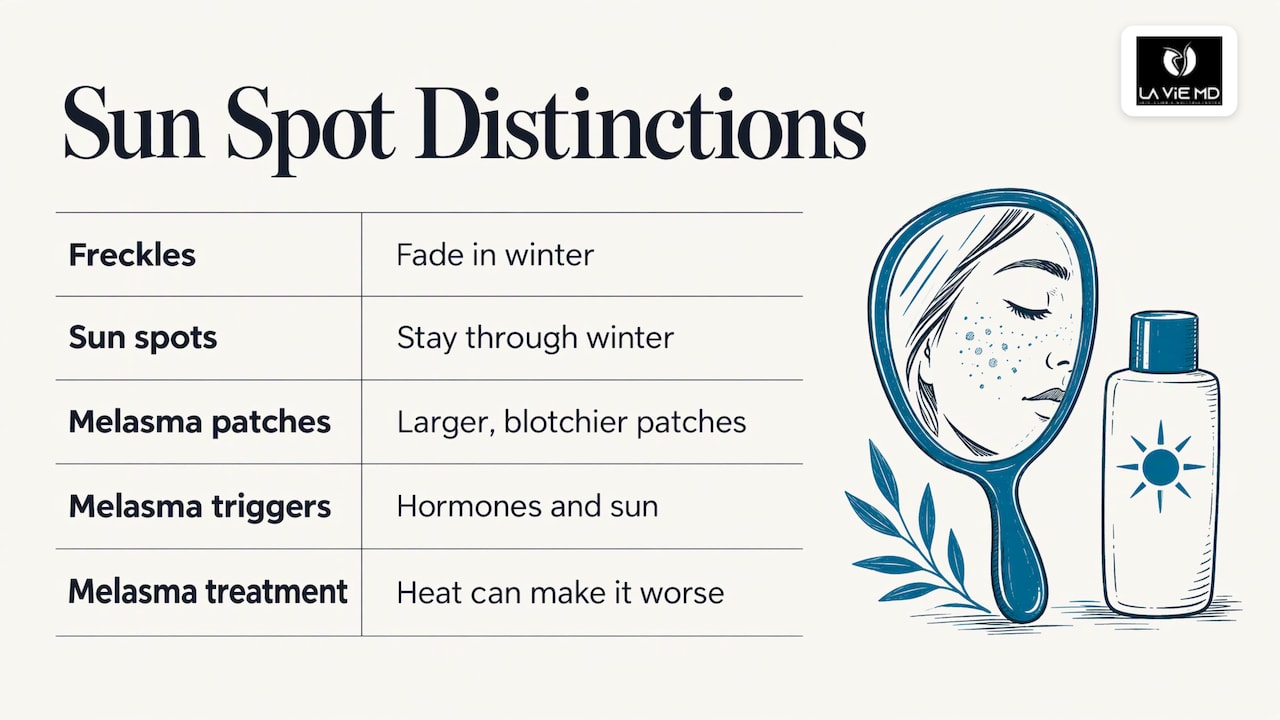
Not every dark patch is a sun spot. Freckles tend to fade in winter, while sun spots stay. Melasma shows up as larger, blotchier patches, often triggered by hormones and sun together, and it behaves differently: aggressive heat-based treatment can make it worse. If you are not sure which one you have, read our guide to melasma vs. sun spots and our page on melasma treatment. Telling them apart is one of the first things a physician does at a consultation.
When to see a doctor before treating a spot
Treatment should only start once a spot is confirmed to be a benign sun spot. Healthline advises talking with a doctor about any spot that is growing, has an irregular border, is itchy, painful or bleeding, or has an unusual color. Those signs call for a skin check, ideally with a dermatologist, before any laser, peel or cream. Lasers destroy pigment, so you do not want to treat a lesion that needs a biopsy.
If a spot is new, changing or looks different from its neighbors, book a skin exam first. We are glad to look at pigment during a consultation, and a suspicious lesion is referred on rather than treated.
How sun spot treatments compare
The table below summarizes what the research and medical bodies say about each approach. Success rates come from the 2025 review and vary with study design, device and skin type, so treat them as a guide to the relative strength of each option, not a promise.
| Treatment | How it works | Reported success in trials | Typical fit |
|---|---|---|---|
| Picosecond laser | Ultra-short pulses shatter melanin | 67.9%–93.02% | Distinct spots, including a single facial lesion |
| Intense pulsed light (IPL) | Light heats and breaks up melanin | 74.6%–90% | Many spots across a wider area |
| Q-switched laser | Targets pigment in nanosecond pulses | 36.36%–76.6% | Isolated spots |
| Cryotherapy | Freezes the spot | 37%–71.4% | A few discrete spots |
| Chemical peel (TCA) | Acid removes damaged outer layers | 12%–46% | Mild, diffuse discoloration |
| Topical mequinol with tretinoin | Prescription lightening | 52.6% to over 80% | Facial spots, patient who prefers no device |
The review also concluded that combining lasers with specific topical agents may improve outcomes and reduce post-inflammatory hyperpigmentation, the temporary darkening that can follow any inflammation of the skin.
Laser treatment
The American Academy of Dermatology says one or two laser treatments can treat age spots quickly, with longer-lasting results than creams. It also notes lasers can cause crusting or temporary darkening, which is why the choice of device and the settings matter.
Picosecond technology is the one we reach for on stubborn facial pigment. PicoWay is part of our laser procedures, offered for pigmentation and melasma-type concerns. Picosecond pulses are designed to break up pigment with less surrounding heat, which matters most on skin that tends to darken after treatment.
If you are weighing light-based options against lasers, our comparison of IPL vs. laser for sun damage walks through the differences in more detail.
Chemical peels
Peels apply acid to create a controlled injury so the top layers shed and fresh skin replaces them. Healthline notes the peel can cause burning for a few minutes. In the review, trichloroacetic acid peels showed a lower success range on sun spots than lasers, so we see peels as the right tool for overall tone, texture and mild pigment, and a helpful partner to laser work rather than a replacement for it.
Wondering which to start with? Our guides on choosing between a chemical peel or laser and chemical peels vs. laser resurfacing lay out how goals and downtime point to one or the other.
Microneedling, HydraFacial and other skin rejuvenation
Sun spots rarely come alone. The same sun that causes them also leaves uneven texture, dullness and fine lines. That is where our skin rejuvenation treatments fit: HydraFacial for cleansing, exfoliating and hydrating, and microneedling to support the skin’s renewal. A medical-grade facial will not replace a laser for a dark, well-defined spot, but it improves the surrounding skin and helps the whole face look more even.
Prescription and medical-grade topicals
Creams work slowly. Healthline reports that a 2023 review found hydroquinone at 2% to 5% once daily effective for hyperpigmentation, with benefits in 5 to 7 weeks and treatment lasting 3 months to a year. Hydroquinone has been prescription-only in the US since the FDA changed its status in 2021. Retinoids, vitamin C, azelaic acid and chemical exfoliants are other common ingredients.
Because hydroquinone requires a prescription and a plan for how long to use it, it makes sense to start with a physician. We also carry medical-grade skincare, and a daily routine built around the right ingredients keeps results going between treatments.
How to choose: a simple framework
Use these questions as a starting point for your consultation.
- How many spots are there? One or two distinct spots point to a targeted pigment laser. Dozens across the cheeks and nose point to a broader approach, such as a series of treatments or a combination plan.
- How dark and how deep? Dark, sharply edged spots usually respond fastest to a laser. Pale, blurry discoloration may respond to peels and topicals.
- What is your skin tone and tanning history? Deeper skin tones and recently tanned skin carry a higher risk of post-inflammatory darkening, so device, settings and timing need adjusting. Tell your provider about recent sun exposure.
- How much downtime can you take? Laser resurfacing can need 10 to 21 days of healing, according to Healthline, while a facial has none. Pigment-focused treatments differ, so ask what to expect for the specific device.
- What else do you want to improve? If you also want better texture or firmness, a combination plan can address everything in one course of care.
This is also the logic behind a practical rule of thumb from clinical guides: treat isolated spots with a targeted approach, and treat widespread sun damage with a broader one, always layering sun protection on top.
What to expect: sessions, recovery and cost
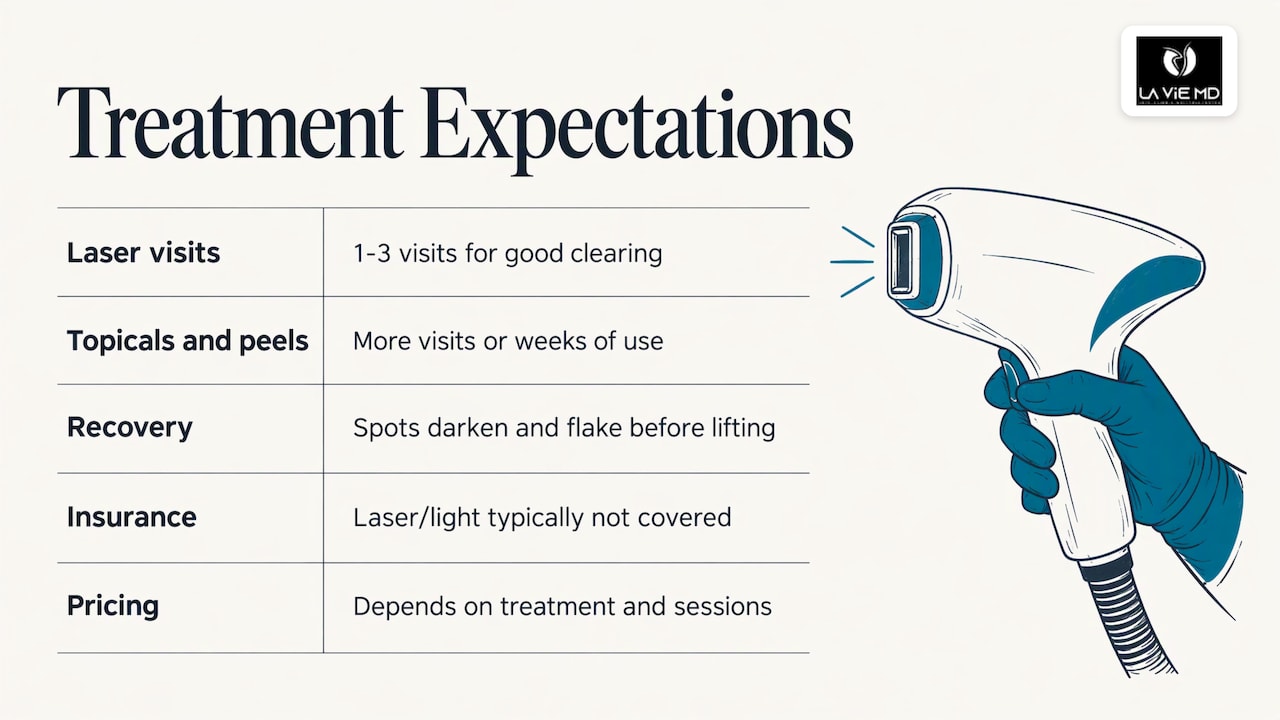
Sessions. Many people see good clearing within one to three laser visits, though the number depends on the device, the spot and your skin. Walgreens’ health blog gives the same one-to-three range for laser. Topicals and peels take more visits or weeks of use.
Recovery. Treated spots commonly darken and flake before they lift. The Mayo Clinic lists redness, swelling, itching, changes in skin color and scarring among possible side effects of laser and light therapy. Following the aftercare instructions, especially the sunscreen, keeps risk low. Our guides on aftercare for laser treatments cover the general principles of caring for skin after a laser session.
Cost. These are cosmetic procedures, and Mayo Clinic notes laser and light treatments typically are not covered by insurance. Pricing depends on the treatment and number of sessions, so we quote it after your consultation.
Keeping sun spots from coming back
Treatment clears existing pigment. It does not stop your skin from making more. Mayo Clinic says that without sun protection, the spots will almost always return or new ones will form, and it recommends a broad-spectrum sunscreen with SPF 30 or higher after laser treatment.
The Cleveland Clinic’s daily habits are straightforward:
- Wear broad-spectrum, water-resistant sunscreen with SPF 30 or higher every day.
- Reapply every two hours, sooner if you swim or sweat.
- Wear a wide-brimmed hat and UV-blocking sunglasses.
- Avoid peak UV hours, 10 am to 4 pm.
Healthline’s cited expert also points to zinc oxide and titanium dioxide as blocking ingredients that help keep dark spots from returning. In the Bay Area, UV exposure does not stop when the fog rolls in, so daily use matters year-round, including on drives and outdoor errands.
What about home remedies?
Lemon juice, turmeric, green tea and similar remedies are popular, but Medical News Today states there is no scientific evidence that they lighten hyperpigmentation, and lemon juice can dry and irritate skin. Citrus plus sunlight can also trigger a burn-like reaction that leaves darker marks. If you want to start at home, the better route is a daily sunscreen plus a physician-recommended routine of proven ingredients, and then a professional treatment for spots that do not respond.
Our perspective
In our practice, sun spots are rarely just a pigment problem. They are a record of years of sun exposure, and the skin around them usually shows it too.
That is why we do not start with a device. We start with a conversation and an examination of your skin: what the spots are, your skin tone, your sun habits and what you want your skin to look like. Because every treatment here is medically supervised, the plan is built around your face, not around a menu.
For defined facial pigment, we like the precision of picosecond technology. For broader skin quality, we pair it with medical-grade facials, peels or microneedling, and with skincare you can use at home. The aim is natural-looking, even skin that you can keep with good sun habits.
Results depend on the person, and the most important step you can take after treatment is also the simplest: wear your sunscreen.
Dr N
Start with a consultation at LA ViE MD
If you have spots on your face that bother you, we can examine them, tell you what they are and design a plan. We treat patients from Danville, Livermore, Dublin and Los Gatos, with physician-supervised care and custom plans for each skin concern.
See our laser procedures to learn about PicoWay for pigmentation, or browse our skin rejuvenation treatments for facials, microneedling and more.

You can also visit laviemd.us to book a consultation at the location nearest you.
FAQ
What is the most effective treatment for dark spots on the face?
In the 2025 systematic review of 41 trials, laser therapy appeared more effective than other options. Picosecond laser success ranged from 67.9% to 93.02% and intense pulsed light from 74.6% to 90%. The right choice still depends on your skin tone and how many spots you have, which a physician can assess in person.
Can a cream remove sun spots?
Creams can fade them, but slowly. Hydroquinone at 2% to 5% showed benefits in 5 to 7 weeks in a review reported by Healthline, and it requires a prescription in the US. Creams generally work better on lighter or more diffuse spots than on dark, defined ones.
How many treatments will I need?
It varies by method. Laser typically takes one to three sessions, according to Walgreens’ health blog, while peels and topicals take longer. We estimate your number of visits after examining your skin.
Will the spots come back?
They can. Mayo Clinic says that without sun protection the spots will almost always return or new ones will form. Daily broad-spectrum SPF 30 or higher is the most important habit after treatment.
Are sun spots dangerous?
Sun spots themselves are benign, but some skin cancers can look similar. Have a doctor examine any spot that is growing, has an irregular border, itches, hurts, bleeds or has an unusual color before you treat it.
Sources
- Age spots (liver spots): symptoms and causes, Mayo Clinic
- How to Get Rid of Age Spots, Cleveland Clinic
- Solar lentigo, DermNet
- Treatment of Solar Lentigines: A Systematic Review
- What can get rid of age spots?, American Academy of Dermatology
- Removing Sunspots on Face, Healthline
- Tips to Get Rid of Dark Spots on the Face, Healthline
- Mayo Clinic Q and A: Treating sunspots
- Sun-Damaged Skin, Cleveland Clinic
- Sun spots: causes, treatment and prevention, Walgreens
- How to get rid of dark spots, Medical News Today