
GLP-1 Weight Loss Program: What a Medically Supervised Plan Includes
A good GLP-1 weight loss program is more than a prescription. It is a medication matched to your health history, a nutrition and activity plan built around it, and regular physician follow-up so the dose and the results can be adjusted. At LA ViE MD, GLP-1 therapy with semaglutide is offered under the supervision of Dr. Neetu Nebhwani, a board-certified Internal Medicine physician, with a plan tailored to your goals. That is the model the clinical guidelines describe, and it is what this guide walks through for women in Danville, Livermore, Dublin and Los Gatos.
TL;DR
- GLP-1 medicines mimic a gut hormone that signals fullness, slows stomach emptying and reduces appetite. They work best alongside food and activity changes.
- Adults generally qualify with a BMI of 30 or higher, or 27 or higher with a weight-related condition such as high blood pressure or type 2 diabetes.
- In a lifestyle program, people on prescription weight-management medication lose about 3% to 12% more body weight after a year than with lifestyle changes alone.
- Protein, strength training and scheduled follow-up protect muscle and make results easier to keep.
- Pregnancy, certain thyroid tumor histories and some other conditions rule treatment out, so a physician review comes first.
Table of Contents
- What GLP-1 medicines do in your body
- Who may qualify
- What results to expect
- What a supervised program includes besides the medication
- Eating well on a GLP-1
- Protecting muscle: why strength training matters
- Side effects and how to manage them
- Planning for the long term
- Why a physician-led med spa fits this treatment
- Start with a consultation
- FAQ
- Sources
What GLP-1 medicines do in your body
GLP-1 is a hormone your gut releases after you eat. It tells your brain you are full, prompts your pancreas to release insulin and slows how fast your stomach empties. GLP-1 agonists are synthetic versions of that hormone. By turning up the fullness signal, they reduce appetite and food cravings, so eating less feels easier rather than like a constant fight.
Two GLP-1-based drugs are approved in the U.S. for obesity: semaglutide (sold as Wegovy, as a weekly injection or a daily pill) and tirzepatide (sold as Zepbound, a weekly injection). Tirzepatide acts on a second hormone pathway as well, which is why the FDA label calls it a GIP and GLP-1 receptor agonist. Both are labeled for use with a reduced-calorie diet and more physical activity.
The FDA’s May 2026 approval package states that Wegovy injection is indicated for long-term weight reduction in adults with obesity, or with overweight plus at least one weight-related condition. Our GLP-1 offering at LA ViE MD is semaglutide therapy, and you can read the details on our semaglutide for weight loss guide.
Who may qualify
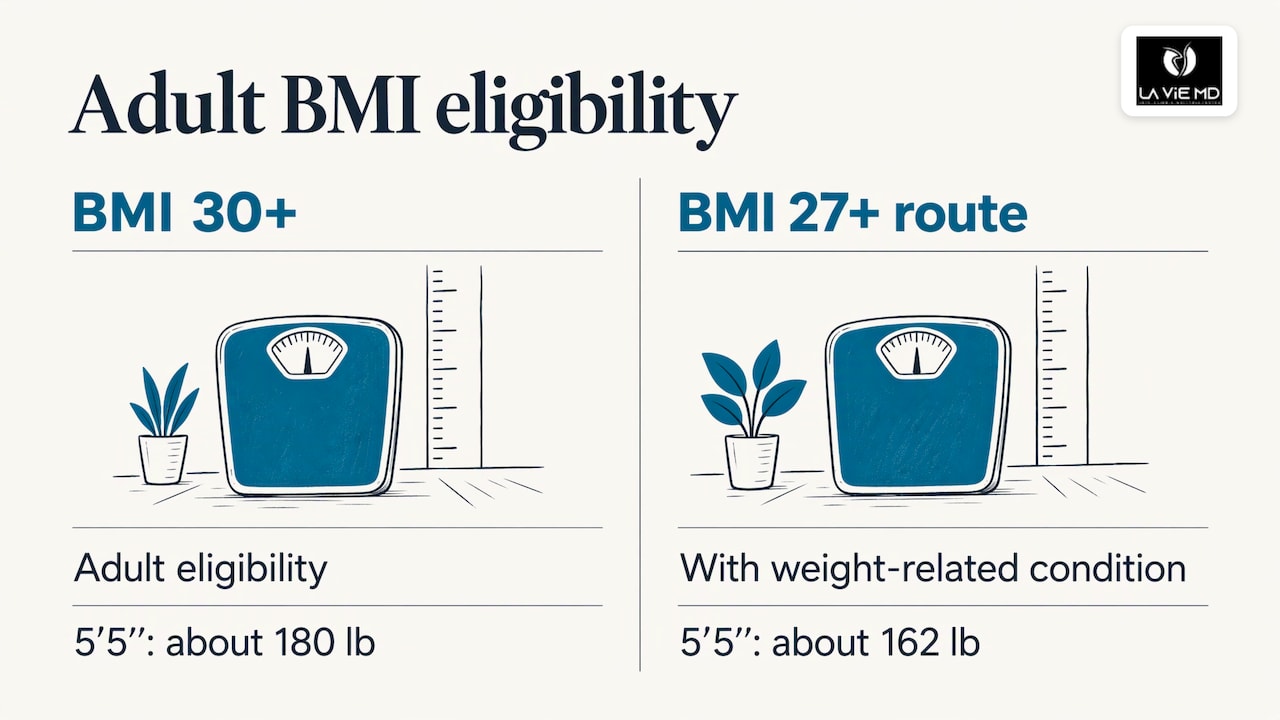
The national guidance is consistent. Adults may be prescribed weight-management medication if they have a BMI of 30 or greater, or a BMI of 27 or greater with weight-related health problems such as high blood pressure or type 2 diabetes. BMI is your weight relative to your height. A 5-foot-5 woman reaches a BMI of 27 at about 162 pounds and a BMI of 30 at about 180 pounds.
BMI is only the starting line. A VA/DoD clinical guide recommends that clinicians also assess for medications that promote weight gain, eating disorders, endocrine disorders and sleep apnea before prescribing. That is a medical conversation, not a questionnaire, and it is why an Internal Medicine physician reviewing your history matters. A joint expert panel (The Obesity Society, the Obesity Medicine Association and the Obesity Action Coalition) describes obesity as a chronic disease that calls for long-term, person-centered care, which is the same thinking behind a custom plan instead of a one-size protocol.
Who should not start
These are safety points to settle with your physician before any prescription:
- Thyroid cancer history. The Wegovy label carries a boxed warning: semaglutide caused thyroid C-cell tumors in rodents, and it is contraindicated with a personal or family history of medullary thyroid carcinoma or multiple endocrine neoplasia syndrome type 2.
- Pregnancy or planning one. Weight-loss medications should not be taken during pregnancy or when planning a pregnancy. The Wegovy label says to stop when pregnancy is recognized and at least 2 months before a planned pregnancy, because semaglutide stays in the body for a long time. Breastfeeding is not recommended during treatment with Wegovy tablets.
- Other conditions. The label also lists acute pancreatitis, gallbladder disease, low blood sugar when combined with insulin, kidney injury from dehydration, severe gastrointestinal reactions (not recommended in severe gastroparesis, or slowed stomach emptying) and aspiration risk during general anesthesia. Tell your physician about every medication and supplement, and about any planned procedure requiring anesthesia.
Weight-loss medications can also interact with other drugs, supplements and herbal products, and should not be combined with other weight-loss products unless prescribed.
What results to expect
Honest numbers help you set a goal you can hit. After one year, adults using prescription weight-management medication as part of a lifestyle program lose 3% to 12% more of their starting body weight than people in lifestyle programs alone. More than half of participants lost 10% or more with some medications, and most of the loss happens in the first six months.
A joint nutrition advisory reports reductions of 5% to 18% in trials, with modestly lower effects in real-world analyses. Here is what that range means in pounds:
| Starting weight | 5% loss | 10% loss | 15% loss |
|---|---|---|---|
| 160 lb | 8 lb | 16 lb | 24 lb |
| 200 lb | 10 lb | 20 lb | 30 lb |
| 240 lb | 12 lb | 24 lb | 36 lb |
So, can you lose 30 pounds? For someone starting near 200 pounds, a 15% loss lands there, and for someone starting near 300 pounds a 10% loss does. For a smaller frame, 30 pounds may be more than a healthy goal. Your physician sets the target with you based on your health markers, not a number from the internet.
The guidance also gives a checkpoint. If a patient has not lost at least 5% of starting weight after 12 weeks on the full dose, a clinician will probably advise stopping the medication. The ADA’s 2026 Standards of Care add that patients who reach 5% or more weight reduction after 3 months should generally continue long term. This is why a program needs a physician who reviews your progress rather than a one-time prescription.
What a supervised program includes besides the medication
Medication is one part. The ADA recommends using obesity medications alongside nutrition, physical activity and behavioral therapy. In medication trials, the lifestyle component typically means a meal plan with a 500-calorie daily deficit plus behavioral support.
A sound program covers five things.
- A baseline review. A joint nutritional advisory recommends screening at the start for dietary habits, emotional triggers, disordered eating, muscle strength and body composition.
- A medication and dose plan. Semaglutide is started low and raised in steps. The Wegovy tablet, for example, starts at 1.5 mg and is titrated every 30 days to a 25 mg maintenance dose, per the FDA approval package. Your physician decides what fits you.
- Nutrition targets. Covered in the next section.
- Activity targets. Also below.
- Scheduled follow-up. The ADA recommends visits at least monthly for the first 3 months, at least every 3 months for the rest of the first year, and at least every 6 months afterward. Real-world clinic data cited in the standards found that more follow-up visits were associated with greater weight reduction.
At LA ViE MD, we build custom treatment plans around each patient’s skin concerns and aesthetic goals, under the direct supervision of Dr. Nebhwani. For many patients, weight loss and how skin looks as the weight comes off are part of the same conversation, which is a reason to keep both in one practice.
Eating well on a GLP-1
When appetite drops, it is easy to under-eat protein and nutrients. The ADA’s 2026 Standards recommend at least 60 grams of protein daily, often 1.2 to 1.6 g per kilogram of body weight during weight reduction, adequate water (3.7 liters a day for men and 2.7 for women, from all beverages and food), and consideration of a registered dietitian referral. They name the risk plainly: appetite suppression can cause protein insufficiency and micronutrient deficiencies.
A JAMA Internal Medicine patient guide from July 2025 offers a practical framework it calls the MEAL plan:
- Begin each meal with 20 to 30 grams of protein.
- Eat smaller meals plus snacks built on slowly digested carbohydrates and healthy fats.
- Avoid high-fat foods and irritating spices, which can worsen stomach side effects.
- Drink 2 to 3 liters of fluid daily.
A worked example for a 150-pound woman (68 kg): 1.2 to 1.6 g per kg works out to roughly 82 to 109 grams of protein a day. Spread across three meals and a snack, that is 25 to 30 grams at each sitting: a three-egg omelet with Greek yogurt on the side, a chicken and quinoa bowl, salmon with lentils.
Protecting muscle: why strength training matters

Weight loss from any method includes some muscle. In meta-analyses of GLP-1 obesity medications, lean body mass accounts for 25% to 30% of total weight reduction. The ADA recommends counseling on adequate protein plus muscle-strengthening activity.
The JAMA guide lays out three steps:
- Build moderate activity from 10 minutes a day up to 150 minutes a week.
- Add strength training 2 to 3 times a week for about 30 minutes.
- Maintain 30 to 60 minutes of daily activity.
That tracks with federal physical activity guidelines of 150 minutes of moderate aerobic activity weekly and 2 days of muscle strengthening, with more than 300 minutes a week sometimes needed to reach or keep a weight goal. In the East Bay and South Bay, that can be as simple as a morning walk on the Iron Horse Trail in Danville or Dublin, or a weekend loop at Almaden Quicksilver in the hills above Los Gatos, plus two resistance sessions at home or a gym.
Side effects and how to manage them
The most common reactions on the Wegovy label (5% or more of users) are nausea, diarrhea, vomiting, constipation, abdominal pain, headache, fatigue, dyspepsia and dizziness. They tend to appear while the dose is being raised, which is a reason for gradual titration and check-ins.
Small habits help: eat slowly, stop at the first sign of fullness, choose smaller meals, keep fluids up and skip greasy meals. Tell your physician promptly about severe or persistent abdominal pain, repeated vomiting, or signs of dehydration, since the label flags pancreatitis, gallbladder disease and kidney injury from fluid loss.
The label also records changes over time: a new acute kidney injury warning in August 2025, an update on severe gastrointestinal reactions in October 2025, and removal of the suicidal behavior and ideation warning in January 2026. Labels are updated, so your physician works from the current one.
Planning for the long term
Obesity medications are designed as long-term care. The expert panel issued strong recommendations for semaglutide and tirzepatide, and for continuing obesity medications during weight maintenance. Patients probably will regain some weight after stopping, so the habits you build in the first months carry the result.
If you and your physician decide to stop, the JAMA guide advises continuing about 60 minutes of daily activity, 2 to 3 resistance sessions weekly and adequate protein to minimize regain. For more on this stage, see our article on the long-term effects of GLP-1 medications, and for the first weeks, what to expect when starting GLP-1 treatment.
Why a physician-led med spa fits this treatment
A GLP-1 program asks four things of the person guiding it: screen you properly, choose and adjust the dose, watch for side effects, and keep you on track at every visit. That is medical work. At LA ViE MD, GLP-1 therapy sits under the supervision of Dr. Nebhwani, who has more than ten years of experience as an Internal Medicine physician. Our approach is individualized: we craft plans around your specific concerns and goals rather than handing everyone the same schedule.
We also offer treatments that many patients pair with weight loss, such as skin tightening and medical-grade facials, which you can see on our skin rejuvenation page. Your consultation is where those choices are sequenced with your weight-loss plan.
Our perspective
Weight loss is a medical decision first and a cosmetic one second. When someone sits down with us, we want to know their history, their medications, their goals and what they have already tried. Then we build the plan around that person.
We favor GLP-1 therapy delivered with real physician oversight because the medication is only as good as the plan around it: protein targets, strength work, dose adjustments and honest check-ins. Our patients in Danville, Livermore, Dublin and Los Gatos come to us for exactly this kind of individualized, supervised care.
Our view is simple. Steady, supervised progress that looks and feels like you is the goal, and we are glad to guide you through it.
Dr N
Start with a consultation
If you are ready to find out whether GLP-1 therapy suits you, we offer physician consultations at our Bay Area locations. You can see our full list of services, or go straight to the page for your city: Danville, Livermore, Dublin or Los Gatos.

Bring a list of your medications and supplements, any past weight-loss attempts, and your health goals. That gives your physician what is needed to build your plan.
FAQ
Can I lose 30 pounds on a GLP-1?
It depends on your starting weight. Trials report body weight reductions of 5% to 18%, with somewhat lower results in real-world use, so 30 pounds is within reach for many people starting around 200 pounds or more with a 15% loss. Your physician sets a realistic target based on your health and checks progress at regular visits.
What is the best way to lose weight on semaglutide?
Pair it with at least 60 grams of protein a day, plenty of fluids, and strength training two to three times a week alongside 150 minutes of moderate activity. Eat smaller meals and attend your scheduled follow-ups so your dose and progress can be reviewed.
How long will I need to stay on treatment?
Guidelines treat obesity as a chronic condition and support continuing medication during weight maintenance when it is working. The ADA says patients who lose 5% or more by 3 months should generally continue long term. Your physician will review this with you at follow-up visits.
Who should not take semaglutide for weight loss?
People with a personal or family history of medullary thyroid carcinoma or MEN 2 should not use it, and it should not be taken during pregnancy or when planning a pregnancy. Share your full medical history, medications and supplements at your consultation so your physician can review them.
Sources
- GLP-1 agonists, MedlinePlus Medical Encyclopedia
- Prescription Medications to Treat Overweight & Obesity, NIDDK
- Comprehensive Management of Adult Overweight / Obesity, VA/DoD provider guide
- Joint TOS/OMA/OAC Expert Guidance Statement
- Pharmacologic Treatment of Obesity in Adults: Standards of Care (ADA 2026)
- Pharmacologic treatment of obesity in adults: Standards of Care, real-world follow-up and lean mass
- Nutritional priorities to support GLP-1 therapy
- JAMA Internal Medicine: I Am Taking a GLP-1 Weight-Loss Medication
- FDA Wegovy label, December 2025
- FDA Wegovy approval package, May 2026
- FDA Zepbound label, February 2026


