Marionette Line Filler: What It Does and What to Expect
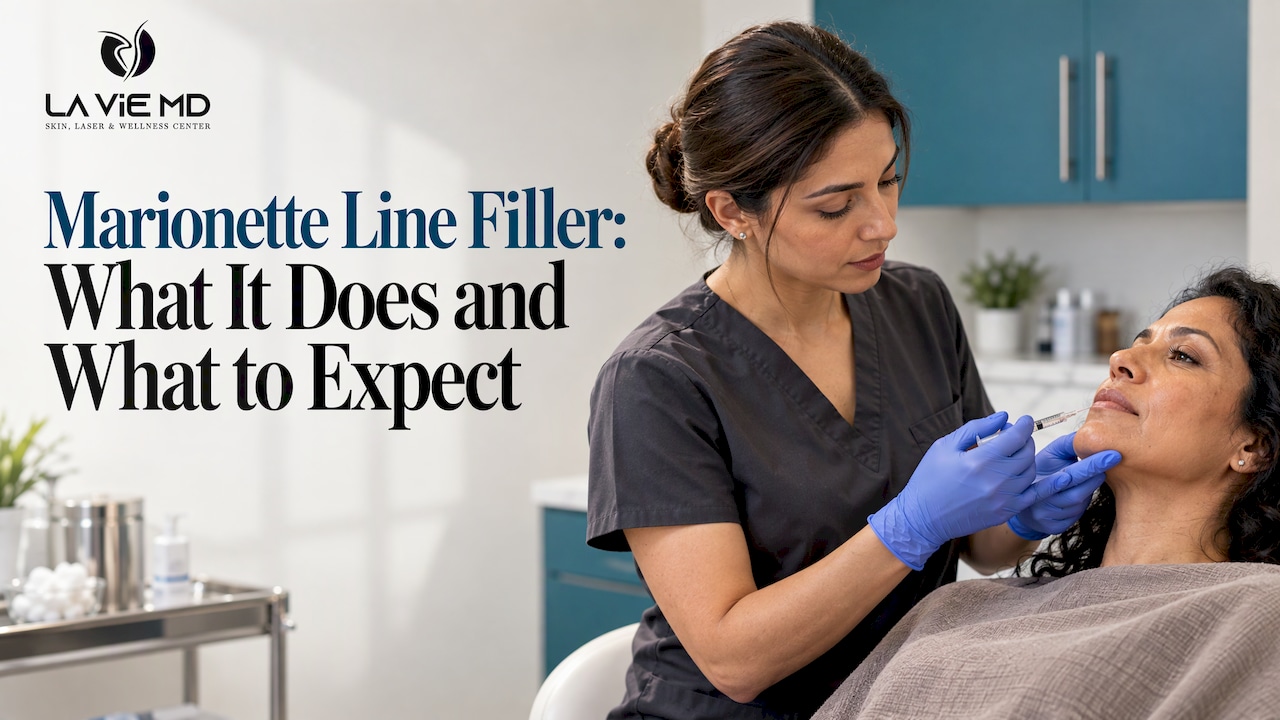
Marionette line filler restores volume around the corners of your mouth and along the jawline side of the chin, so the shadow and crease running down from your lips look softer and the mouth corners look less downturned. It works best when a physician looks at the whole lower face first, because the crease is rarely the only thing causing the shadow. At LA ViE MD, dermal fillers are planned by a board-certified physician, Dr. Neetu Nebhwani, and tailored to your anatomy rather than applied to the line alone.
TL;DR
- Marionette lines run from the mouth corners toward the chin. They come from volume loss, bone and fat changes, muscle pull and skin laxity, not just a surface crease.
- Filler softens them by restoring support under and around the fold. HA filler results appear right away and typically last 4 to 12 months, according to the American Academy of Dermatology.
- The best results usually come from a custom plan that treats the surrounding volume, and sometimes adds a neuromodulator for the muscles that pull the mouth down.
- Mild redness, swelling and bruising usually clear within 7 to 14 days. Choose a medical setting and a trained physician.
- If you live in Danville, Livermore, Dublin or Los Gatos, you can start with a physician consultation.
Table of Contents
- What marionette lines are and why they form
- How filler softens marionette lines
- Filler, Botox or both?
- What the appointment looks like
- How long marionette line filler lasts
- Safety, side effects and recovery
- What affects the cost
- Who is a good candidate
- Treatment at LA ViE MD
- FAQ
- Sources
What marionette lines are and why they form
Marionette lines are creases that run from the corners of the mouth down toward the chin. Clinicians also call them melomental folds. Cleveland Clinic lists several contributors: loss of collagen and elastin with age, genetics, sun exposure, frequent lip pursing, severe stress and smoking.
The visible line is only part of the story. A 2024 peer-reviewed review in Skin Research and Technology describes several mechanisms that can act together: bone resorption, gravitational descent, changes in the fat compartments, muscle compression, ligament tethering, redundant skin and descent of the jowl or buccal fat. That is why two people with similar-looking lines can need quite different treatment.
Why this matters for your plan
If the shadow at your mouth corner comes mostly from lost support, volume is the answer. If it comes partly from a muscle that tugs the corner down, relaxing that muscle belongs in the plan. If skin has loosened, tightening may help. The same review concludes that treatment may need to address more than the crease you see in the mirror. A good consultation sorts out which of these apply to you before anyone picks up a syringe.
How filler softens marionette lines
Filler does not simply fill a groove. A 2025 anatomical review reports that volumizing the area can elevate depressed tissue, soften the edge of the fold and create an apparent lifting effect at the corner of the mouth. The gel is placed along and slightly medial to the crease, and neighboring volume deficits may be treated too. The review describes linear-threading and retrograde-fanning techniques, and stresses precise placement with awareness of facial vessels and nerves.
In practice that means the lower face is assessed as a unit: the mouth corner, the area beside the chin, the lower cheek and the jawline. Treating only the line can leave the real cause untouched. Our dermal filler page explains how we restore lost volume across the face, and the benefits of dermal fillers article covers what lasting results look like.

Choosing the filler
Clinicians choose the product, the depth, the amount and the technique based on how severe the fold is and how your anatomy sits. Hyaluronic acid (HA) gels are the most common family. Other materials exist, such as calcium hydroxylapatite and poly-L-lactic acid. The AAD’s filler FAQ notes that HA, calcium hydroxylapatite, collagen, fat and PMMA fillers generally give immediate results, while poly-L-lactic acid commonly takes two to three weeks to show.
At LA ViE MD, the filler and biostimulator options include dermal fillers and Sculptra, and you can see the full range on our injectables page. Which one suits your mouth corners is a decision made at your consultation, not from a chart.
Filler, Botox or both?
This is one of the most common questions readers ask, and the honest answer is that they do different jobs.
| Treatment | What it does | Role for marionette lines |
|---|---|---|
| Dermal filler | Restores volume and support beneath and around the fold | Softens the shadow and supports the mouth corner |
| Neuromodulator (Botox, Dysport, Daxxify) | Relaxes muscles pulling the mouth corners down | Often paired with filler to ease the downward pull |
| Skin tightening and resurfacing | Improves skin quality and firmness | Supports the result when skin texture or laxity is part of the picture |
The Aesthetic Society explains that neuromodulators such as Botox, Dysport and Xeomin can relax the muscles pulling the mouth corners downward and are commonly combined with filler for these folds. That combination is why a single-product approach is rarely the whole plan. Cleveland Clinic’s list of options also includes chemical peels, laser resurfacing and microneedling for skin quality.
We offer Botox and, for comparing the neuromodulator brands, our guide to Botox, Dysport, Xeomin and Daxxify explains how they differ. For skin quality around the mouth and lower face, our skin rejuvenation treatments include microneedling, Morpheus8 and Forma, which can sit alongside filler in a custom plan.
What the appointment looks like
- Consultation and assessment. The physician looks at your face at rest and in motion, and asks what bothers you: the crease, the shadow, the downturned corner or all three. This is where volume loss, muscle pull and skin quality get separated.
- A custom plan. Our approach is individualized: a treatment plan built around your skin concerns and goals, supervised by a board-certified physician. It may include filler alone, or filler with a neuromodulator or a skin treatment.
- Treatment. The filler is placed with technique matched to the depth and severity of your fold. The 2025 anatomical review notes that cannulas can be a consideration in deeper or more severe cases.
- Aftercare and follow-up. You leave with clear instructions and a plan for maintenance.
Some people need more than one session. The Mayo Clinic says fillers may require one to three sessions, with repeat injections after about six months to maintain results.
How long marionette line filler lasts
The AAD says HA gel fillers typically last 4 to 12 months, and that results are temporary and vary by treatment area and filler. The Aesthetic Society describes filler results as generally immediate and lasting approximately six months to a year. Several things shape where you land in that range:
- the product chosen and how it is placed
- how much volume was lost to begin with
- how active the area is, since the mouth moves all day
- your own metabolism and skin
Because the mouth corner moves constantly, many patients plan for periodic touch-ups. A schedule is easier to set once you have seen how your face responds to the first session.
Safety, side effects and recovery
Filler is a medical procedure, and the person doing it matters. The AAD states that serious complications become more likely when injections are performed by inadequately trained people or in nonmedical settings, and it advises choosing a qualified medical professional rather than a salon, a home or a nonmedical spa. That is a good reason to have lower-face filler done in a physician-supervised practice.
Common, temporary effects
The AAD lists redness, swelling, tenderness and occasional bruising, usually clearing within 7 to 14 days or earlier. The Mayo Clinic describes inflammation, bruising and skin-color changes that tend to clear within weeks.
Less common risks to know about
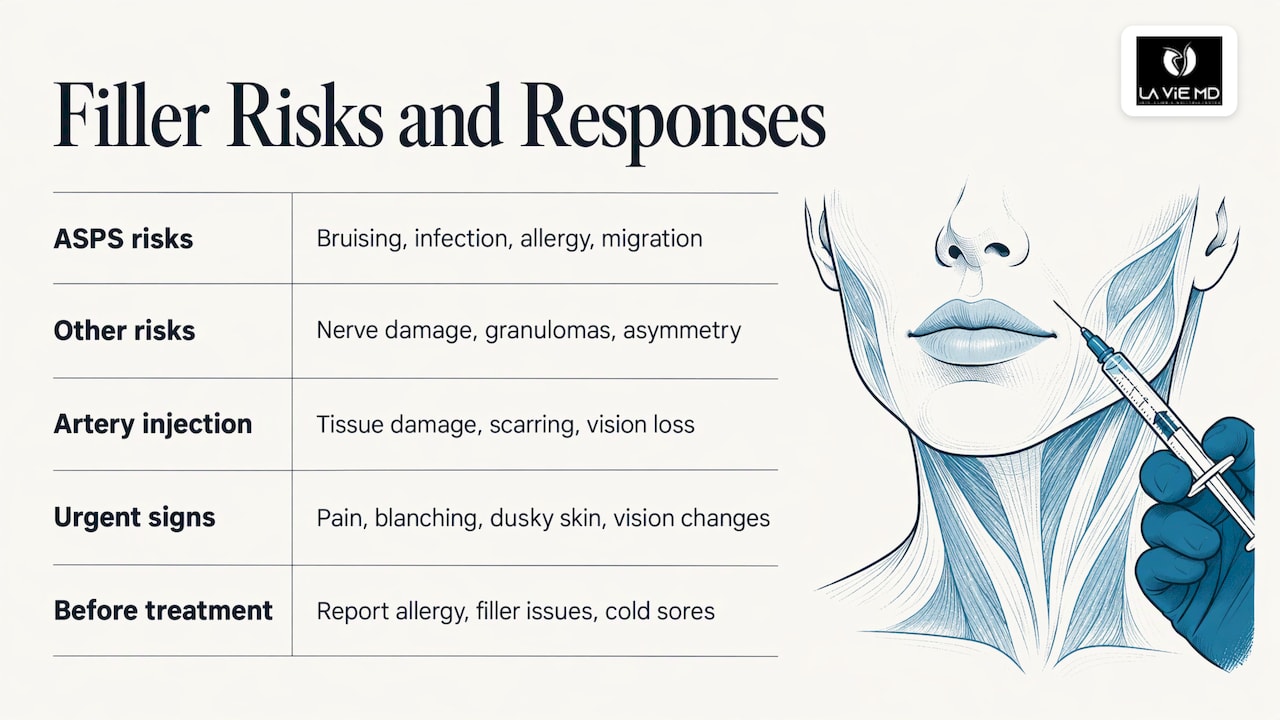
The American Society of Plastic Surgeons lists bruising, infection, allergic reaction, migration, nerve damage, granulomas, asymmetry, over- or underfilling and ischemia among possible risks. It notes that accidental injection into an artery can cause tissue damage, scarring and, in severe cases, vision loss. The AAD also mentions lumps, ridges, skin discoloration and severe swelling. Seek urgent medical care if you notice severe pain, blanching or dusky skin, or any change in vision after an injection, and tell your injector about any history of allergic reactions, filler complications or cold sores before treatment.
This is the reason the anatomy-based approach matters: the 2025 review emphasizes that careless placement near facial arteries and nerves can cause vascular or neural injury, and that is precisely what a physician’s knowledge of the lower face is there to prevent.
Aftercare in the first week
The ASPS advises avoiding touching or rubbing the treated area and strenuous activity for the first 24 hours. Intermittent icing for 10 to 15 minutes can help with swelling and bruising during the first week. Follow the specific instructions you are given at your visit.
What affects the cost
There is no single national price for marionette line filler, and the figures quoted online vary widely. What changes the total is consistent:
- How many syringes or vials your plan needs. A mild fold may need little, while a deeper fold with surrounding volume loss needs more.
- Which product is used. Different fillers are priced differently.
- Whether the plan includes a neuromodulator or skin treatment. Combination plans add components.
- How many sessions are needed to reach the result.
Because a plan depends on your anatomy, a quote is most reliable after an in-person assessment. LA ViE MD does not publish set prices for dermal fillers online, so the consultation is where you get the numbers for your plan.
Who is a good candidate
You may be a good fit if the shadow at your mouth corners bothers you, you want a softer and less tired lower face, and you are looking for a non-surgical option with little downtime. Our patients are typically adults in the Bay Area who want natural-looking enhancement rather than a visibly changed face.
Tell the physician if you are pregnant or breastfeeding, have a bleeding disorder or take blood thinners, have had a reaction to a filler before, or have an active skin infection near the area. These are questions to settle with your physician before treatment.
Our perspective
When someone asks us about marionette lines, we look at the whole lower face before we talk about product. The crease is where the eye lands, but the cause is often a mix of lost support, a mouth corner that has drifted down and skin that has lost some of its spring.
That is why we build plans around you. Under physician supervision, we decide whether volume, muscle relaxation, skin treatment or a combination will give you the softest, most natural result. Our goal is a face that looks rested and still looks like yours.
Filler is a medical treatment, and the quality of the assessment is as important as the syringe. We would rather take time to understand your anatomy and goals than rush to fill a line.
Dr N
Treatment at LA ViE MD
LA ViE MD is a boutique medical spa in the Bay Area, led by Dr. Neetu Nebhwani, a board-certified Internal Medicine physician with over ten years of experience. We offer dermal fillers, Botox, Sculptra and skin rejuvenation treatments, and we build custom plans based on your specific concerns and goals. You can book a consultation at our Danville, Livermore, Dublin or Los Gatos locations.

To see the options for the lower face, start with our injectables page, or read about dermal fillers in Danville and dermal fillers in Dublin. If you are ready to talk through your own plan, you can book a consultation with LA ViE MD.
FAQ
How long will filler last in marionette lines?
HA gel fillers typically last 4 to 12 months, according to the AAD, and results vary with the product, the area and the individual. The mouth corners move constantly, so many people schedule maintenance around the six-month mark, as the Mayo Clinic describes. Your physician can suggest a timeline after your first session.
Should I get filler or Botox for marionette lines?
They do different jobs. Filler restores volume and support, while a neuromodulator relaxes muscles that pull the mouth corners down. The Aesthetic Society notes that neuromodulators are commonly combined with filler for these folds. A physician can tell you which, or both, fits your face.
Is marionette line filler painful?
Most people describe it as pressure and mild discomfort, and your provider can discuss comfort measures before treatment. Redness, swelling and tenderness are common afterward and usually settle within 7 to 14 days, according to the AAD. Contact your provider if anything feels more severe than that.
How much does it cost to fill marionette lines?
The total depends on how much product your plan needs, which filler is used and whether you add other treatments. Because those vary by face, the most accurate answer comes from an in-person assessment. At LA ViE MD, that starts with a physician consultation.
Can I prevent marionette lines?
You cannot stop aging, but Cleveland Clinic lists factors you can influence, including daily facial sunscreen and avoiding smoking. Early treatment of volume loss can also help keep the lower face looking supported. A consultation can show you where you stand.
Sources
- Cleveland Clinic: Marionette Lines
- Skin Research and Technology review: Why do marionette lines appear?
- Anatomical-based diagnosis and filler treatment review, 2025
- The Aesthetic Society: Best nonsurgical treatments for nasolabial folds and marionette lines
- American Academy of Dermatology: Fillers FAQs
- Mayo Clinic: Wrinkles, diagnosis and treatment
- American Society of Plastic Surgeons: Dermal fillers